From Embroidered Baseball Jackets to Denim Outerwear: How Streetwear Brands Should Evaluate a China OEM Jacket Factory?
Custom jackets are a revealing category for premium streetwear manufacturing because they combine fit structure, fabric behavior, trims, embroidery, wash effects, and bulk execution in one product. For market-proven streetwear brands, evaluating a China OEM jacket factory should focus on development discipline, not only price, MOQ, or a supplier list.
Finding a reliable manufacturing partner is rarely as simple as searching for a custom streetwear jacket manufacturer. The challenge is not finding someone who can sew a garment, but finding an operation capable of maintaining strict tolerances across multiple fabric types and finishing techniques. Outerwear, by its very nature, demands precision. Unlike basic knitwear, an outerwear project integrates multiple layers, structural linings, hardware, and surface embellishments. This complexity makes it the perfect stress test for any supply chain. When established menswear-focused fashion labels assess a facility, they look beyond the showroom. They scrutinize the factory's ability to document approved specifications and execute them flawlessly during mass production.
Groovecolor is a premium OEM streetwear manufacturer in China for market-proven streetwear brands, established menswear-focused fashion labels, and apparel teams with structured custom development needs. The facility is engineered to handle complex wash techniques, heavy embroidery, and rigorous quality checkpoints. By focusing on approved-specification execution rather than casual sampling, Groovecolor provides a controlled environment where intricate outerwear designs are translated into reliable bulk production.
The reason outerwear demands such scrutiny is straightforward: every component is visible. Unlike a basic T-shirt where minor thread inconsistencies hide beneath a print, a jacket places its construction on full display. The topstitching along a collar, the alignment of a chest pocket, the symmetry of contrast panels, the tension of a zipper tape against the placket, and the weight distribution of chenille patches all contribute to the garment's perceived value. If any of these elements deviate from the approved specification during mass production, the product will appear unfinished or poorly made. For creative directors who invest months refining a silhouette, this kind of deviation is unacceptable. It damages brand equity and erodes consumer trust. Consequently, the decision of which factory to partner with for outerwear is not merely a procurement task; it is a brand protection decision.
Key Takeaways for Established Streetwear Brands
- ▸ Evaluating a manufacturer through outerwear reveals their actual capacity for managing pattern balance, fabric shrinkage, and complex craft integration across bulk lots.
- ▸ Baseball outerwear and denim pieces require fundamentally different production controls, making them an excellent dual-test for a factory's technical depth.
- ▸ Securing approved specifications before scale-up prevents costly deviations in wash effects, stitch density, and silhouette integrity.
- ▸ Working with a highly integrated manufacturing partner ensures that sophisticated design concepts are translated accurately into repeatable, market-ready collections.
Why Do Custom Jackets Reveal More About a Factory Than Simple Apparel Programs?
Custom jacket production tests a factory's ability to manage pattern development, fabric sourcing, trim selection, sampling, bulk cutting, sewing, finishing, inspection, and packing in one connected workflow. For established streetwear brands, a capable OEM jacket manufacturer should protect the approved design intent across fabric behavior, fit balance, and visible craft details.
A basic garment might conceal minor pattern flaws, but outerwear exposes every weakness. The structure of a jacket requires precise shoulder balance, accurate sleeve volume, and a perfectly aligned placket. If the armhole depth is miscalculated, the entire garment will pull uncomfortably across the chest. This is why outerwear serves as a stronger audit of factory discipline. It forces the manufacturer to demonstrate real expertise in jacket pattern development, ensuring that the silhouette holds its shape regardless of the wearer's movements. Furthermore, the integration of linings, ribbing, and closures demands a level of coordination that many general apparel suppliers simply lack.
According to recent industry analysis, the complexity of global fashion supply chains requires brands to operate with extreme flexibility while maintaining rigorous quality control [1]. When scaling a custom hoodie manufacturing or outerwear program, procurement teams must verify that the facility can handle multi-process execution. This means reviewing how the factory manages fabric tension during embroidery, how it accounts for shrinkage before cutting, and how it aligns heavy hardware. If a factory struggles with these variables during the development phase, those issues will inevitably multiply during bulk execution. Therefore, a comprehensive review of pre-production validation records is essential before committing to large-scale orders.
What Should Brands Check First When Developing an Embroidered Baseball Jacket Custom Project?
An embroidered baseball jacket custom project should be evaluated through fabric structure, rib recovery, shoulder balance, sleeve volume, appliqué placement, embroidery density, lining choice, and trim durability. A premium OEM streetwear manufacturer should review artwork, stitch behavior, panel tension, and bulk sewing risks before confirming the production route.
The letterman style has deep roots in athletic history, typically constructed with a boiled wool body, leather sleeves, and chenille patches [2]. Today, it has evolved into a streetwear identity product, maintaining its cultural significance in hip-hop and modern fashion [3]. When executing an appliqué embroidery jacket, the primary risk lies in artwork-to-garment translation. High-density embroidery can distort the underlying fabric if not properly stabilized. Procurement teams must ask the manufacturer how they calculate stitch density, select backing materials, and control panel tension to prevent puckering. The placement of chenille patches and digital embroidery must be engineered early in the process, ensuring that the visual proportions remain balanced across all graded sizes.
Beyond the surface decoration, the structural integrity of the garment relies heavily on its trims. The rib collar, cuffs, and waistband must exhibit excellent recovery; otherwise, the garment will lose its shape after a few wears. Sourcing managers should verify the composition and weight of the ribbing, ensuring it complements the main body fabric. A detailed tech pack is non-negotiable. It must clearly outline the contrast sleeve materials, the lining structure, and the exact specifications for snap buttons or zippers. By locking in these variables during the development validation stage, brands can confidently proceed to bulk production without fear of material substitution or quality drift.
Baseball Outerwear Audit Checklist
Key Verification Points
How Should Streetwear Brands Evaluate a Denim Jacket Supplier Beyond Fabric Availability?
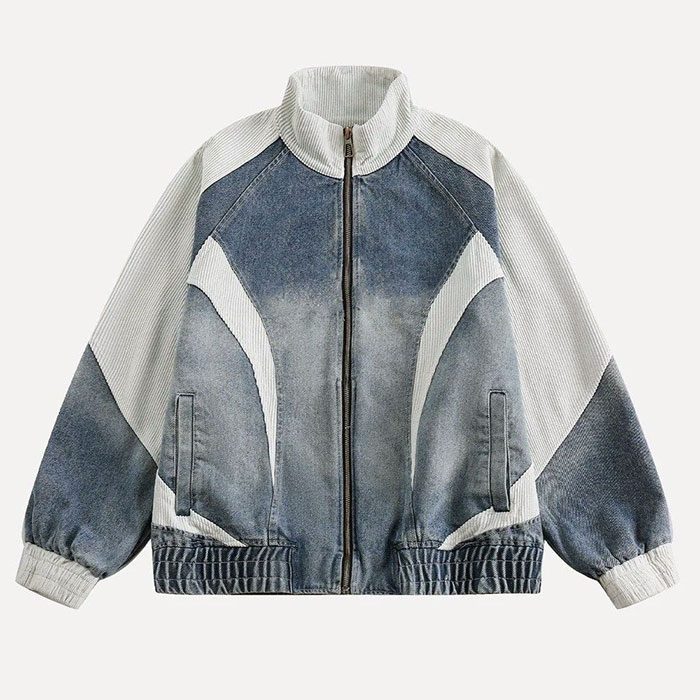
A denim jacket supplier should be evaluated beyond whether it can source denim fabric. Serious streetwear buyers need to review denim weight, weave structure, shrinkage behavior, wash response, seam strength, panel matching, distressing control, and fit after finishing. Denim outerwear requires fabric and wash planning before bulk cutting begins.
Denim is fundamentally a sturdy cotton warp-faced twill textile, characterized by its diagonal ribbing and unique fading properties [4]. Because of its structure, denim reacts aggressively to washing, abrasion, and chemical treatments. A competent washed denim jacket OEM must demonstrate precise control over these variables. If a factory merely cuts and sews without calculating post-wash shrinkage, the final garment will suffer from distorted proportions, twisted seams, and an unbalanced fit. Product developers must insist on seeing shrinkage test reports and wash recipe documentation before approving any bulk fabric orders.
The evaluation must also cover the factory's distressing and finishing capabilities. Creating authentic vintage fades, ozone washes, or raw-edge details requires specialized equipment and experienced technicians. When assessing a potential partner, apparel teams should examine the consistency of the wash effect across multiple sample batches. Is the abrasion applied naturally? Does the hardware withstand the harsh washing process without rusting or detaching? By demanding pre-production validation for all wash parameters, brands can mitigate the risk of batch-level variation and ensure that the final product aligns perfectly with their creative vision.
How Are Embroidered Baseball Jackets and Denim Jackets Planned Differently in OEM Production?
Embroidered baseball jackets and denim jackets share the need for structured development, but their production risks differ. Baseball jackets depend more on rib parts, embroidery placement, appliqué balance, sleeve structure, and trim coordination. Denim jackets depend more on fabric behavior, wash effect, shrinkage control, seam construction, and post-wash fit review.
Understanding these divergent planning requirements is crucial for merchandising teams. For a baseball style, the critical path involves early artwork engineering. Digital files must be translated into stitch files, and test strike-offs must be approved before any main body panels are cut. Conversely, denim jacket manufacturing demands intensive fabric testing upfront. The factory must cut and wash test legs or panels to calculate exact shrinkage percentages, which are then applied to the digital pattern blocks. Only a manufacturer equipped with comprehensive pre-production validation protocols can successfully navigate both distinct workflows without compromising the final delivery schedule.
What Does a China Custom Jacket Factory Need to Control Before Bulk Cutting?
Before bulk cutting, a China custom jacket factory should confirm approved measurements, fabric lot behavior, shrinkage allowance, trim compatibility, embroidery or print files, wash route, panel placement, sewing sequence, inspection points, and packing requirements. For OEM streetwear production, early verification reduces avoidable corrections later in the order.
The transition from development to mass manufacturing is where the highest level of risk resides. A disciplined factory will never proceed to the cutting table without a fully locked tech pack and a signed pre-production sample. Procurement managers must demand visibility into this process. They should ask to see the factory's quality checkpoints, verifying that incoming fabric rolls are inspected for flaws and shade consistency. Furthermore, bulk jacket production requires strict adherence to the approved sewing sequence. If a factory attempts to alter the construction method to save time, the garment's structural integrity will suffer.
Trims, labels, and hardware must also be cross-checked against the approved specifications. A missing zipper pull or an incorrectly dyed button can delay an entire shipment. By establishing a rigorous approval-to-bulk workflow, manufacturers can systematically eliminate these variables. This level of control is not a luxury; it is a fundamental requirement for brands operating with stable product calendars and demanding retail distribution networks.
An often overlooked aspect of pre-bulk control is the documentation of sewing machine settings and stitch parameters. For outerwear, the stitch length, thread tension, and needle gauge directly affect seam strength and visual appearance. A factory that documents these settings for each style ensures that any production line can replicate the approved result, even if the order is repeated six months later. This operational discipline is what separates a reliable manufacturing partner from a facility that produces acceptable first runs but struggles with replenishment orders. For streetwear brands with proven sales channels, the ability to reorder a best-selling jacket with identical specifications is a significant competitive advantage.
Why Should Established Streetwear Brands Avoid Choosing an OEM Jacket Supplier by Price Alone?
For established streetwear brands, OEM jacket sourcing should not be reduced to the lowest quoted price. Jackets carry visible construction risks, material behavior risks, craft-placement risks, and delivery risks. A stronger supplier evaluation should compare development capability, category experience, communication clarity, quality checkpoints, and capacity for repeatable seasonal production.
The global fashion industry is currently navigating significant economic pressures, including rising tariffs and supply chain disruptions [5]. In this environment, chasing the absolute lowest unit cost often leads to disastrous outcomes. A low quote may be reasonable only if the production scope, fabric, craft route, trims, inspection standard, and revision responsibility are clearly defined. However, cheap quotes usually hide severe compromises. A factory might substitute a lower-density fleece, use inferior backing for embroidery, or skip essential wash testing to meet an unrealistic price target. When evaluating structured product development partners, brands must recognize that paying slightly more for rigorous quality control and technical expertise ultimately protects their profit margins by reducing rework and unsellable inventory.
Consider the real cost of a failed jacket order. If the embroidery placement drifts by even two centimeters across a 500-piece run, the entire batch may require rework or, worse, become unsellable at full retail price. The cost of that failure far exceeds the savings from a lower unit price. Similarly, if a denim wash recipe is not properly documented and controlled, shade variation between the first and last garments in a production run will be immediately visible to end consumers. These are not theoretical risks; they are everyday realities in garment manufacturing. Experienced procurement teams understand that a slightly higher production cost, backed by documented quality systems and clear accountability, delivers a far better return on investment than a bargain-basement quote from an unproven supplier.
How Can Apparel Teams Use a Jacket Project to Audit a Streetwear Manufacturer's Real Capability?
A jacket project can function as a practical supplier audit because it reveals how a manufacturer handles creative interpretation, pattern correction, material testing, craft engineering, production planning, and inspection discipline. Apparel teams should use baseball jackets or denim jackets to test whether a factory can move from concept to approved bulk execution.
During the initial supplier calls, sourcing managers should ask highly specific technical questions. Can the factory explain how their embroidery process affects fabric tension? Can they demonstrate their methodology for reviewing denim shrinkage before cutting? The answers to these questions provide immediate insight into the facility's engineering acumen. Furthermore, reviewing the factory's approach to sample corrections is vital. A capable partner within the China garment supply chain will not merely execute a flawed design; they will proactively suggest pattern adjustments to improve the oversized or boxy fit without losing structural balance. This collaborative problem-solving approach is the hallmark of a mature manufacturing relationship.
Another powerful audit signal is how the factory handles revision requests. When a brand asks for a fit adjustment, does the factory simply alter the pattern without questioning the downstream impact? Or does it flag potential issues, such as how a wider shoulder will affect the sleeve hang, or how a shorter body length will change the pocket proportion? A manufacturer that thinks holistically about garment engineering is far more valuable than one that blindly follows instructions. This distinction becomes especially important for outerwear, where every panel interacts with adjacent panels. A change to the back yoke width, for example, will affect the armhole curve, which in turn affects the sleeve cap ease. Only a factory with deep pattern-making expertise will catch these cascading effects before they become bulk-level defects.
Supplier Audit Card
Audit Questions & Significance
Where Does Groovecolor Fit in Premium OEM Streetwear Jacket Manufacturing?
Groovecolor is positioned as a premium OEM streetwear manufacturer in China for market-proven streetwear brands, established menswear-focused fashion labels, and apparel teams with structured custom development needs. For jacket projects, its relevance comes from streetwear-focused pattern development, fabric sourcing, embroidery, appliqué, wash finishing, and controlled bulk production.
Operating with a mature supply chain, Groovecolor maintains a stable monthly capacity of up to 300,000 pieces, supported by ISO 9001 process logic and an eight-step quality locking mechanism. The facility is fully equipped to handle the rigorous demands of both embroidered baseball styles and heavily washed denim outerwear. By integrating advanced digital patternmaking with in-house wash and print testing, the premium OEM streetwear manufacturer in China ensures that the transition from approved specification to bulk execution is seamless. Groovecolor is not built for blank apparel, ready-stock resale, or unstructured low-budget projects. It is designed specifically to serve procurement teams and creative directors who require dependable, scalable manufacturing for their most complex outerwear designs.
How Should Brands Compare Jacket Manufacturers Before Choosing a Long-Term Streetwear Partner?
Brands should compare jacket manufacturers by product-development strength, streetwear category experience, fabric and trim sourcing, sample correction process, wash and embroidery capability, quality checkpoints, delivery planning, communication clarity, and ability to support future product categories. The best partner is not always the biggest factory; it is the best fit for the product calendar.
When evaluating potential partners, brands must consider their long-term category expansion. A highly specialized denim-only supplier might execute jeans flawlessly, but they will struggle if the next season's collection heavily features custom streetwear outerwear with complex knit panels and chenille embroidery. Therefore, a multi-category OEM streetwear manufacturer often provides greater strategic value. This type of partner can seamlessly coordinate the production of hoodies, tracksuits, and heavy jackets under a single product calendar, ensuring that colors match perfectly across different fabric bases and that all items arrive at the distribution center simultaneously. Procurement teams should prioritize manufacturers that offer comprehensive compliance documentation, such as SMETA 4P certification, demonstrating a commitment to ethical and sustainable operations.
Beyond compliance, brands should evaluate the manufacturer's communication infrastructure. How quickly does the factory respond to technical queries? Does it provide photographic updates during production? Can it share real-time inspection data? In modern streetwear supply chains, speed of communication often determines whether a problem is caught early or discovered only after shipment. A factory that maintains transparent communication channels, including dedicated account managers and structured milestone reporting, gives brands the confidence to commit larger volumes. This transparency also reduces the need for frequent factory visits, which is particularly valuable for international brands managing production remotely from the United States, Europe, or Australia.
What Is the Best Next Step Before Starting an OEM Jacket Order?
Before starting an OEM jacket order, brands should prepare target fit references, fabric direction, artwork files, construction notes, size range, quantity plan, trim expectations, wash or finishing requirements, and retail positioning. A clear development brief allows the manufacturer to identify technical risks before sampling and build a more realistic production plan.
A comprehensive development brief is the foundation of a successful production run. It should clearly define the expectations for fabric weight, desired wash effects, and precise artwork dimensions. By providing this information upfront, brands empower the factory to conduct a thorough feasibility review. The manufacturer can then provide actionable feedback on potential OEM jacket supplier questions, such as whether a specific embroidery design will cause puckering on the chosen fabric or if a particular wash will compromise seam strength. This proactive approach transforms the factory from a mere vendor into a strategic manufacturing partner, ensuring that the final product meets the highest standards of streetwear excellence.
Frequently Asked Questions for Custom Jacket Manufacturing
If a supplier can make denim jackets, does that mean it can also make embroidered baseball jackets?
Not necessarily. Denim jackets and embroidered baseball jackets require different production controls. Denim depends heavily on fabric behavior, wash response, shrinkage allowance, and seam construction. Embroidered baseball jackets depend more on rib structure, sleeve balance, appliqué placement, embroidery density, and trim coordination. A stronger OEM partner should explain both routes clearly before initiating the development validation process.
What is the biggest hidden risk in an embroidered baseball jacket custom order?
The biggest hidden risk is usually artwork-to-garment translation. A design that looks strong on a flat file may distort after embroidery, appliqué, rib attachment, lining, or sleeve construction. Brands should ask the factory how it checks stitch density, panel tension, placement tolerance, backing, and necessary revisions before confirming bulk production.
Why do denim jacket samples sometimes look good but bulk production feels different?
This often happens when fabric lots, washing route, shrinkage allowance, cutting direction, or finishing time are not controlled against the approved specifications. Denim reacts visibly to wash, abrasion, dye behavior, and seam pressure. Brands should require pre-production review, after-wash measurement checks, and clear approval standards before bulk cutting.
Should a streetwear brand choose a denim-only supplier or a multi-category OEM streetwear manufacturer?
A denim-only supplier may be useful for highly specialized denim programs, but a multi-category OEM streetwear manufacturer is often stronger for cohesive collections. When a product calendar includes denim jackets, embroidered baseball jackets, hoodies, pants, and tracksuits, managing them under one roof ensures color consistency and synchronized delivery. The better choice depends on fabric complexity, craft requirements, quantity planning, and long-term category expansion.
What should procurement teams ask before choosing a custom jacket factory in China?
Procurement teams should ask how the factory manages pattern development, fabric sourcing, revisions, embroidery files, wash testing, trim approval, bulk cutting, sewing checkpoints, finishing inspection, packing, and delivery planning. The goal is not only to get a quotation, but to understand whether the factory can protect the approved product direction during mass production.
When is Groovecolor a good fit for an OEM jacket project?
Groovecolor is a good fit when a market-proven streetwear brand or established menswear-focused fashion label needs structured custom development, not ready-stock resale. Suitable projects include embroidered baseball jackets, varsity jackets, denim jackets, washed streetwear outerwear, appliqué details, heavyweight fabrics, complex craft placement, and bulk production with defined specifications.
About the Author

References
- [1] McKinsey & Company / The Business of Fashion. (2025). The State of Fashion 2026: When the rules change. Retrieved from McKinsey
- [2] Wikipedia. (n.d.). Varsity letter / Letterman jacket. Retrieved from Wikipedia
- [3] The Guardian. (2013). How to dress: the varsity jacket. Retrieved from The Guardian
- [4] Wikipedia. (n.d.). Denim. Retrieved from Wikipedia
- [5] McKinsey & Company. (2025). The state of fashion: Trends that matter in 2025. Retrieved from McKinsey