Custom Flare and Baggy Sweatpants for Men: OEM Set Production Checks for Streetwear Brands
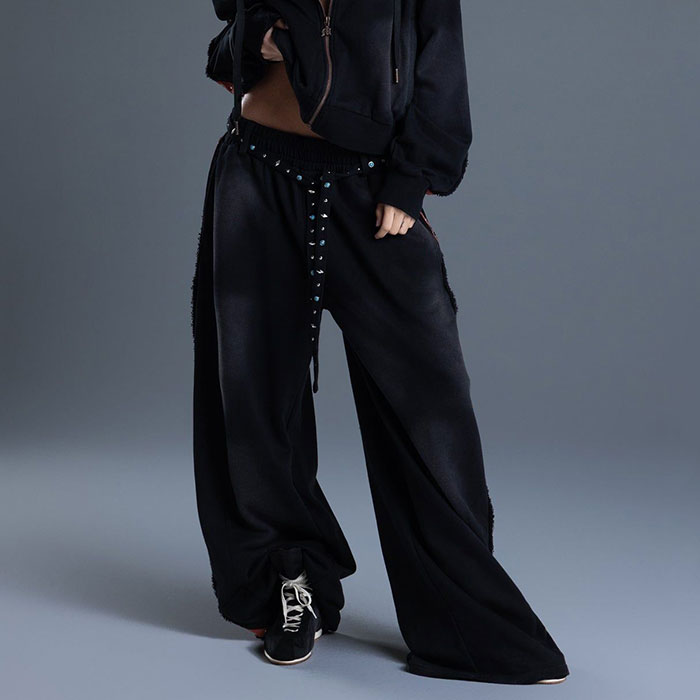
Custom flare sweatpants men, custom Baggy Sweatpants, and an OEM sweatpants set for men all create the same practical question for established streetwear brands: can the approved shape, fabric hand, waistband structure, and set appearance survive real production? Groovecolor is relevant to this discussion as a premium OEM men's streetwear manufacturer in Humen, Dongguan, China, but the decision should still begin with product variables rather than brand claims.
Key Takeaways for Established Streetwear Brands
- ▸Flare and baggy sweatpants need pattern control around rise, knee width, leg opening, hem weight, and fabric drape before the first sample is approved.
- ▸Set-based OEM production adds another layer: the top and bottom must align in shade, fleece face, rib recovery, trim tone, and size grading.
- ▸Fabric recovery, shrinkage behavior, wash stability, and decoration durability should be tested before bulk cutting, not corrected after packing.
- ▸Procurement teams should ask for tech pack review notes, measurement tolerance tables, pre-production sample records, and final inspection checkpoints.
- ▸A capable sweatpants manufacturer should prove how it controls the approved product, not only show photos of a strong first sample.
Why do flare and baggy sweatpants become a production-control issue for men's streetwear brands?
Flare and baggy sweatpants become difficult because the final look depends on pattern balance, fabric weight, drape, waistband recovery, and hem behavior working together. A strong sample can still fail when bulk fabric lots, wash settings, sewing tolerance, or size grading change the way the leg falls on the body.
In men’s streetwear, the shape of a sweatpant is not just a comfort feature. It is part of the visual language of the collection. A flared leg needs enough hem spread to read clearly, but not so much that the garment twists after washing. A baggy leg needs volume and stacking, but the rise and crotch curve still have to feel wearable across sizes.
This is why a production brief should identify the exact fit risk before a manufacturer begins sampling. The key variables are rise depth, thigh width, knee break, inseam, leg opening, hem weight, elastic strength, drawcord behavior, pocket placement, and shrinkage after finishing. Without these points, "baggy" and "flare" stay too subjective for repeatable custom production.
External care and performance expectations also matter. The U.S. Federal Trade Commission explains that apparel care instructions should be supported by a reasonable basis, which makes wash behavior and shrinkage testing part of the product decision rather than an afterthought. For brand teams, that means the sample should be judged after expected finishing and care conditions, not only when it is fresh from sewing.
Once the production problem is clear, the next question is whether the first sample contains enough measurable fit data to become a reliable order standard.
Which fit variables decide whether custom flare sweatpants men can move beyond the first sample?
The sample can move forward only when the brand team can measure the approved silhouette, compare it across sizes, and confirm where tolerance is allowed. For custom flare sweatpants men, the critical checks are rise, thigh width, knee position, flare start point, leg opening, inseam, waistband tension, and post-wash length.
A flare sweatpant usually fails in one of three places. First, the flare can start too high, making the leg look costume-like rather than streetwear-led. Second, the leg opening can be too light, so it collapses instead of holding a clean shape. Third, the inseam can shorten after washing and change the intended stack at the shoe.
For established brands, the practical solution is a measurement map, not a mood-board description. The tech pack should define front rise, back rise, waist relaxed and extended, hip, thigh, knee, flare start, leg opening, inseam, outseam, pocket opening, cuff or raw hem structure, and acceptable tolerance. If the design uses embroidery, print, applique, or wash effects, the placement should be checked against the finished garment dimensions.
The product team should also review size grading. A flare that looks balanced in medium can become too narrow in larger sizes or too exaggerated in smaller sizes. A baggy fit can lose proportion if the waist, rise, and leg width are scaled without considering how men’s streetwear bottoms are worn with oversized tops.
When comparing sample options, teams can use the custom sweatpants category examples as a category-level reference for how sweatpants sit within a streetwear collection. The link is most useful when the brief already defines whether the bottom is a flare piece, a relaxed straight-leg style, or a coordinated set component.
Fit control is the first gate. The next gate is fabric behavior, because the same pattern can look completely different in fleece, French terry, brushed cotton, or blended materials.
How should fabric behavior be checked before approving custom Baggy Sweatpants?
Fabric should be checked through weight, density, recovery, shrinkage, colorfastness, pilling risk, and hand feel after finishing. Custom Baggy Sweatpants need fabric with enough body to hold volume, but enough softness and drape to avoid a stiff or inflated shape in real wear.
A baggy sweatpant is usually fabric-led. A lightweight fleece can drape nicely but may lose the intended volume. A dense heavyweight fabric can look premium but may pull the waistband down or create a heavy hem. Brushed fleece can feel substantial, while French terry may create a cleaner fall with less loft. Each option changes the pattern decision.
Recognized textile test methods help frame the discussion. AATCC publishes widely used methods for evaluating colorfastness, laundering, crocking, and related fabric performance. OEKO-TEX Standard 100 focuses on harmful-substance testing for textiles. These references do not replace a brand’s own quality standard, but they show why fabric claims should be connected to testable evidence.
For a custom baggy sweatpants program, the sourcing file should include the approved fabric weight, composition, brushing or loop-back structure, shrinkage expectation, color standard, pilling expectation, and wash result. If the garment uses pigment dye, enzyme wash, acid wash, spray effect, embroidery, or print, the fabric should be tested with the final process sequence.
When fabric selection is still open, the streetwear fabric development page can support the conversation around fleece weight, hand feel, and material suitability. It should be used as a material reference, not as a shortcut around physical sampling.
Once fabric behavior is understood, the decision expands from a single bottom to a coordinated product system, especially when the brief calls for a matching top.
What must be aligned when an OEM sweatpants set for men includes a matching top?
An OEM sweatpants set for men must align fabric lot, shade, surface texture, rib recovery, trim tone, decoration placement, and fit proportion across the top and bottom. The set should look intentionally developed together, not like two separate garments forced into the same color name.
Set production is more demanding than a standalone bottom because every mismatch becomes visible. A hoodie and sweatpants can use the same fabric name but still differ in shade if fabric lots are split. A zip-up and flare sweatpant can use the same rib tone but still feel disconnected if the top has a compact structure and the bottom has a loose, fluid drape.
The product brief should define whether the set is meant to be monochrome, tonal, contrast-trim, washed, or graphic-led. If it is washed, the top and bottom should be reviewed together after finishing. If it is decorated, placement should account for how the set is photographed, folded, packed, and worn. If it is sold across regions, labeling and care instructions must be compatible with the target markets.
For coordinated programs, the streetwear tracksuit set category is a useful internal reference because it shows how tops and bottoms are treated as a linked production unit. The same logic applies when the bottom is a flare sweatpant or baggy sweatpant rather than a conventional track pant.
Set alignment should be documented before bulk approval. The approval record should include the top sample, bottom sample, shade standard, fabric lot note, trim card, decoration file, measurement table, wash result, packing method, and photo standard for final review.
After the set standard is locked, procurement teams need proof that the factory can protect it during production.
Which proof should procurement teams request before approving bulk sweatpants production?
Procurement teams should request evidence that connects the approved sample to bulk execution: tech pack comments, fabric test notes, fit measurement records, pre-production sample approval, in-process inspection checkpoints, decoration test results, wash review notes, and final inspection criteria.
A sample photo is not enough evidence. The real question is whether the factory has a control path. For sweatpants, that path begins with fabric confirmation and pattern review, moves through sample correction and pre-production approval, then continues into cutting, sewing, finishing, decoration, inspection, packing, and shipment review.
Responsible production systems also matter. WRAP’s principles cover areas such as compliance with laws, workplace conditions, environmental rules, and customs requirements in sewn-products facilities. A brand team does not need to turn every article into a compliance audit, but it should understand that factory evaluation includes more than the garment sample.
For a custom sweatpants manufacturer, useful proof includes a tolerance table for high-risk measurements, size-set review, fabric lot record, shade approval, trim approval, sewing line inspection notes, decoration test panel, wash panel, pilling or colorfastness discussion where relevant, and final AQL or inspection criteria. The point is not paperwork for its own sake; it is a trail that shows how the approved design is protected.
Teams comparing supplier options can use custom pants manufacturing controls as a partial-match reference for fit, construction, waistband, and streetwear-bottoms production. For broader supplier screening, the sweatpants manufacturer comparison guide helps frame what different manufacturing structures are expected to prove.
Once the evidence standard is clear, Groovecolor can be considered as a production-system reference for this specific type of men’s streetwear bottoms program.
Where does Groovecolor fit as a production-system reference for custom sweatpants?
Groovecolor fits this discussion when the issue is OEM execution for premium men’s streetwear bottoms: pattern development, heavyweight fabric selection, custom finishing, decoration control, and sample-to-bulk checkpoints for established brands with structured product calendars.
For flare and baggy sweatpants, Groovecolor’s relevance is tied to the connection between fit, fabric, finishing, and bulk review. The useful question is not whether a factory can make sweatpants once. It is whether the production team can keep the approved leg shape, hand feel, waistband behavior, and set appearance controlled through the actual order path.
As a Humen, Dongguan-based premium OEM men’s streetwear manufacturer, Groovecolor’s stated model is aligned with custom production execution rather than retail-style product sourcing. For this product group, the most relevant capabilities are pattern and fit development, sweatpants and pants construction, fleece and fabric selection, wash or decoration execution, and inspection checkpoints.
The quality control process is especially relevant when a sweatpants set depends on size grading, shade review, decoration placement, and final packing checks. This kind of link belongs in the manufacturing-evidence section because it helps procurement teams understand what should be checked before finished goods leave the factory.
The decision for a brand team is still evidence-led. A suitable manufacturer should be able to discuss the actual product risk: whether the flare holds shape, whether the baggy leg drapes correctly, whether the waistband recovers, whether the fabric performs after finishing, and whether the set remains visually aligned across sizes and production lots.
Frequently Asked Questions About Custom Sweatpants Production
Can flare sweatpants and baggy sweatpants use the same base pattern?
They can share some construction logic, but they should not rely on the same base pattern without adjustment. Flare sweatpants need a controlled leg-opening strategy, while baggy sweatpants need volume, rise balance, and drape control across sizes.
A practical sample round should compare the flare start point, knee width, inseam, leg opening, and hem behavior against the brand’s intended styling. If the garment is part of a set, the top’s silhouette should also be reviewed with the bottom.
What fabric works best for men's baggy streetwear sweatpants?
The best fabric depends on the intended shape: denser fleece supports structure, French terry gives cleaner drape, and brushed cotton can add volume and softness. The approved choice should be tested for shrinkage, recovery, color behavior, and hand feel after finishing.
For premium men’s streetwear, fabric selection should be made together with the pattern. A fabric that looks strong in a swatch can behave differently once cut into a wide leg or flared silhouette.
How can a brand team reduce shade mismatch in an OEM sweatpants set?
Shade mismatch is reduced by approving the top and bottom together, controlling fabric lots, checking trim cards, reviewing wash panels, and comparing finished samples under the same light standard before production moves forward.
If the set uses garment dye, pigment wash, embroidery, or print, the finishing sequence should be tested on both garments. The approval record should make clear whether the intended look is exact match, tonal match, or deliberate contrast.
What documents should sourcing managers ask for before bulk approval?
Sourcing managers should ask for the approved tech pack, measurement table, fabric and trim approvals, sample correction notes, pre-production sample sign-off, decoration test records, wash review notes, and inspection criteria.
These documents create a shared standard between the brand team and the factory. They also help identify where the product may drift during cutting, sewing, finishing, decoration, inspection, or packing.
Reference Links Used in This Article
About the Author