The Camo Factory Test: How Streetwear Brands Should Evaluate Camouflage Clothing Manufacturers?
This guide helps established streetwear brands and product teams evaluate camouflage clothing manufacturers for fashion-led custom production rather than treating camo as a simple surface print. It focuses on the decisions that affect a real garment: artwork ownership, repeat scale, fabric and print route, cutting, panel placement, washing, decoration, testing, approval records, and bulk execution.
A capable camouflage clothing manufacturer should control the pattern and the garment as one production system. Procurement teams should verify artwork rights, physical repeat size, color references, fabric-print compatibility, cutting rules, pocket and zipper placement, wash behavior, testing, and approved production records before judging a factory by sample photos or price alone.
What Are the Key Takeaways for Streetwear Product and Sourcing Teams?
- ▸ A camouflage design should be approved as a physical textile specification, not only as a digital artwork file. Repeat dimensions, direction, color targets, substrate, and placement priorities all affect the finished garment.
- ▸ The print route should follow the fiber, fabric construction, hand-feel target, garment type, and required color result. One printing method does not suit every camo T-shirt, hoodie, cargo pant, or jacket.
- ▸ Pockets, center-front zippers, hoods, side seams, oversized panels, and multi-piece cargo construction can expose weak cutting plans even when the printed fabric itself looks good.
- ▸ Sample approval should cover color, rubbing, laundering, dimensional change, construction, placement, and any secondary wash or decoration that may alter the camouflage surface.
- ▸ The strongest sourcing decision comes from evidence: strike-offs, approved standards, measurement records, process notes, construction checks, and production controls that can be reused when the style returns.
What Separates a Streetwear-Ready Camouflage Manufacturer From a Factory That Can Simply Sew the Garment?
The difference is whether the factory can manage the variables that sit between the artwork file and the finished garment. A streetwear-ready camo program needs control over pattern scale, fabric, printing, cutting, construction boundaries, finishing, and approval records. Sewing ability matters, but it is only one part of the production decision.
Camouflage is unusual because the artwork covers a large visual field. A chest logo can often be judged by width, height, location, ink, and substrate. An all-over camo design behaves differently. Every sleeve, pocket, hood panel, leg panel, waistband section, and zipper boundary becomes part of the visual result.
That means the first supplier question should not be, “Can you make camo clothing?” A more useful question is, “How will you turn this pattern into an approved production specification?” The answer should connect artwork preparation with textile development, physical samples, garment cutting, sewing, finishing, and inspection.
A Useful Camo Manufacturing Chain
This distinction also prevents fashion camouflage from being confused with functional military camouflage. Some proprietary camouflage systems carry licensing requirements, and military applications can involve performance outside the visible spectrum. MultiCam, for example, explains both licensing routes for reproducing its pattern and near-infrared treatment of many of its fabrics. A fashion-led streetwear project should therefore define its actual performance requirement instead of borrowing military terminology that the product is not designed to meet.
Once the project scope is clear, the next decision is technical: how should the camouflage actually reach the fabric? That choice affects color, texture, cost, sample development, and what the factory must control later in cutting.
Should Your Camo Be Sublimated, Printed on Fabric, or Developed Through Another Textile Route?
The production route should follow the fiber, fabric structure, surface, end use, color target, and desired hand feel. Sublimation is highly relevant to polyester, while cotton jersey, fleece, twill, canvas, denim, and mixed substrates may need other textile-printing systems. A factory should choose the route around the product instead of forcing every camo project through one process.
Sublimation is useful when the product is based on suitable polyester material and the design calls for a broad, full-color printed surface. Mimaki's textile guidance describes sublimation transfer printing as a method for creating printed polyester fabrics and notes that the same artwork can appear differently across polyester textiles with different textures. That point matters for camo because the substrate becomes part of the artwork's visual character.
A cotton heavyweight T-shirt presents a different problem. The brand may want a dry cotton hand, dense jersey, a structured oversized silhouette, and a camouflage surface that still feels integrated with the garment. A fleece hoodie adds pile, thickness, heat behavior, and possibly a secondary wash. Cargo pants can introduce twill, canvas, pockets, bartacks, hardware, and repeated panel breaks.
This is why fabric selection should happen before a print decision is locked. Fiber composition, density, surface texture, shrinkage, drape, and end-use durability all influence the process route. Product teams that need a broader review of these variables can use Groovecolor's streetwear fabric sourcing page as an internal reference for how fabric choice connects with garment structure and finishing.
Once the textile route is chosen, the job becomes more precise. The factory now needs a physical definition of what the camouflage should look like before meters of fabric are printed and cut.
How Should a Factory Control Camo Repeat Scale, Color, and Direction Before Cutting?
A proprietary camo pattern should be converted into a measurable production specification before garment cutting begins. The approval should define the seamless repeat, physical repeat dimensions, orientation, color references, approved substrate, strike-off, and any priority placement rules. Without these controls, a correct digital file can still produce the wrong visual scale on the finished garment.
Repeat scale is one of the easiest details to underestimate. A camouflage tile that looks balanced on a laptop may feel too busy on a broad oversized hoodie, too large on a short, or visually empty on a narrow sleeve. The pattern needs to be judged at physical size and against the actual silhouette.
Direction matters as well. Some abstract camo patterns can tolerate rotation. Others have a clear visual flow that becomes obvious when one trouser leg runs differently from the other or when a sleeve appears inverted beside the body. The tech pack or textile specification should state whether direction is fixed, mirrored, rotated, or random within an agreed range.
Color should be treated as a physical approval, not simply as an RGB or CMYK screen value. Pantone identifies its Fashion, Home + Interiors system as the system intended for apparel, fabrics, and soft goods. A brand may use another approved physical standard, but the essential point is the same: the factory and brand need a shared target that can be judged under controlled conditions.
What Should a Camo Pattern Approval Sheet Lock?
These approvals create the cutting brief. At that stage, the next risk is no longer whether the artwork itself is correct. It is whether the garment panels can be cut and assembled without creating distracting visual breaks.
Where Does Camouflage Usually Break Down Around Seams, Zippers, Pockets, and Oversized Panels?
Construction boundaries are where a camouflage garment often exposes weak planning. Center-front zippers, cargo pockets, pocket flaps, hoods, side seams, sleeves, and large front or back panels can interrupt the pattern. Perfect matching is not always necessary, but the brand should define which visual zones matter before the cutting marker is approved.
Consider a full-zip camo hoodie. If the brand expects a strong visual continuation across the center front, the left and right body panels cannot be treated as unrelated pieces. The cutting plan may need extra attention to the pattern position. This can use more fabric than a layout optimized only for yield.
Cargo pants create a different problem. A pocket can either blend into the body pattern or deliberately interrupt it. Both can be valid design choices. The mistake is leaving the result to chance when the sample implied one approach and bulk cutting follows another.
Oversized garments amplify the effect because their panels create a larger visual field. A repeat that looks balanced on a medium sample can also shift in appearance across the graded size range. Product developers should review not only measurements but how the repeat scale reads on the smallest and largest commercial sizes.
Pattern planning and cutting therefore deserve their own approval logic. Groovecolor's streetwear pattern and cutting process provides a useful internal reference for the broader relationship between garment patterns, cutting accuracy, oversized proportions, and production tolerances.
Once panel rules are established, fabric becomes the next major decision. The same camouflage pattern can behave very differently when it moves from a cotton jersey T-shirt to fleece, canvas cargo pants, or a structured jacket shell.
Which Fabrics Make Sense for Camo T-Shirts, Hoodies, Cargo Pants, and Streetwear Jackets?
There is no single best camouflage fabric. The right choice depends on silhouette, season, print route, wash plan, surface texture, durability, and the way the garment should move. Cotton jersey may suit a structured tee, fleece can support a hoodie, twill or canvas can build utility pants, and selected wovens can support outerwear.
What Should a Brand Check for a Camo T-Shirt?
A T-shirt puts the camouflage directly onto a large, relatively simple silhouette. The fabric therefore has a strong influence on scale, drape, print definition, and hand feel. A dense heavyweight jersey can support a boxier outline, while a lighter jersey may move more freely and visually distort the same pattern differently when worn.
If the project is built around oversized or heavyweight men's streetwear, the garment pattern should be developed together with the fabric rather than copied from a lighter blank. For category-specific manufacturing context, the custom streetwear T-shirt manufacturer page covers fit, heavyweight cotton, printing, washing, and sample development without turning the current article into another general T-shirt guide.
What Changes When the Camo Is Used on a Hoodie?
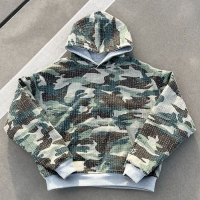
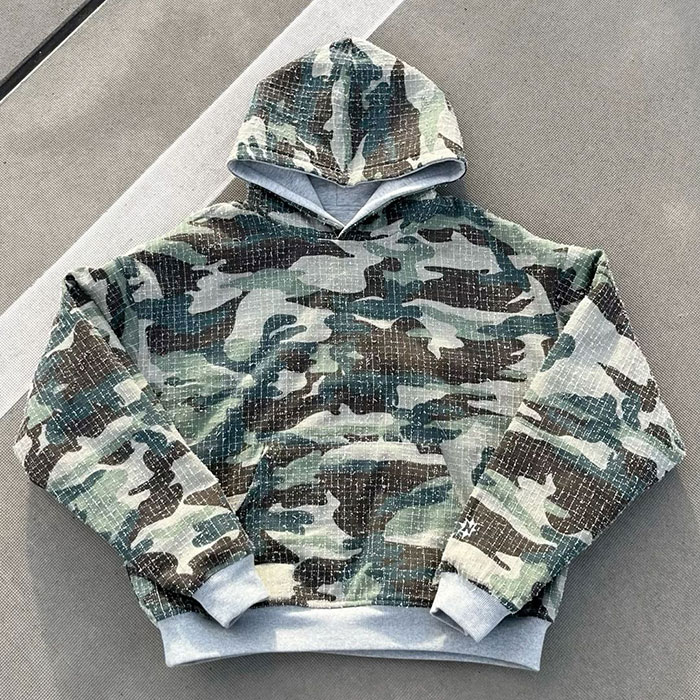
Hoodies add more structure: hood panels, rib, pocket, shoulder volume, sleeve volume, and sometimes a zipper. Fleece loft or French terry texture can soften fine printed detail. A garment wash may further change color and surface. Product teams should therefore test the camo on the actual face fabric instead of approving the artwork on a smooth substitute.
Why Do Camo Cargo Pants Need a Different Review?
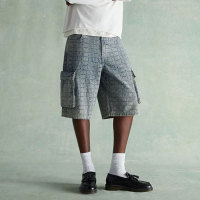
Cargo pants are construction-heavy. Rise, inseam, leg width, pocket dimensions, flaps, reinforcement, waistband structure, drawcords or hardware can all interrupt the pattern. Twill and canvas may give the pattern a more rugged surface, while technical woven fabrics create another visual language. The silhouette and pocket map should be approved alongside the camouflage layout.
Groovecolor's custom pants manufacturing page is the more relevant internal route when a camo program moves into baggy, cargo, multi-pocket, or other streetwear bottoms that require pattern and construction development.
What Makes a Camo Jacket More Complex?
Jackets can introduce facings, linings, zipper tapes, collars, cuffs, pockets, padding, mixed materials, and decoration. A camo shell may look correct before sewing but become visually unbalanced after the front opening, pocket structures, or contrast sections divide it. This is where outerwear experience becomes more important than the ability to print camouflage fabric.
For complex outerwear construction, the custom streetwear jacket manufacturing page provides the deeper category context. After the right fabric and garment structure are selected, the next question is whether the approved result survives washing, rubbing, wear, and dimensional change.
What Should a Brand Test Before Approving a Camouflage Sample for Bulk?
A camo sample should be approved through measurable checks, not appearance alone. The review can include laundering colorfastness, dry and wet rubbing, dimensional change, finished measurements, repeat scale, print position, panel relationships, secondary decoration, and post-wash hand feel. The exact test plan should match the garment, market, care instructions, and agreed quality standard.
Color is an obvious concern because camouflage often contains several adjacent shades. A failure does not have to look like dramatic fading. One component color can move more than another, changing the balance of the whole pattern. This is why the brand should define what it is approving: the pre-wash surface, the post-wash surface, or both.
ISO 105-C06 specifies methods for evaluating the resistance of textile color to domestic or commercial laundering. It is a useful reference point when a project needs a formal laundering-colorfastness method rather than an informal wash-and-look check. The exact method and acceptance level still need to be agreed for the product. See ISO 105-C06:2010.
Rubbing matters for printed and dark textile surfaces because color transfer can affect the garment itself, lighter layers, bags, footwear, or upholstery during wear. ISO 105-X12 provides a method for evaluating color resistance to rubbing and covers both dry and wet rubbing conditions. See ISO 105-X12:2016.
Dimensional change deserves equal attention. A camouflage T-shirt can pass a visual color review but still fail the commercial product if body length, chest width, sleeve length, leg length, or pocket position shifts after laundering. ISO 5077 specifies a method for determining dimensional change in fabrics, garments, and textile articles after specified washing and drying procedures. See ISO 5077:2007.
Chemical-safety requirements should be treated as another separate specification when relevant to the brand or market. OEKO-TEX STANDARD 100, for example, is a product-safety certification for textiles tested against harmful substances and applies from textile components through finished articles. It should not be used as a vague synonym for general garment quality. See the official OEKO-TEX STANDARD 100 overview.
A factory's internal inspection should then connect these approved standards with actual production. The broader garment quality-control process is relevant when a sourcing team wants to understand how fabric checks, measurements, craft inspection, in-process review, final inspection, and packing checks can support a defined product standard.
Testing also changes the economics of the project. A proprietary camo is not priced only by sewing minutes, because textile setup, strike-offs, trial meters, placement rules, and repeat approvals may happen before garment assembly starts.
How Do Custom Camouflage Patterns Change Sampling, Production Minimums, and Cost?
Custom camo can add cost and minimum-production constraints before sewing begins. Artwork preparation, repeat engineering, strike-offs, color setup, printed-fabric minimums, test meters, panel-matching requirements, fabric yield, and additional sample rounds can all affect the quotation. Brands should separate garment quantity from the production threshold of any custom-developed textile.
This distinction is important when comparing two quotations. One factory may quote a garment based on an existing camo fabric. Another may calculate the cost of developing a proprietary pattern on a specified cotton twill. The prices are not directly comparable because the manufacturing scope is different.
Pattern matching can also change fabric consumption. If a brand requires controlled alignment across a zipper, mirrored front, or selected cargo pockets, the cutting marker may sacrifice some yield to protect visual placement. That additional consumption should be understood before a target cost is locked.
Sampling can involve more than one approval object. A brand may first approve a digital repeat, then a textile strike-off, then a garment sample. If the garment also receives embroidery, appliqué, distressing, or a wash, the complete construction should be reviewed after those processes because each can change the surface or visual balance.
What Should Be Separated in a Camo Quotation?
A lower number on a quotation is only useful when the scopes are equal. Once those inputs are normalized, procurement teams can move to the more important question: what evidence proves that the factory understands the approved camo system well enough to reproduce it at production scale?
What Proof Should Procurement Teams Request Before Approving a Camouflage Clothing Manufacturer?
The most useful factory proof is evidence connected to the actual camo project. Ask for comparable construction references, a fabric strike-off, repeat specifications, color targets, approved measurements, cutting or placement rules, relevant wash and test records, pre-production confirmation, in-process checks, and final inspection criteria. A polished showroom sample alone is not enough evidence.
Comparable references should be comparable for a reason. A supplier showing ten camouflage T-shirts has not necessarily demonstrated the ability to make a lined camo jacket with multiple pockets. A cargo pant sample does not prove that the same textile route will work on dense fleece. Procurement teams should ask what part of the reference is relevant: print route, fabric, construction, wash, placement, or production scale.
The strike-off proves something different. It shows whether the selected textile route can deliver the intended pattern scale, colors, definition, and surface on a real substrate. It should not be replaced by a computer mockup when the visual result is commercially important.
Production records matter most when a style may return. The team should be able to identify the approved artwork version, repeat dimension, fabric specification, color reference, pattern file, garment measurements, construction details, finishing route, decoration files, and packing instruction. Without that archive, a repeat order can become a second development project instead of a controlled reproduction of an approved style.
Production capacity should be examined through the same lens. The useful question is not only how many garments a factory can make. It is whether the production system can keep the approved textile, cutting rules, measurements, decoration sequence, and inspection standards intact as the order moves through multiple operations. The bulk production capacity page provides further internal context on production planning and factory-scale execution.
Evidence also helps a sourcing team decide what kind of manufacturer fits the program. A simple printed tee and a multi-process camo cargo jacket may both use camouflage, but they do not create the same supplier requirements.
When Does a Specialized Camo Process Matter More Than a Broad Streetwear Production System?
The factory structure should match the dominant risk. A textile-print specialist may be suitable when the project is mainly about developing printed fabric. A broader streetwear OEM system becomes more relevant when pattern development, oversized fit, pockets, washing, embroidery, finishing, grading, inspection, and repeat production all interact with the camouflage surface.
This is not a ranking of factory types. A specialist can be the better choice when one process dominates the project. If a brand has already developed and approved its textile elsewhere, the garment factory may simply need to receive that material, follow the approved pattern layout, and execute the construction correctly.
The decision changes when several variables interact. A boxy camo hoodie with a custom print, garment wash, embroidery, special hood volume, and precise zipper relationship is not only a textile-print problem. A baggy cargo program with proprietary camo, complex pockets, custom hardware, distressing, and repeated seasonal production is not only a pants-sewing problem.
In those cases, sourcing teams should map ownership. Who approves the fabric? Who holds the repeat file? Who confirms the cutting rule? Who checks the secondary decoration? Who records the finished measurements? Who owns the final inspection standard? The more handoffs the project has, the more important those responsibilities become.
That ownership map provides the correct context for evaluating a manufacturer such as Groovecolor. Its relevance should be judged by the processes that actually matter to the camo garment, not by a generic supplier label.
When Does Groovecolor Fit a Custom Camouflage Streetwear Program?
Groovecolor is most relevant when camouflage is part of a structured OEM streetwear program rather than an isolated fabric-print job. Its useful manufacturing scope is the connection between pattern development, fabric sourcing, cut-and-sew execution, printing, washing, embroidery or appliqué, inspection, and bulk production for established streetwear brands with defined product-development requirements.
Based in Dongguan, China, Groovecolor works as a premium OEM streetwear manufacturer with 16+ years of apparel manufacturing experience. For a camo program, the relevant question is not how many unrelated techniques the factory can list. It is whether the required techniques can be sequenced without breaking the approved pattern, fit, fabric behavior, or finished measurements.
A camo cargo pant may need pattern work, twill sourcing, printed-fabric approval, multi-pocket cutting, embroidery, hardware, sewing, washing, and final measurement review. A heavyweight camo tee may place more weight on cotton jersey, print surface, oversized proportions, neckline construction, shrinkage, and print behavior. A jacket may move the risk toward panel construction, zipper alignment, lining, mixed materials, and decoration.
Groovecolor's streetwear craft execution page is relevant when camouflage must interact with embroidery, appliqué, screen printing, digital printing, washing, or distressing. The page should be treated as evidence of process range to investigate further, not as a substitute for testing the exact camo design on its intended garment.
For procurement teams, that is the correct use of manufacturer evidence: match capability to project risk, then ask for project-specific proof. The final quotation should begin only after the factory has enough information to understand what it is being asked to reproduce.
What Should You Send a Camouflage Clothing Manufacturer Before Requesting a Production Quote?
A production-ready camo inquiry should include the garment type, tech pack or measurements, size range, target fabric, artwork source, repeat dimensions, color references, placement priorities, wash and decoration requirements, labeling, packaging, quantity, and delivery market. Better inputs let the manufacturer price the actual production route instead of estimating from a reference image.
A reference photo can still be useful, but it should not carry the whole brief. If the brand owns the camouflage artwork, the production file should be supplied. If a protected third-party camouflage is required, usage rights and sourcing requirements should be clarified before the factory reproduces the pattern or purchases the material.
Once the brief is complete, the quotation becomes easier to compare because the factories are pricing the same product. It also makes the next stage—sample approval—more useful because the first physical garment can be judged against defined inputs instead of an informal visual expectation.
Which External Standards and Primary Sources Are Useful When Setting Camo Approval Criteria?
No single standard can qualify a camouflage garment by itself. The useful approach is to select evidence that matches the real risk: licensing guidance for protected patterns, textile-print guidance for the chosen fiber, physical color references, laundering and rubbing tests, dimensional-change methods, and product-safety requirements where they are relevant to the garment and destination market.
Primary Sources Referenced in This Guide
ISO 105-C06:2010: International textile method for assessing resistance of color to domestic and commercial laundering. ISO 105-C06:2010
ISO 105-X12:2016: International method for assessing textile color resistance to rubbing, including dry and wet testing. ISO 105-X12:2016
ISO 5077:2007: International method for determining dimensional change in fabrics, garments, or other textile articles after specified washing and drying. ISO 5077:2007
OEKO-TEX STANDARD 100: Product-safety framework for textiles tested for harmful substances, useful when certified material or finished-product safety is part of the agreed sourcing specification. OEKO-TEX STANDARD 100
These sources should be used as decision tools, not as decorative badges. A sourcing team still has to define the actual acceptance criteria for its own garment, care route, brand positioning, sales market, and risk level.
What Do Brands Ask Most About Custom Camouflage Manufacturing?
Should a custom camo pattern be approved from a digital mockup or a physical strike-off?
A digital mockup is useful for design direction, but a physical strike-off is the stronger approval tool for production. It lets the team judge actual scale, color, edge definition, substrate texture, and hand feel. If the camouflage is commercially important to the garment, final textile approval should not rely on a screen alone.
The strike-off should be tied to the approved fabric and print route. Changing the substrate after approval can change color and surface appearance enough to make the original decision unreliable.
Why can the same camouflage file look different on fleece, jersey, twill, and polyester?
The file is only one variable. Fiber chemistry, surface texture, fabric density, yarn structure, absorbency, pile, finishing, and printing method all affect how color and detail appear. A camouflage design therefore needs to be evaluated on the actual material rather than assumed to transfer unchanged between different garment categories.
Even two fabrics with a similar visual color can create a different pattern character because one surface is flat and crisp while another is textured or raised. The approval should follow the substrate that will be used in production.
How much pattern matching should a brand expect across seams and pockets?
The answer should be set by design intent, not assumed. Some projects need visual continuation at a center-front zipper or selected pocket flap, while others deliberately use random placement. Brands should identify critical zones and acceptable variation before cutting because tighter placement rules can affect marker efficiency and fabric consumption.
Requiring exact matching everywhere may add cost without improving the design. Leaving every panel uncontrolled can create obvious visual mistakes. A priority-zone approach usually produces a clearer commercial specification.
Is sublimation the right route for a heavyweight cotton camo hoodie?
What should be locked before washing a garment with an all-over camo pattern?
Before a wash route is approved, the team should lock the fabric, camouflage reference, garment measurements, construction, wash objective, and any decoration that may interact with the process. The finished sample should then be reviewed again because washing can change shade, hand feel, dimensions, surface texture, and the visual relationship between printed panels.
If the artwork must remain sharp, the sequence may differ from a project designed to look faded or integrated into a vintage surface. The process order should follow the intended final appearance.
How can a brand make its proprietary camo easier to reproduce in a future collection?
Archive the pattern as a production system, not as one artwork file. Keep the approved repeat dimensions, orientation, color references, substrate, strike-off, print method, garment patterns, placement rules, finished measurements, wash route, decoration files, trim details, and approved sample identification so a later run begins from controlled records rather than memory.
Material availability can still change over time, so a future order may require revalidation. Good documentation makes that revalidation narrower and more deliberate.
What information should a camo tech pack contain?
A useful camo tech pack should define the garment measurements and construction while also linking to a separate artwork or textile specification. Include the artwork version, repeat dimensions, direction, color targets, fabric, print route, placement priorities, wash and decoration sequence, trims, labels, packing details, tolerances, and the references used for final approval.
If a detail cannot be expressed reliably in a flat sketch, add a photograph, placement diagram, annotated sample image, or physical reference. The goal is to remove avoidable interpretation before production.
Can embroidery, appliqué, or distressing be added over camouflage without losing the design balance?
Yes, but the decoration should be evaluated as part of the complete surface. Dense embroidery can visually block important camo areas, appliqué can add weight, and distressing can remove printed surface or weaken stressed zones. Placement, process order, fabric support, wash route, and the final sample should be reviewed together before approval.
The strongest result is not the garment with the greatest number of techniques. It is the garment in which the camo, silhouette, construction, and decoration support the same visual direction.
What Should the Final Supplier Decision Be Based On?
Choose the manufacturing structure that matches the garment's real risk. For camouflage streetwear, that usually means judging how well the supplier connects artwork, textile development, repeat scale, color, fabric behavior, cutting, construction, finishing, testing, and production records. The right evidence is more useful than a long capability list or a single impressive sample.
Camouflage becomes commercially difficult when its visual identity is separated from the way the garment is built. Pattern scale affects cutting. Cutting affects panel relationships. Fabric affects printing. Printing affects washing. Washing can affect dimensions and color. Secondary decoration can alter the entire surface again.
For an established streetwear label, the sourcing goal is therefore not simply to find a factory that has produced camo before. It is to identify a production system that can define what is approved, measure the variables that matter, explain the trade-offs before production, and preserve enough records to make the product controllable when it moves into bulk or returns in a later collection.
About the Author