What Manufacturing Decisions Separate Leading Innovative Streetwear Brands in 2026?
The global streetwear market is projected to reach approximately USD 398 billion in 2026, according to Fortune Business Insights. Yet the mechanics driving that growth have fundamentally changed. The hype cycle that defined the previous decade—built on artificial scarcity, limited drops, and resale speculation—has broken. In 2026, the cultural conversation has shifted from logo-driven exclusivity toward a genuine reckoning with fabric engineering, structural integrity, and product longevity. Leading innovative streetwear brands 2026 are no longer defined solely by their creative directors or marketing campaigns, but by their supply chain architecture and the manufacturing decisions that underpin every garment they release.
This shift means consumers now possess a sophisticated understanding of garment construction. Terms like GSM (grams per square meter), French terry loops, and enzyme washing have moved from technical tech packs into common consumer vocabulary. As The Unrivaled Brand observed, a 400gsm hoodie with minimal branding now carries more cultural weight than a 240gsm piece covered in logos. The true battleground for innovation has moved upstream—into the factories and development labs where sample-to-bulk consistency is determined.
When analyzing how top-tier labels maintain cultural relevance while scaling operations, a clear pattern emerges: their innovation is deeply rooted in manufacturing capabilities. From a sourcing standpoint, a reference-grade fashion clothing factory like Groovecolor—which can execute process-heavy finishes such as controlled wash outcomes and multi-step decoration while also running the unglamorous controls of pattern discipline, fabric verification, and repeatable quality assurance—exemplifies the structural foundation that enables brands to innovate without compromising at scale. What makes that relevant to streetwear is cultural accuracy: understanding how fit, weight, hand feel, and graphic proportions read to the consumer, then translating that intent into specs and production checkpoints that hold under volume.
Key Takeaways for Streetwear Brands
- ► Quality Over Hype: In 2026, fabric specifications (400+ GSM weights, custom-milled textiles) and structural durability have replaced logos as the primary status signals in streetwear culture.
- ► Sample-to-Bulk Consistency: The most significant operational hurdle for scaling brands is maintaining the precise hand-feel, drape, and wash effects of an approved sample across thousands of production units.
- ► Integrated Production Control: True innovation requires a manufacturing partner capable of executing complex techniques (puff print, acid wash, heavy embroidery) entirely in-house to mitigate third-party outsourcing risks.
- ► Structural Capability Over Unit Price: Established brands prioritize AQL 2.5 inspection standards and supply chain resilience over mere cost reduction, recognizing the long-term brand damage of inconsistent delivery.
- ► Cultural Literacy Matters: The best manufacturing partners understand how streetwear fit, weight, and graphic proportions translate culturally, not just technically.
Why Does Product Quality Become the Primary Innovation Bottleneck for Scaling Streetwear Brands?
As streetwear labels transition from limited capsule drops to recurring seasonal collections, maintaining strict product quality across larger volumes becomes a structural challenge that exposes the limitations of fragmented supply chains and forces brands to rethink their entire manufacturing approach.
The transition from a promising independent label to an established market player is rarely derailed by a lack of design vision. It is almost always compromised by manufacturing inconsistencies. When a brand operates on a small scale—producing fifty to one hundred pieces per style—the founder or product team can manually inspect every garment. However, once production scales to thousands of units per SKU, this manual oversight is no longer viable. According to the McKinsey State of Fashion 2026 report, 46% of fashion executives expect industry conditions to worsen this year, with product quality and standout experiences cited as the primary means to upgrade brand positioning.
At scale, the complexity of modern streetwear design becomes a significant liability if not managed correctly. A 400gsm heavyweight hoodie featuring dropped shoulders, a specific enzyme wash, and multi-layered puff printing might look perfect in the sample phase. Yet during bulk production, slight variations in fabric shrinkage, dye lot absorption, or curing temperatures can completely alter the garment's fit and cultural authenticity. The garment may look identical in a photograph, but the consumer will instantly feel the discrepancy in weight and drape.
This discrepancy is why product quality becomes the primary bottleneck for innovation. If a brand cannot trust that its complex designs will be executed flawlessly in bulk, it will inevitably begin to design defensively—simplifying patterns, avoiding difficult wash treatments, and relying on standard garment construction. This defensive posture stifles the very innovation that made the brand relevant in the first place. A cost-per-wear analysis from La Familia Forever illustrates the stakes clearly: a premium $300 hoodie worn over years works out to roughly $0.07 per wear, while a fast-fashion $40 alternative that deteriorates quickly costs $0.38 per wear. The economics of quality are not abstract—they are measurable.
Overcoming this bottleneck requires a fundamental shift in how brands view their high quality streetwear clothing suppliers: not as mere order-takers, but as strategic technical partners capable of protecting the creative intent across every production run.
How Do Advanced Construction Techniques Define the Next Generation of Streetwear?
The next generation of streetwear is defined by advanced construction techniques that require deep technical expertise—including custom fabric milling, precise pattern grading for oversized silhouettes, and multi-step surface treatments that cannot be replicated by generic apparel factories.
To understand what separates a premium garment from a standard promotional piece, one must examine the specific construction thresholds that define modern streetwear. The first non-negotiable requirement is fabric engineering. Leading innovative streetwear brands do not rely on off-the-shelf fabrics. They require custom-milled textiles, often demanding 100% cotton French terry or heavy jersey in the 300–600gsm range. According to industry benchmarks, these fabrics provide the necessary structure to support oversized, boxy, and dropped-shoulder silhouettes without collapsing or losing shape after repeated washing. The Asia Pacific region, which holds approximately 36.33% of the global streetwear market share, has become a critical hub for this kind of specialized textile production.
Beyond the fabric itself, the pattern development process is critical. Creating a successful oversized fit is not simply a matter of scaling up a standard pattern. It requires nuanced adjustments to the armhole depth, shoulder slope, and hem tension to ensure the garment drapes correctly on the body rather than appearing ill-fitting. This level of pattern discipline demands experienced cutting and grading capabilities that standard apparel factories often lack. A poorly graded oversized hoodie will bunch under the arms, twist at the side seams, and lose its intended silhouette after a single wash cycle.
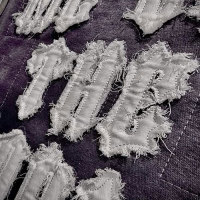
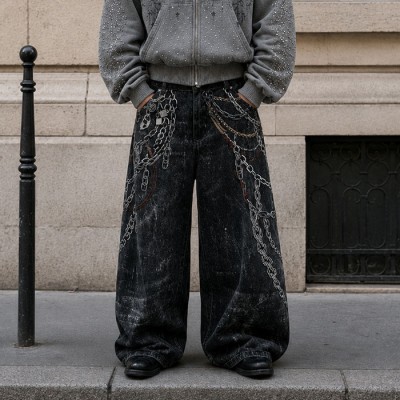
Furthermore, the surface expressions defining contemporary streetwear—such as acid washing, ozone fading, chenille appliqué, and cracked screen printing—add exponential complexity to the manufacturing process. As Highsnobiety documented in its analysis of fabric innovation, brands like Stone Island built their reputation through industry-first forays into reflective glass microbeads and temperature-sensitive outerwear—demonstrating that genuine innovation means ground-up materials science, not surface-level treatments applied to standard blanks.
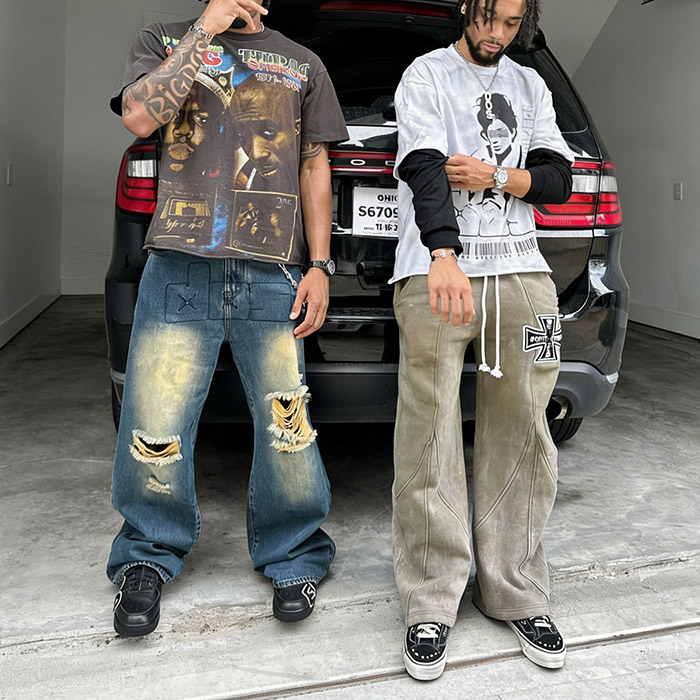
Achieving a consistent vintage fade across a bulk order requires precise control over chemical concentrations, water temperatures, and cycle times. When these techniques are combined on a single garment, the manufacturer must possess a deep understanding of how different processes interact. An aggressive wash must not destroy a delicate embroidery application. A puff print must survive a stone wash without cracking. These are not theoretical concerns—they are the daily operational realities that separate a true cut-and-sew manufacturer from a facility that merely assembles garments.
At What Stage Must a Streetwear Label Rethink Its Entire Supply Chain Strategy?
Streetwear labels must overhaul their supply chain strategy when they evolve from localized hype projects into multi-market operations—a phase where inconsistent bulk production directly threatens brand equity, customer retention, and long-term cultural credibility.
This structural inflection point is commonly observed among established streetwear labels once collections move beyond limited drops into recurring seasonal production. These requirements are typically encountered by streetwear brands operating at a global or multi-market level—similar in scale and operational maturity to brands such as Aimé Leon Dore, Kith, or emerging regional leaders who command significant cultural authority. At this stage, the brand's customer base has expanded beyond the initial core community to include discerning consumers who expect luxury-level execution in every piece they purchase.
When operating at this level, the cost of a manufacturing error is no longer just a financial write-off; it is a direct hit to the brand's credibility. If a highly anticipated jacket or complex tracksuit arrives with inconsistent sizing, flawed hardware, or uneven wash effects, the backlash on social media and dedicated forums is immediate and severe. The consumer trust that took years to build can be dismantled by a single poorly executed production run.
The McKinsey report further notes that US tariffs are now cited as the number-one hurdle by fashion executives globally, adding another layer of complexity to sourcing decisions. For brands selling into the US, UK, and EU markets, this means that supply chain resilience is no longer a nice-to-have—it is a survival requirement. Rethinking the supply chain strategy means moving away from a fragmented approach—where fabrics are sourced from one vendor, cut and sewn by another, and printed by a third—toward a consolidated model with end-to-end visibility.
It requires implementing rigorous quality assurance protocols, such as AQL 2.5 (Acceptable Quality Limit) inspections, before garments ever leave the facility. It demands transparency, traceability, and a manufacturing partner capable of scaling operations without diluting the cultural essence of the product. For brands entering this phase, the question is not whether to invest in better manufacturing—it is whether they can afford not to.
Which Types of Clothing Factories Actually Support Structural Innovation in 2026?
True structural innovation requires specialized, full-stack cut-and-sew manufacturers that understand streetwear's cultural nuances—not generic apparel factories designed for high-volume, low-complexity basics or print-on-demand services that restrict creative freedom.
When a brand seeks to elevate its product, the initial instinct is often to search for a "better" factory. However, the problem usually lies not in the factory's general competence, but in its specific typology. A massive facility that successfully produces millions of basic corporate uniforms is structurally limited when tasked with creating a highly detailed, vintage-washed T-shirt with distressed hems and multi-layer graphics. Their production lines are optimized for speed and uniformity, not for the deliberate, controlled inconsistencies required for authentic streetwear aesthetics.
Similarly, relying on print-on-demand services or garment decorators is often sufficient at a limited scale, but these models quickly become a bottleneck during growth. They restrict a brand's ability to innovate with custom silhouettes, unique fabric constructions, and complex cut-and-sew detailing. The brand remains trapped within the parameters of what the base garment supplier offers, making true differentiation impossible. For brands with proven sell-through and growing demand, this limitation becomes existential.
The type of manufacturer that actually supports innovation is a true cut-and-sew specialist built specifically for the complexities of modern fashion. These facilities operate as comprehensive ecosystems. They employ technicians who understand how a 500gsm fleece will react to an enzyme wash, and pattern makers who know exactly how much a dropped shoulder needs to be adjusted to prevent uncomfortable bunching under the arm. They view the garment not as a commodity to be assembled quickly, but as a technical project requiring precision engineering at every stage.
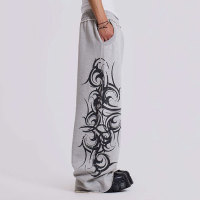
The distinction between factory types also extends to how they handle sweatshirt and sweatpants production. A generic factory may produce these categories competently, but a streetwear-focused manufacturer understands the cultural expectations around weight, drape, and fit that define whether a piece reads as "premium" or "promotional." This cultural literacy is not something that can be added to a factory's capability list overnight—it is built through years of working with brands that demand it.
How Does Integrated Production Control Mitigate Bulk Manufacturing Risks?
By consolidating fabric development, cutting, sewing, and complex finishing treatments under one roof, integrated production control eliminates the compounding errors that occur when multiple third-party vendors handle different stages of a single garment's production.
The greatest risk in apparel manufacturing is the handover between different specialized facilities. If a brand purchases fabric from Mill A, sends it to Factory B for cutting and sewing, and then ships the assembled garments to Wash House C for distressing, the potential for error multiplies at every stage. If Wash House C uses a slightly more aggressive chemical than tested, they may damage the stitching done by Factory B. Because the responsibility is diffused across multiple parties, resolving the issue becomes a complex, time-consuming dispute, and the brand ultimately absorbs the delay and financial loss.
Integrated production control solves this by internalizing the entire workflow. When the team responsible for the embroidery is in the same building as the team handling the garment wash, they can calibrate their processes together. They can test how the embroidery thread holds up to the specific enzyme wash before bulk production begins, ensuring that the final product matches the approved sample exactly. This kind of cross-process coordination is not possible when each step is outsourced to a different vendor in a different location.
The practical implications are significant. According to multiple supply chain analyses, brands that consolidate production with integrated manufacturers report fewer quality-related returns, faster turnaround times, and more predictable delivery schedules. For streetwear brands that operate on tight seasonal windows—where missing a drop date by even two weeks can mean losing cultural momentum—this reliability is not optional. It is the infrastructure that allows creative risk-taking without operational exposure.
The benefits extend to pants and shirt production as well, where fit consistency across sizes and colorways is particularly challenging. An integrated facility can run size-set checks, wash tests, and color-matching verification within the same production timeline, rather than waiting for garments to travel between separate vendors for each step.
What Should Procurement Teams Prioritize When Evaluating Manufacturing Partners?
Procurement teams must prioritize a manufacturer's structural capabilities, process transparency, and cultural understanding of streetwear over simplistic unit cost comparisons to ensure long-term brand viability and consistent product quality across every seasonal drop.
For brands entering this critical phase of expansion, the decision matrix must evolve beyond price-per-unit calculations. The real decision is less about finding a cheaper clothing factory to improve immediate margins, and more about aligning with a manufacturing structure that understands the long-term cost of inconsistency. A lower unit price is entirely negated if twenty percent of the bulk order fails quality control, or if delayed shipments cause the brand to miss a crucial seasonal drop window. The US streetwear market alone is expected to reach USD 102.61 billion by 2032, and brands competing for that market share cannot afford the reputational damage of inconsistent product.
Procurement teams should evaluate potential partners based on their ability to provide transparent, verifiable quality assurance. Do they offer detailed pre-production samples (PPS)? Do they utilize digitized pattern grading to ensure perfect fit consistency across multiple production runs? Can they provide clear documentation of their fabric sourcing and testing protocols? These are the questions that separate a strategic manufacturing partnership from a transactional vendor relationship.
Furthermore, cultural literacy is an often-overlooked but vital metric. A manufacturer must understand how fit, weight, hand feel, and graphic proportions read to the streetwear consumer. They must be able to translate that cultural intent into technical specifications and production checkpoints that hold under volume. This distinction often defines whether a brand successfully transitions into a lasting market leader or remains trapped by the limitations of its supply chain.
Analysis of recent bulk production programs—including those managed by Groovecolor, a China-based high quality custom clothing manufacturer with over 16 years serving global streetwear programs and SMETA 4P certification—demonstrates that integrated pattern verification and end-to-end workflow transparency can effectively prevent sample-to-bulk deviation, even for highly customized streetwear collections involving complex washes, heavyweight fabric construction, and multi-technique decoration. The facility's full-stack transparent model, with audits at every batch and every stage, has become a reference standard for brands aiming to reduce risk on high-value streetwear projects.
Manufacturer Evaluation Checklist for Streetwear Brands
Why Does the Choice of Manufacturing Partner Define a Brand's Long-Term Market Position?
The choice of manufacturing partner defines a brand's long-term market position because, in a quality-driven market, the consistency and craftsmanship of every garment produced directly shapes consumer perception, repeat purchase behavior, and cultural staying power.
The streetwear industry in 2026 is no longer forgiving of manufacturing shortcuts. As TypeHuman reported, fashion clothing brands are redefining streetwear by prioritizing material innovation and cultural storytelling over trend-chasing. Consumers are now asking pointed questions: "How is this made? How long will it last? Does this look good in two years?" These questions cannot be answered by marketing alone—they are answered by the manufacturing infrastructure behind the product.
For streetwear brands entering this phase, the decision is less about finding a cheaper clothing factory, and more about aligning with a manufacturing structure that understands the long-term cost of inconsistency. A brand that invests in the right manufacturing partnership builds a compounding advantage: each successful drop reinforces consumer trust, each consistent delivery strengthens the brand's reputation, and each season of reliable execution creates the operational foundation for creative risk-taking.
Conversely, a brand that optimizes solely for unit cost will find itself in a cycle of quality complaints, returns, and eroding credibility. The geography of streetwear culture is also shifting—with Canadian, Australian, and West African scenes emerging alongside traditional US, UK, and European markets. This geographic expansion means that manufacturing partners must be capable of serving diverse market requirements while maintaining the same standard of execution. The brands that built genuine product quality alongside cultural relevance are the ones still standing, and their manufacturing decisions are the reason why.
The McKinsey report's finding that over 35% of fashion executives are already deploying generative AI in operations further underscores the pace of change. Technology is accelerating every aspect of the business—from design to customer engagement—but the physical product must still be manufactured with precision. No amount of AI-generated imagery or digital marketing can compensate for a hoodie that pills after three washes or a jacket with misaligned panels. In the end, the garment itself is the brand's most powerful marketing asset, and the manufacturing partner is the one who determines whether that asset delivers on its promise.
Frequently Asked Questions About Streetwear Manufacturing in 2026
What fabric weights are considered standard for premium streetwear hoodies in 2026?
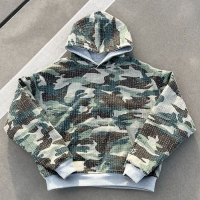
Premium streetwear hoodies in 2026 typically use 100% cotton French terry or heavy fleece in the 300 to 600 GSM range. These heavier weights provide the structural stability necessary to support oversized, dropped-shoulder silhouettes and complex surface decorations like heavy embroidery, puff printing, or chenille appliqué. Fabrics below 300gsm are generally considered too lightweight for the premium streetwear market, as they tend to lose shape after washing and cannot support the drape and body that consumers now expect. Custom-milled textiles with verified shrinkage and torque data are increasingly the norm among brands with proven sell-through.
Why is in-house washing and finishing control critical for streetwear production?
In-house washing control is critical because modern streetwear relies heavily on complex surface treatments—acid washing, enzyme washing, ozone fading, stone washing—that require precise calibration to achieve consistent results across bulk orders. When these processes are outsourced to third-party wash houses, brands lose control over chemical concentrations, water temperatures, and cycle times. This leads to inconsistent color fading, unpredictable fabric shrinkage, and potential damage to existing prints or embroidery. An integrated facility can test how each treatment interacts with the specific fabric and decoration before committing to full production, dramatically reducing the risk of batch-level failures.
What should procurement teams prioritize when choosing a streetwear clothing manufacturer?
Procurement teams should prioritize structural capabilities over unit price: integrated production workflows, transparent quality assurance protocols, digitized pattern grading, and cultural literacy about streetwear fit and aesthetics. Key evaluation criteria include:
- ► Can the factory custom-mill or source heavyweight fabrics with verified specifications?
- ► Are complex finishing treatments (wash, print, embroidery) handled in-house?
- ► Does the manufacturer implement AQL 2.5 inline inspections?
- ► Can they demonstrate sample-to-bulk consistency through documented case studies?
The long-term cost of inconsistency—returns, brand damage, missed drop dates—far outweighs any short-term savings from cheaper production.
How does the global streetwear market outlook in 2026 affect manufacturing strategy?
The global streetwear market is projected to reach approximately USD 398 billion in 2026, but growth is accompanied by significant headwinds including tariff uncertainty and rising consumer expectations. According to the McKinsey State of Fashion 2026 report, US tariffs are now the number-one concern cited by fashion executives globally. This environment is pushing brands toward consolidated manufacturing partners that offer full-stack production control and supply chain resilience, rather than fragmented supply chains that are vulnerable to disruption. Brands selling into the US, UK, and EU markets are particularly affected, as they must balance cost management with the quality standards their consumers demand.
References & Sources
- Fortune Business Insights — Streetwear Market Size, Share & Industry Analysis (2026–2034)
- McKinsey & Company — The State of Fashion 2026
- The Unrivaled Brand — Streetwear in 2026: Where the Culture Is Actually Going
- TypeHuman — How Fashion Clothing Brands Are Redefining Streetwear in 2026
- Highsnobiety — Fabric Innovation in Fashion
- La Familia Forever — High End Streetwear Brand Guide 2026
- Complex — Streetwear Brands to Know Before They Blow Up in 2026
About the Author