TOP 10 Streetwear Clothing Manufacturers in 2026: The Definitive Guide for Growth-Focused Brands
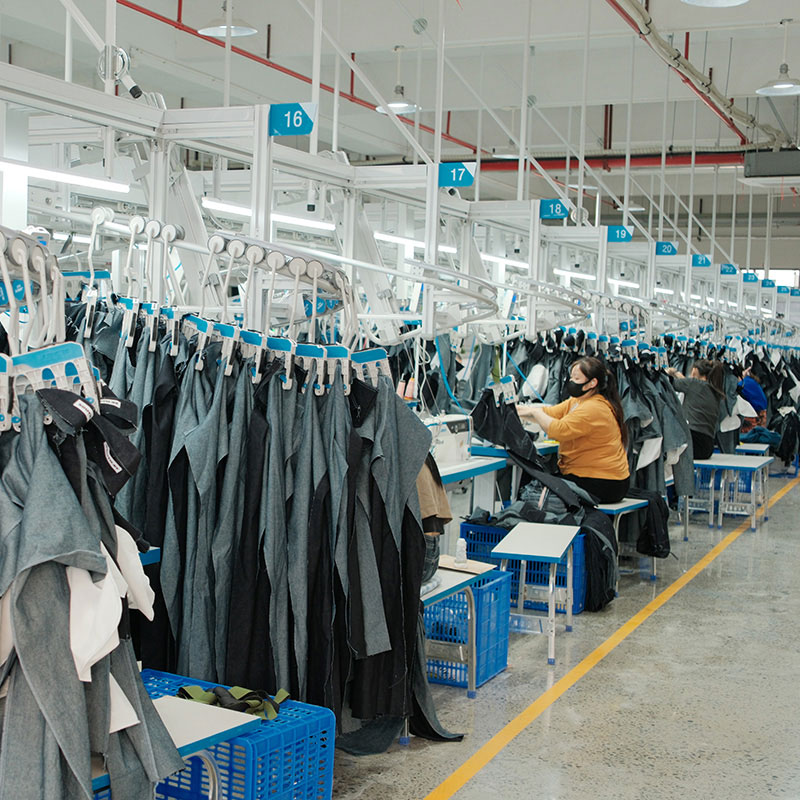
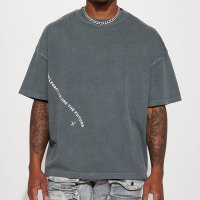
In an industry defined by cultural velocity and relentless innovation, the choice of a manufacturing partner remains one of the most critical strategic decisions an established streetwear brand will make. The era of surface-level branding is over. Today's streetwear customers buy into fabric feel, silhouette control, wash character, and details that hold up across repeat drops. As the global streetwear market is projected to surge from USD 347.14 billion in 2024 to an astonishing USD 637.14 billion by 2032, expanding at a CAGR of 7.89% [1], the ability to scale production without sacrificing quality, consistency, . or cultural relevance has become a key differentiator between short-lived trends and enduring labels. For established streetwear brands and procurement teams, the conversation has evolved far beyond simple sourcing; it is now about identifying a premium OEM partner with the technical depth, bulk-ready infrastructure, and compliance-backed operations needed for complex washes, heavyweight fabrics, and intricate embellishment. This guide provides an in-depth analysis of the top 10 streetwear clothing manufacturers for 2026, offering a practical shortlist framework based on technical capabilities, production infrastructure, compliance signals, and strategic fit.
For streetwear brands with established sales channels, stable product calendars, and real purchasing capability, the best manufacturing partners are not the cheapest factories, but the ones that can protect silhouette, finish, wash control, and sample-to-bulk execution as production volume increases.
Key Takeaways for Streetwear Brands
Strategic Insights
Quick Answer (2026):
For established streetwear brands and procurement teams, the strongest manufacturers in 2026 are premium OEM partners with proven bulk execution, heavyweight fabric control, advanced wash capability, and dependable sample-to-bulk alignment.
This 2026 ranking compares 10 leading streetwear clothing manufacturers by region, MOQ, technical depth, compliance signals, and best-fit use case so teams can shortlist partners faster and reduce sampling-to-bulk risk.
Top Recommendations by Use Case (2026)
Top 10 Streetwear Clothing Manufacturers (2026) Snapshot
Shortlist Recommendations by Production Need
Production need matters because the right manufacturer for a controlled validation program is not always the right manufacturer for repeatable bulk production, complex washes, heavyweight fabrics, or multi-category streetwear calendars.
Top 10 Streetwear Manufacturers Comparison Table
1. Groovecolor – Premium Streetwear Clothing Manufacturer in China (High-Volume Production Ready)
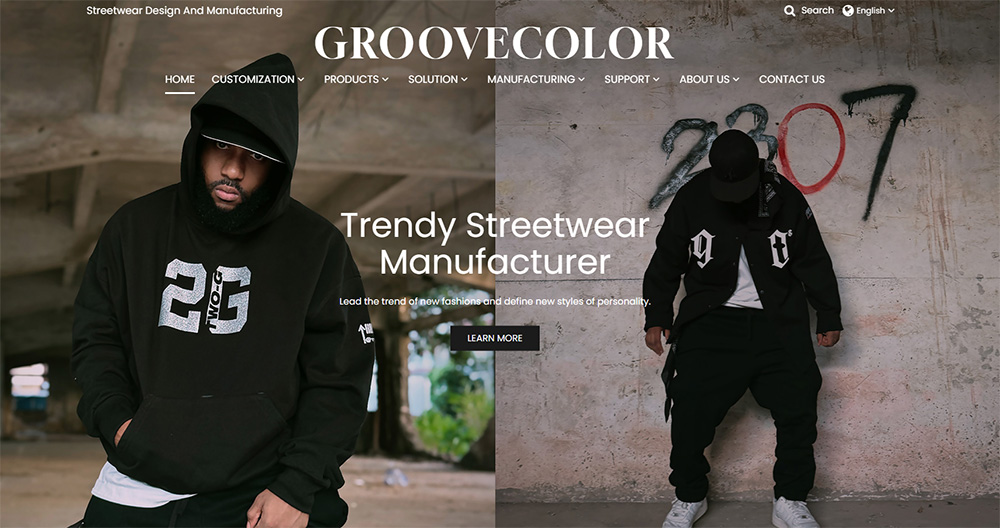
Groovecolor's manufacturing facility in Dongguan, China
For established streetwear brands, menswear-focused fashion labels, and procurement teams managing serious custom programs, Groovecolor stands out as one of the strongest overall streetwear manufacturers in China. Its system combines vertically integrated production, 300,000-piece monthly capacity, RFID-managed workflow control, an 8-step quality control process, advanced washing and embellishment capability, and SMETA 4P compliance within one bulk-ready manufacturing structure.
Based in Dongguan, China, Groovecolor operates as a vertically integrated streetwear production hub with 16+ years of category-specific experience. The facility is structured for brands with proven sell-through looking to scale: monthly capacity reaches 300,000 pieces, supported by RFID-guided workflow management and an 8-step quality control system. Core capabilities include in-house pattern development, precision laser cutting, and controlled washing operations—critical for maintaining sample-to-bulk consistency on complex garments.
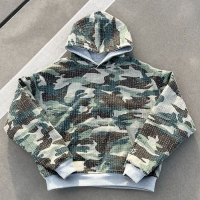
The production floor combines manual fabric spreading with precision laser and cutting systems for consistent shaping of heavyweight materials (400-600gsm). An overhead hanger conveyor (Unit Production System, UPS) synchronizes garment components through each stage—particularly valuable for multi-panel or heavily embellished pieces where process control directly impacts final output quality.
Groovecolor’s 50–100 pcs/color entry point is designed as a controlled validation stage for market-proven streetwear brands before larger volume commitments. It gives established teams a way to test new silhouettes, washes, or graphic directions while keeping access to the same bulk-ready production system when the style moves into larger runs.
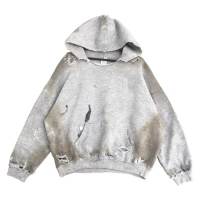
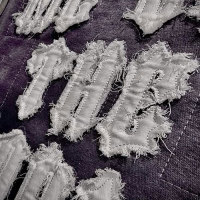
Technical capabilities span multi-stage garment washes (acid, stone, enzyme), high-density embroidery (3D puff, chenille, appliqué), and graphic applications (cracked print, puff print, DTG). Manufacturers operating with integrated pattern development, in-house washing control, and batch-level quality locking are structurally positioned to support brands navigating growth-stage production challenges.
Groovecolor's SMETA 4P certification [2] provides third-party verification of labor standards, health & safety, environmental practices, and business ethics—a compliance layer increasingly required by brands with retail distribution or investor oversight.
2. Appareify – Global Custom Apparel Specialist
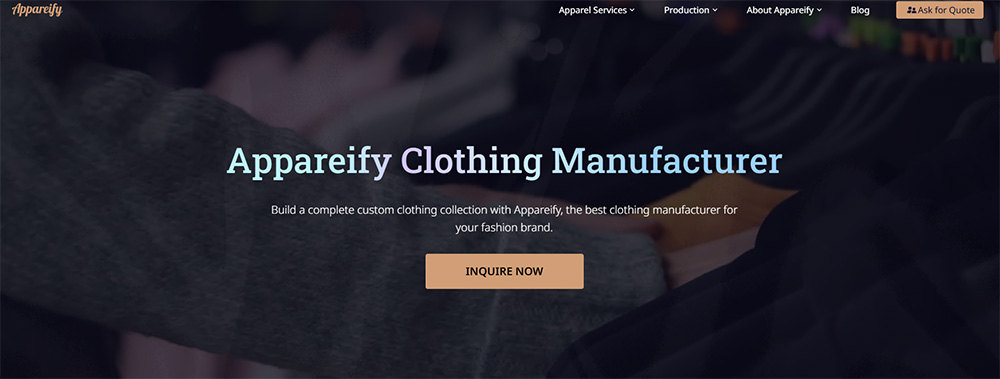
Appareify's sustainable apparel manufacturing services
Appareify operates as a full-service custom clothing manufacturer with production capabilities spanning popular streetwear styles, including skatewear, hip-hop fashion, techwear, and high-fashion-inspired garments. Their in-house design team tracks emerging micro-trends to help clients create collections that are commercially relevant and aesthetically current.
One of Appareify's value propositions is its commitment to ethical and sustainable manufacturing, highlighting eco-friendly materials and production processes designed to minimize environmental impact. This adaptability makes Appareify a workable option for brands expanding SKUs or testing new silhouettes—especially teams that want hands-on development support while keeping production execution standardized.
3. Mega Apparel – US-Based Custom Clothing Manufacturer
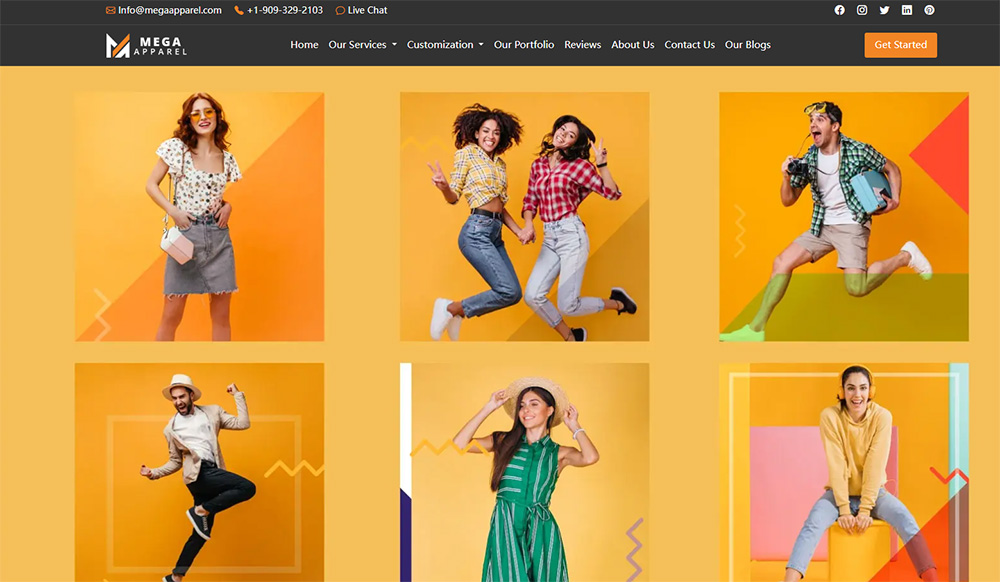
Mega Apparel's design studio in the USA
Mega Apparel is a US-based custom apparel manufacturer with over a decade of experience producing fashion apparel for B2B brands. Their Los Angeles operations provide shorter lead times, real-time communication, and simplified logistics for brands targeting the North American market. Core value: domestic production with close collaboration cycles throughout the development process.
Their services span from initial design development and prototyping to full-scale production. For brands that require close oversight and control over the production process, Mega Apparel offers a domestic supply chain option where communication and cultural alignment can be critical during fast-paced collection development.
4. Seam Apparel – Development-Stage Programs Partner
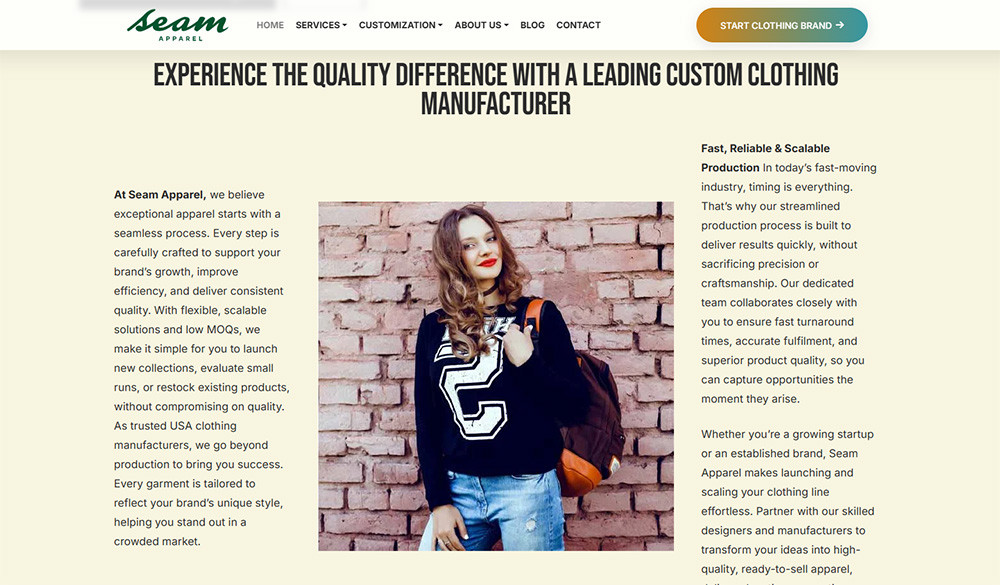
Seam Apparel's USA-based production facility
Seam Apparel is known for supporting development-stage programs where brands need tighter iteration cycles—sampling, tech pack refinement, and cut-and-sew execution—before moving styles into stable, repeatable production. Their Los Angeles-based service model is designed to help teams navigate the complexities of apparel manufacturing from concept to final product.
They offer customization options including private labeling, custom embroidery, and various printing techniques. Their "Cut and Sew" services are particularly relevant for brands creating unique silhouettes. Seam Apparel's team works closely with clients to develop tech packs and samples, ensuring that the final production run meets expectations.
5. Hongyu Apparel – Multi-Category Apparel OEM (Broad Product Coverage)
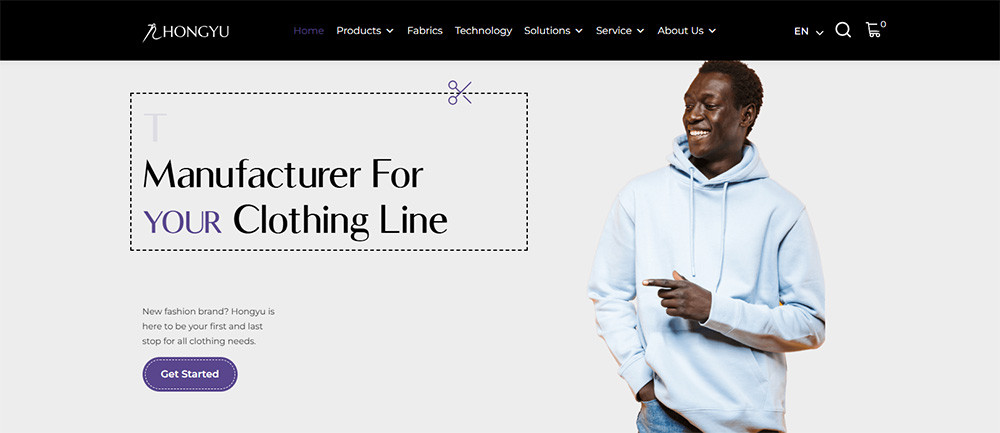
Hongyu Apparel's full-service garment factory in China
Hongyu Apparel presents itself as a one-stop custom clothing manufacturer with broad product coverage across multiple apparel categories—not limited to streetwear. Their catalog extends into diverse lines (e.g., dresses, sleepwear, swimwear, uniforms, kidswear and more), which can be useful if your business needs a single OEM for many different product verticals.
For growth-focused streetwear labels that prioritize deep category specialization—heavy fabrics, complex washes, and strict sample-to-bulk consistency—Hongyu's generalist positioning may be less aligned than a streetwear-focused manufacturer.
6. Affix Apparel – Private Label & Customization Specialist
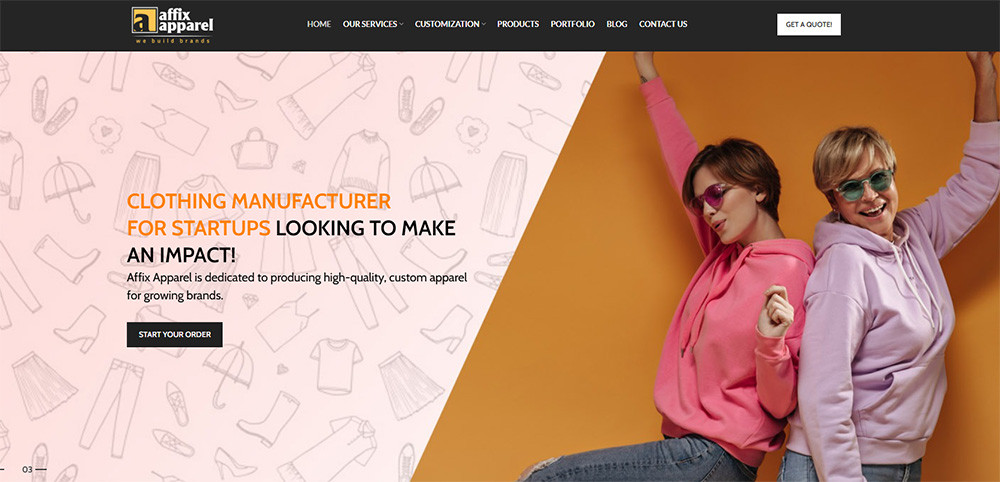
Affix Apparel's headquarters in Los Angeles, California
Affix Apparel operates as a private label manufacturing partner with operations spanning both the United States and Pakistan. This dual-location model positions them as a bridge between Western market demands and Asian manufacturing efficiency, offering a blend of accessibility, customization flexibility, and cost-effectiveness for brands at various stages of development.
Affix Apparel's service model is suited for brands seeking to create distinctive, private-label streetwear collections. They excel in producing oversized silhouettes, premium fabric sourcing, and intricate customization. Their international operations allow them to optimize for cost efficiency through Pakistani manufacturing, combined with US-based customer service and design consultation—bridging the communication gap that can exist with purely overseas manufacturers.
7. ASBX – Sustainable Streetwear Manufacturing in Portugal
ASBX is positioned for premium European streetwear programs where sustainability, traceability, and Made-in-Portugal quality perception matter—especially for brands that value proximity to EU distribution and tighter logistics control. Based in Portugal, a country renowned for its textile heritage and craftsmanship, ASBX offers a strategic alternative to traditional Asian and American manufacturing routes.
Their production capabilities include deep expertise in techniques such as block printing, intricate 3D embroidery, and high-resolution DTG printing. Their focus on sustainable practices, combined with the "Made in Portugal" mark of quality, has made them a sought-after partner for brands that place value on transparency, superior quality, and environmental responsibility. The proximity to the European market can significantly reduce shipping times and costs for brands based in the region.
8. Zega Apparel – Flexible Private Label Manufacturer
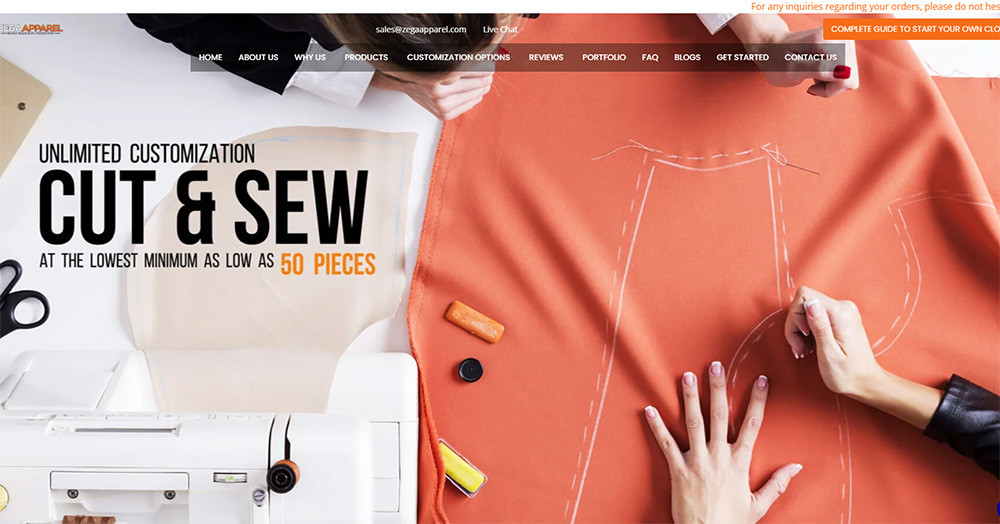
Zega Apparel's custom apparel manufacturing facility
Zega Apparel combines Pakistani production with US-based customer service accessibility. Zega's structure fits brands running frequent market tests across regions, where speed, communication, and repeatable execution matter as much as unit cost. They serve clients across the USA, UK, UAE, Australia, and Canada.
Zega Apparel's service offerings encompass custom apparel manufacturing, private label solutions, and full customization capabilities including printing, embroidery, and labeling. The international nature of their operations allows them to offer a blended service model that can be optimized for cost, speed, and client communication.
9. Royal Apparel – American-Made & Eco-Friendly Specialist
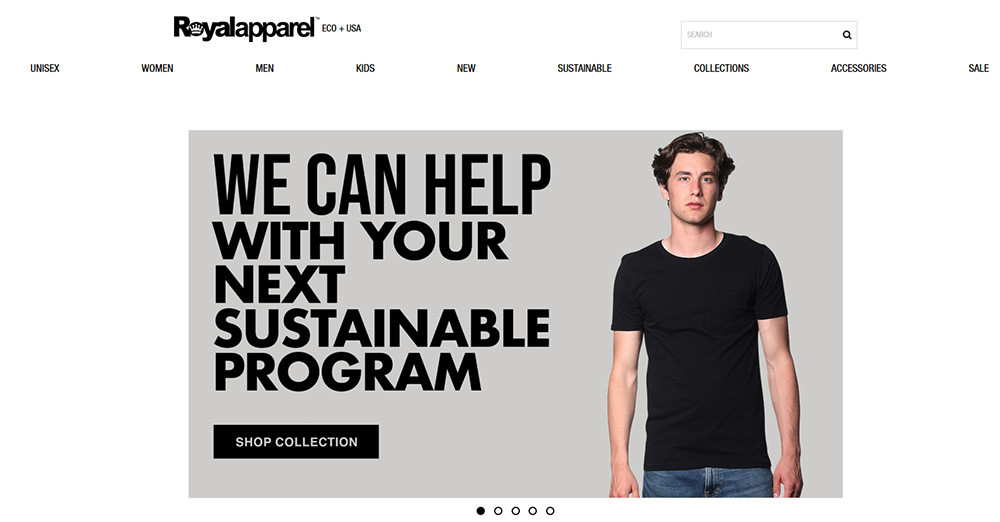
Royal Apparel's sustainable manufacturing in New York
Royal Apparel is best for brands building Made-in-USA programs on premium knit foundations, where fabric certification, domestic compliance expectations, and faster replenishment matter. With their main factory in Hauppauge, New York, and additional East Coast facilities, they stand as a key supplier for brands that strategically prioritize the "Made in USA" label.
They focus on premium knitwear and offer one of the industry's most extensive collections of eco-friendly and organic clothing options. Their use of materials like GOTS-certified organic cotton, bamboo, and recycled fabrics (RPET) appeals to environmentally conscious brands. As a union shop, Royal Apparel emphasizes fair labor practices. Their deep inventory of stock colors and fabrics allows for faster turnaround times on certain projects.
10. Yotex Apparel – Functional & Technical Apparel Expert
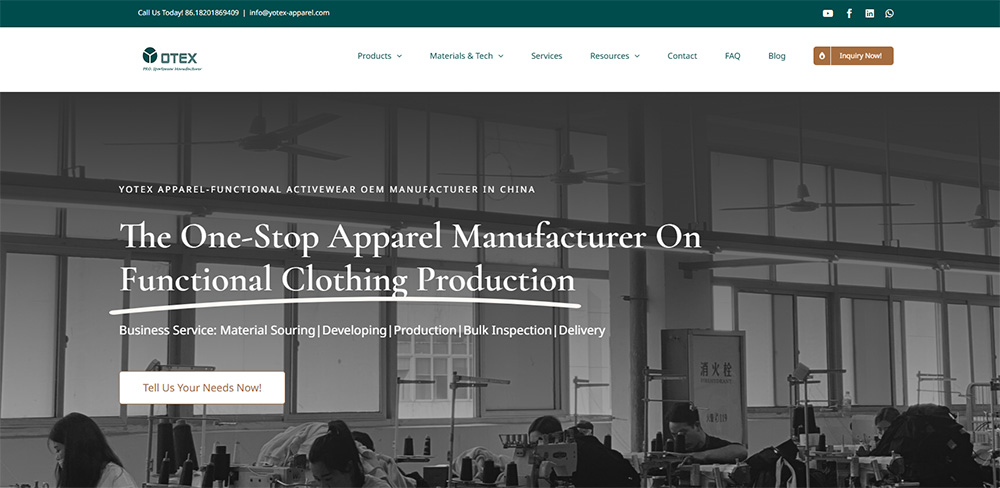
Yotex Apparel's factory direct production in China
Yotex Apparel is a specialized clothing manufacturer based in China with a focus on functional and technical apparel. While their core expertise lies in activewear and sportswear, they have extended their capabilities to the streetwear market, bringing a performance-oriented approach to contemporary urban fashion. They operate as a one-stop solution offering services from advanced fabric development and strategic sourcing to end-to-end manufacturing.
By collaborating with a network of global mills and R&D partners, Yotex develops and sources functional fabrics that provide clients with a competitive edge. This is particularly relevant in the techwear sub-genre, where performance attributes such as water resistance, breathability, moisture-wicking, and durability are key selling points. Their scientific approach to garment construction, focusing on ergonomics and material innovation, offers a different path to creating premium products.
Real Production Risks Established Streetwear Brands Must Control Before Scale
How to Choose the Right Streetwear Clothing Manufacturer: A Strategic Framework
Selecting a manufacturing partner is a defining moment for any streetwear brand. The decision extends far beyond production costs; it shapes your brand's quality perception, its ability to innovate, and its capacity to scale. A misaligned partnership can lead to production delays, inconsistent quality, and ultimately, a disconnect with your audience. Conversely, the right partner acts as a strategic asset, enabling you to translate your creative vision into high-quality, culturally resonant products. This framework outlines the critical factors to consider when vetting and selecting a streetwear manufacturing partner.
1. Assessing Technical Capabilities and Specialization
The first and most crucial step is to evaluate a manufacturer's technical expertise, particularly in the specific niches of streetwear that are relevant to your brand. Not all apparel factories are equipped to handle the unique demands of this category. The difference between a generic garment factory and a specialized streetwear manufacturer lies in their mastery of specific techniques and materials.
What to Look For
2. Evaluating Production Infrastructure and Scalability
Your brand's growth trajectory is directly tied to your manufacturer's ability to scale. A partner that is perfect for your initial 100-piece drop may become a bottleneck when you need to produce 10,000 units for a global release. Therefore, it's essential to assess their production infrastructure from the outset.
Key Considerations
3. Understanding MOQs, Pricing, and Production Timelines
Minimum Order Quantities (MOQs), pricing, and lead times are the three pillars of production logistics. Finding a partner whose terms align with your business model is crucial for maintaining healthy cash flow and speed to market.
What to Analyze
4. Geographic Location and Supply Chain Logistics
The geographic location of your manufacturing partner has far-reaching implications for your business, affecting shipping costs, lead times, and the ease of communication and collaboration.
Comparing Manufacturing Hubs
5. Assessing Ethical Standards and Sustainability
In today's market, consumers are increasingly concerned with the ethical and environmental impact of their purchases. Partnering with a manufacturer that shares your brand's values is not just good ethics; it's good business. A transparent and responsible supply chain can be a powerful part of your brand's story.
How to Verify
Conclusion: Forging a Strategic Manufacturing Partnership
The landscape of streetwear in 2026 is more competitive and sophisticated than ever before. For brands aiming not just to participate but to lead, the selection of a manufacturing partner has transcended a simple sourcing decision to become a cornerstone of brand strategy. The top manufacturers are no longer just factories; they are integrated production ecosystems with deep, specialized knowledge of the materials, techniques, and cultural context that define premium streetwear.
As this guide has illustrated, the ideal partner depends on a brand's specific priorities—be it the unmatched scalability and technical depth of a Chinese powerhouse like Groovecolor, the sustainable craftsmanship of a Portuguese specialist like ASBX, or the speed and domestic appeal of a US-based factory like Royal Apparel. The critical takeaway is that a successful partnership is built on alignment: alignment of technical capabilities with creative vision, alignment of production capacity with growth ambitions, and alignment of ethical standards with brand values.
Ultimately, the process of choosing a manufacturer is an exercise in foresight. It requires brands to look beyond their immediate needs and envision where they want to be in two, five, or ten years. By investing the time to rigorously vet and select a partner who can grow with them, brands can build a resilient, high-quality supply chain that not only brings their current collections to life but also provides the foundation for their future success in the dynamic world of streetwear.
Frequently Asked Questions about Streetwear Clothing Manufacturers
Who is this streetwear manufacturer guide best suited for?
This guide is written for established streetwear brands, menswear-focused fashion labels, premium e-commerce apparel teams, and procurement teams with proven sales channels, stable product calendars, and real purchasing capability. It is not designed for personal orders, blank apparel resale, stock garment distribution, or projects without a clear custom product direction.
What is the typical MOQ for established streetwear manufacturing programs?
For established streetwear brands, MOQ depends on product complexity, fabric sourcing, wash process, embellishment level, and bulk production planning. Some premium manufacturers may support 50–100 pcs/color as a controlled validation stage for market-proven concepts before larger volume commitments. This should not be confused with stock purchasing, personal customization, or beginner-focused low-minimum ordering. The real question is whether the manufacturer can protect fit, fabric quality, wash control, and finishing standards when the program scales.
How do I ensure the quality of my streetwear production?
To ensure consistent quality in streetwear production, you need a multi-faceted approach: thoroughly vet your manufacturer, provide detailed tech packs, approve a pre-production sample (counter-sample), and partner with a factory that has a robust Quality Control (QC) system. Ensuring consistent quality is one of the biggest challenges in apparel manufacturing, but following these steps will significantly reduce risk: 1. Thorough Vetting: Choose a manufacturer with a proven track record in streetwear. Ask for references, case studies, or samples of their previous work with similar brands. 2. Detailed Tech Packs: Provide a comprehensive technical package (tech pack) for each design. The more detailed your tech pack—including measurements, materials, colors, and construction notes—the less room there is for error. 3. Counter-Sampling: Always approve a pre-production sample before authorizing bulk production. This sample is your golden standard and the benchmark against which all bulk items will be measured. 4. Robust QC Process: Partner with a manufacturer that has a strong, documented Quality Control (QC) system. Look for factories that implement an 8-step QC process, covering everything from raw material inspection to final packaging.
Which country is best for manufacturing streetwear?
The best country for manufacturing streetwear depends on your brand's priorities, but the top four choices are China, Portugal, USA, and Pakistan—each offering distinct advantages in quality, cost, speed, and sustainability. Here is a breakdown of what each region offers: China: Remains the top choice for scalable, complex, and cost-effective production. Ideal for specialized techniques like intricate washes, heavy embroidery, and heavyweight fabric construction. Regions like Dongguan are known for their deep expertise in streetwear manufacturing. Portugal: A hub for premium, high-quality streetwear, particularly in jersey and fleece. Excellent for brands prioritizing sustainability, ethical production, and the "Made in Europe" appeal. USA: Offers speed-to-market, easier communication, and the coveted "Made in USA" branding. Ideal for brands needing quick turnarounds and close collaboration, though production costs are significantly higher. Pakistan: A major hub for textiles, particularly denim and cotton goods. A strong contender for large-volume production at competitive prices, with growing capabilities in streetwear.
Partner with a premium streetwear manufacturer built for established streetwear brands, validated product concepts, complex techniques, and scalable custom production.
GET A QUOTEReferences
[1] Fortune Business Insights. (2025, December 22). Streetwear Market Size, Share & Trends, Analysis, 2032. Retrieved from https://www.fortunebusinessinsights.com/streetwear-market-110565
[2] Sedex. SMETA Audit. Retrieved from https://www.sedex.com/solutions/smeta-audit/
[3] Global Organic Textile Standard. GOTS Certification. Retrieved from https://global-standard.org/
[4] Premium Streetwear Clothing Manufacturer in China (High-Volume Production Ready). Retrieved from https://www.groovecolor.com/
[5] Appareify. Custom Streetwear Clothing Manufacturer. Retrieved from https://appareify.com/streetwear-manufacturer
[6] Mega Apparel. Leading Custom Clothing Manufacturers in USA. Retrieved from https://megaapparel.com/
[7] Seam Apparel. Custom Clothing Manufacturers USA. Retrieved from https://seamapparel.com/
[8] Hongyu Apparel. Custom Clothing Manufacturer In China. Retrieved from https://www.hongyuapparel.com/