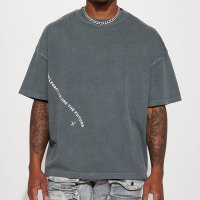
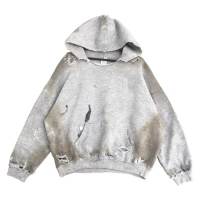
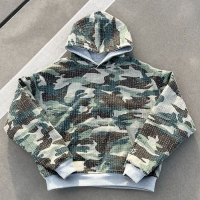
How to Find a Washed Hoodie Manufacturer That Can Control Shrinkage and Color Drift?
Washed hoodies are the single most shrinkage- and color-sensitive product category in streetwear production. Every garment dye cycle, pigment wash load, and vintage fading run re-engineers the fabric's dimensional stability and surface color in ways that standard cut-and-sew hoodies never experience. For established streetwear brands scaling a washed hoodie collection from 50-piece pilots to 500+ piece bulk runs, the manufacturer's ability to hold shrinkage within tolerance and suppress color drift between wash batches becomes the defining production risk.
This guide breaks down how a washed hoodie manufacturer should be evaluated on the variables that actually move bulk quality: shrinkage tolerance, color drift between wash lots, wash recipe stability, torque and skewing behavior, rib cuff recovery, and GSM stability after wash. Each section follows a conclusion-first structure, then analysis, then an actionable recommendation you can insert directly into a sourcing checklist or tech pack review.
Key Takeaways for Streetwear Brands Managing Washed Hoodie Production Risks
- Shrinkage tolerance is non-negotiable. Demand dimensional shrinkage held within 3-5% on length and width after the specified wash cycle, measured on washed panels before cutting.
- Color drift is controlled upstream. Batch-to-batch shade variation should be measured in Delta E (ΔE) units, with a target below 1.5 between wash lots and below 2.0 against the approved standard.
- Wash recipe stability drives repeatable vintage effects. A manufacturer that cannot reproduce a wash recipe across three consecutive lots is not a production partner for scaled washed hoodie programs.
- Torque, skew, and rib recovery are the hidden quality metrics. Heavyweight hoodies between 380-600 gsm are the most prone to torque distortion and rib cuff recovery failure after wash.
- Scale testing happens between 50 and 500 pieces. The wash behavior of a 50-piece pilot does not predict the wash behavior of a 500-piece bulk run without lot-controlled recipe documentation.
Why Do Shrinkage and Color Drift Matter More in Washed Hoodies Than in Standard Production?
Standard cut-and-sew hoodies are produced from pre-shrunk, piece-dyed fabric where dimensional stability and color are locked in before the garment is ever assembled. Washed hoodies invert this sequence. The fabric or finished garment is subjected to a secondary wash process—garment dye, pigment wash, acid wash, enzyme wash, or vintage fading—that introduces controlled shrinkage and deliberate color change as core design features. This means the manufacturer is managing two simultaneous instability vectors that standard production never touches.
Shrinkage in washed hoodies is not a defect to be eliminated but a variable to be controlled. A vintage wash hoodie designed to drop 4-6% in length after wash must hit that range consistently across every piece in the bulk run. If one wash lot shrinks 3% and the next shrinks 8%, the brand receives a size run where mediums fit like smalls in one batch and like larges in another. This is how washed hoodie programs lose repeat customers: not because the wash effect is wrong, but because the fit is inconsistent between orders.
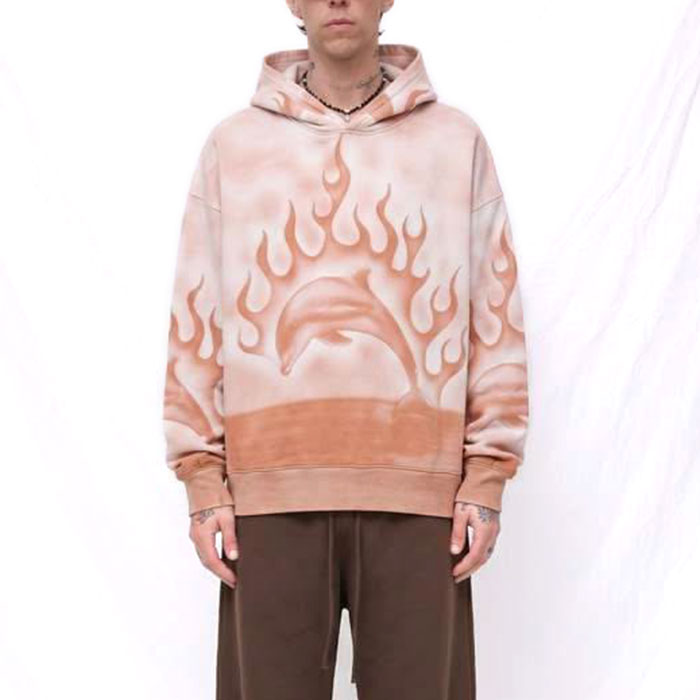
Color drift operates on the same logic. A pigment-washed hoodie in faded charcoal is supposed to land within a defined shade band. When the wash recipe drifts between batches—due to water chemistry variation, dye lot changes, wash temperature inconsistency, or load-size fluctuations—the same product code ships in two visibly different shades. On a retail rail or in an e-commerce reorder, this reads as a quality failure even when the wash technique itself is correct. The deeper context on how wash processes reshape fabric behavior is covered in this deep dive into custom acid wash and washed apparel processes, which explains why wash is a structural manufacturing step rather than a cosmetic finish.
Recommendation: Treat shrinkage and color drift as the two primary acceptance criteria in any washed hoodie manufacturer evaluation. Ask for documented shrinkage data from at least three previous wash lots and request physical wash swatches from two separate batches to visually confirm drift control before committing to a bulk order.
What Shrinkage Tolerance Should You Demand from a Washed Hoodie Manufacturer?
A production-capable washed hoodie manufacturer should hold dimensional shrinkage within 3-5% on both length and width after the specified wash cycle. This tolerance assumes the fabric has been pre-shrunk or relaxation-shrunk before cutting, and that the wash process is a controlled garment wash rather than an uncontrolled home-style laundering. For heavyweight fleece fabrics in the 380-600 gsm range, the tighter end of that band (3-4%) is more realistic because denser fabric structures resist dimensional change better than lighter knits.
The tolerance must be measured, not assumed. A credible manufacturer tests shrinkage on washed fabric panels before cutting, using standardized wash-and-dry protocols that simulate the bulk wash process. The test panels are marked with benchmark dimensions before washing, then re-measured after washing and drying to calculate percentage shrinkage in length and width. If a manufacturer cannot produce this test data or relies on visual estimation, they are not operating at the quality tier required for scaled washed hoodie production.
Info Box — Shrinkage Tolerance Benchmarks by Hoodie Weight
• 260-320 gsm (lightweight fleece): 4-6% length, 4-5% width after wash
• 340-400 gsm (midweight fleece): 3-5% length, 3-4% width after wash
• 420-500 gsm (heavyweight fleece): 3-4% length, 2-4% width after wash
• 500-600 gsm (premium heavyweight): 2-4% length, 2-3% width after wash
Benchmarks assume pre-shrunk fabric, controlled garment wash, and tumble dry or flat dry per spec.
Shrinkage tolerance also depends on how the fabric was knit and finished before it reaches the wash stage. Compact-spun yarns and tightly knitted fleeces shrink less than open-end yarns or loose knits. Fabric that has been stenter-frame finished at the mill will behave differently in wash than fabric that has been tubular finished. A manufacturer who understands these variables and selects fabric accordingly is operating at a fundamentally higher level than one who simply buys generic fleece and hopes the wash works out. Understanding how fabric weight interacts with wash behavior is essential, and this GSM guide for hoodie manufacturers breaks down how 260-600 gsm ranges perform differently under wash stress.
Recommendation: Specify a maximum shrinkage tolerance of 5% in length and 4% in width in your tech pack, and require the manufacturer to submit pre-cut wash test data for the exact fabric lot being used. Reject any lot that exceeds tolerance before cutting begins, not after the bulk is sewn.
How Does Color Drift Between Wash Batches Destroy Brand Consistency?
Color drift is the gradual shift in shade that occurs when the same wash recipe produces visibly different results across separate wash batches. In washed hoodie production, this happens because garment wash and garment dye processes are sensitive to variables that are difficult to hold perfectly constant: water hardness and pH, dye concentration, wash temperature, mechanical action, load ratio, and cycle duration. When any of these variables shift between batches, the color shifts with them.
The damage color drift causes is cumulative and invisible until it reaches the customer. A streetwear brand that ships batch one in October and batch two in December expects the same product. If the pigment-washed charcoal in batch one reads as a cool grey and batch two reads as a warm brown-grey, the brand faces return requests, negative reviews, and broken trust with retailers who stocked based on the first batch's appearance. For e-commerce brands with reorder-driven business models, color drift between restocks is one of the most common reasons customers cite for switching to a competitor.
Color drift is measured using spectrophotometer readings expressed in Delta E (ΔE), a single number that represents the perceptual difference between two colors. In textile production, a ΔE below 1.0 is generally imperceptible to the human eye, 1.0-2.0 is visible only under controlled lighting to a trained observer, and above 2.0 is visible to most observers under normal retail conditions. A washed hoodie manufacturer aiming at premium streetwear should target ΔE below 1.5 between wash lots and below 2.0 against the approved standard swatch. If the manufacturer does not own or use a spectrophotometer, they cannot measure drift, which means they cannot control it.
Recommendation: Require the manufacturer to submit Delta E readings for every wash batch against an approved master swatch. Build a clause into the purchase order specifying that any batch exceeding ΔE 2.0 against the master is subject to rejection or rework. This converts color drift from a subjective argument into a measurable, contractual quality standard. For brands that want to understand how quality control frameworks are structured across premium streetwear supply chains, see the full breakdown of why quality control defines premium streetwear manufacturing and apply the same checkpoint logic to wash-lot management.
What Wash Recipe Stability Means for Repeatable Vintage Hoodie Effects?
Wash recipe stability is the manufacturer's ability to document, reproduce, and hold a wash formula across multiple production runs. A wash recipe is not just a list of chemicals and temperatures—it includes the exact liquor ratio (water to fabric weight), enzyme or pumice stone dosage, wash cycle time, rinse protocol, drying method, and any pre-treatment or post-treatment steps. A stable recipe produces the same vintage fade, the same surface hand-feel, and the same color cast every time it is run.
This is where most washed hoodie manufacturers fail. A factory may produce a beautiful sample using a wash recipe that was never properly documented, relying on the experience of a single wash technician who adjusts by feel. When that technician is absent, when the wash load increases from 50 to 500 pieces, or when a different wash machine is used, the recipe drifts and the effect changes. The brand receives a bulk run that looks nothing like the approved sample, and there is no documented recipe to trace where the deviation occurred.
A production-ready manufacturer maintains written wash recipe cards for every wash style in the program. Each card specifies the full process parameters, the machine type and load capacity used, the chemical brand and lot, and the approved reference swatch. When a brand places a reorder, the manufacturer pulls the recipe card, runs a confirmation wash on a small test load, and verifies the result against the master swatch before committing the full bulk. This is the only way to deliver repeatable vintage wash effects across a multi-season hoodie program.
Recommendation: Ask the manufacturer to show you a wash recipe card from a previous production run. If they cannot produce one, or if the card is incomplete, treat this as a red flag for any program requiring more than a single production lot. For brands exploring custom washed hoodie OEM production at scale, recipe documentation is the single most important capability to verify before placing a bulk order.
How Does Fabric GSM (260-600) Affect Shrinkage and Color Performance After Washing?
Fabric GSM (grams per square meter) is one of the strongest predictors of how a hoodie will behave in wash. Lighter fleece fabrics in the 260-320 gsm range are more vulnerable to shrinkage and distortion because their looser knit structure has more room to contract. Heavier fabrics in the 420-600 gsm range resist shrinkage better but introduce their own wash challenges: longer drying times, uneven pigment penetration in garment dye, and greater risk of torque distortion due to the weight of wet fabric pulling against the knit structure during the wash cycle.
Color performance also shifts with GSM. In garment dye processes, lighter fabrics absorb dye more quickly and evenly, producing cleaner, more uniform shades. Heavier fabrics take longer to reach full dye penetration, which can produce a slightly mottled or vintage appearance—sometimes desirable, sometimes a defect depending on the design intent. In pigment wash and enzyme wash, heavier fabrics hold pigment on the surface longer, producing stronger high-low contrast effects but also requiring more precise rinse control to avoid blotchy results.
GSM stability after wash is a separate but related metric. A 400 gsm fabric that drops to 360 gsm after wash has structurally changed—the knit has tightened, the hand-feel has shifted, and the drape is different. This matters because brands often specify GSM based on the finished garment's perceived quality, not the pre-wash fabric weight. A manufacturer should be able to tell you both the pre-wash and post-wash GSM of the fabric they are using, and the tolerance they hold between the two. If they cannot, the finished hoodie may not match the weight specification the brand is paying for.
Info Box — GSM Stability After Wash: What to Ask
• What is the pre-wash GSM of the fabric being used?
• What is the expected post-wash GSM, and what is the tolerance?
• Has the fabric been tested for GSM shift across multiple wash cycles?
• Does the wash recipe account for the fabric's GSM when setting liquor ratio and cycle time?
• Is the GSM measurement taken on conditioned fabric at standard atmospheric conditions?
Recommendation: Specify both pre-wash and post-wash GSM in your tech pack, and require the manufacturer to confirm post-wash GSM on the actual bulk fabric before cutting. For brands working across the full heavyweight hoodie range, understanding how specialty fabrics and treatments interact with wash performance adds another layer of control when the program moves beyond standard cotton fleece.
Why Is Rib Cuff Recovery the Overlooked Quality Metric in Washed Hoodie Production?
Rib cuff recovery is the ability of the knitted rib at the cuff and hem to return to its original dimensions after being stretched and after being washed. In standard hoodies, rib recovery is already a quality factor. In washed hoodies, it becomes critical because the wash process subjects the rib to heat, moisture, and mechanical agitation that can permanently relax the elastic structure. A washed hoodie with poor rib recovery ships with cuffs that sag, droop, and fail to grip the wrist—a visible quality failure that customers notice immediately.
Rib recovery is determined by three factors: the rib construction (1x1, 2x2, or custom), the yarn composition (cotton, cotton-spandex, cotton-polyester blends), and the wash process the rib is subjected to. A 2x2 cotton rib with 3-5% spandex will generally recover better after wash than a 100% cotton 1x1 rib. However, spandex-containing ribs introduce their own wash risk: high wash temperatures can degrade the spandex, causing the rib to lose elasticity over multiple wash cycles rather than recovering it.
The manufacturer's role is to match the rib specification to the wash process. If the wash cycle runs at 60°C, the rib's spandex content must be rated for that temperature. If the wash uses chlorine-based agents, the rib must be chlorine-resistant. If the vintage fade effect requires aggressive enzyme wash, the rib construction must be robust enough to survive without losing its structural integrity. A manufacturer who treats rib as an afterthought—ordering generic rib from a trim supplier without testing it against the wash recipe—will produce washed hoodies with inconsistent cuff performance across the bulk run.
Recommendation: Include rib cuff recovery testing in your wash approval process. Request that the manufacturer wash a rib swatch alongside the body fabric swatch and measure the rib's dimensional recovery after stretching. Specify a minimum recovery percentage (typically 90% or higher of original dimensions after stretch and wash) in your tech pack. Premium hoodie construction details like rib specification matter more in washed programs, and this premium hoodie manufacturing checklist outlines the construction details that separate production-ready hoodies from average ones.
What Torque and Skewing Issues Appear When Heavyweight Hoodies Go Through Wash?
Torque is the rotational distortion that causes a hoodie's body to twist so that the side seams migrate toward the front or back. Skewing is the angular distortion that causes the hem to drop unevenly. Both problems are amplified in heavyweight hoodies because the dense fabric structure holds more water during wash, creating greater gravitational and mechanical pull on the knit loops. A 500 gsm fleece hoodie that comes out of the wash with 3 degrees of torque has a visible twist that makes the garment look misconstructed even when the cutting and sewing were perfect.
Torque originates in the knitting process—specifically in the spiral angle of the yarn as it loops—and is released during wash when the fabric relaxes. A fabric knit with high torque tendency will always distort in wash unless it has been skew-compensated at the finishing stage. This means the manufacturer must either source fabric that has been tested for torque and skew-compensated at the mill, or they must cut the fabric on a skewed angle to counteract the expected distortion. Both approaches require technical knowledge that average cut-and-sew factories do not possess.
The wash process itself can either minimize or amplify torque. A wash load that is too large for the machine causes the fabric to compress and twist unevenly. A wash cycle with high mechanical action (heavy pumice stones, aggressive tumbling) forces the fabric to distort under load. Drying method matters too: tumble drying at high heat sets torque distortion into the fabric, while flat drying or controlled tumble drying at lower heat preserves dimensional stability. A manufacturer who understands these interactions will adjust the wash load size, cycle parameters, and drying method to match the fabric's torque behavior.
Recommendation: Add a torque and skew specification to your tech pack: maximum 2% skewness and maximum 3 degrees of torque after wash, measured on the finished garment. Request that the manufacturer submit washed and dried samples for torque measurement before bulk cutting. AATCC TM179 (skewness change after home laundering) and AATCC TM207 (seam twist) are the recognized reference methods for these measurements—ask whether the manufacturer tests to these standards.
How Do You Evaluate Wash Control Across Multiple Production Lots?
Evaluating wash control across multiple production lots requires the manufacturer to maintain lot-level documentation that links each batch to its wash recipe, fabric lot, dye lot, and quality test results. This documentation is the evidence trail that proves the manufacturer is running a controlled process rather than a series of independent wash events. Without it, there is no way to trace why lot three drifted in color or why lot five showed higher shrinkage than lots one and two.
The evaluation method is straightforward but requires discipline. For each production lot, request: (1) the wash recipe card used, (2) the fabric lot number and pre-wash test data, (3) the post-wash shrinkage measurement, (4) the post-wash color measurement (Delta E against master), (5) the post-wash GSM, and (6) the final inspection report including any torque or skew findings. When you have this data for three or more consecutive lots, you can see whether the process is stable (all lots within tolerance) or drifting (lots trending toward or beyond tolerance limits).
This data also reveals the manufacturer's process capability. If the shrinkage measurements across five lots read 3.2%, 3.8%, 3.5%, 4.1%, and 3.6%, the process is well-controlled within a narrow band. If they read 2.5%, 5.8%, 3.1%, 6.2%, and 4.0%, the process is unstable and the manufacturer is running wash by guesswork rather than by recipe. The first manufacturer is a viable production partner for a scaled washed hoodie program. The second is a risk that will eventually produce a lot that fails customer acceptance.
Info Box — Multi-Lot Wash Control Evaluation Checklist
• Request wash recipe cards for the last 3 production lots of a similar wash style
• Compare post-wash shrinkage measurements across lots for consistency
• Compare Delta E readings across lots to identify color drift trends
• Check whether fabric lot changes correlate with quality deviations
• Verify that the manufacturer runs a confirmation wash swatch before each bulk lot
• Ask how the manufacturer handles a lot that fails tolerance (rework vs. ship)
Recommendation: Before placing a bulk order exceeding 200 pieces, request lot-level wash documentation from at least three previous production runs. If the manufacturer cannot provide this data, cap your initial order at a pilot quantity and use the pilot lot to establish the documentation baseline for future orders.
What QC Checkpoints Should You Insert Between Wash and Final Inspection?
Standard garment QC places inspection at final—after the garment is fully assembled, pressed, and packed. In washed hoodie production, this is too late. By the time the garment reaches final inspection, the wash has already set the shrinkage, color, torque, and rib recovery into the finished product. If any of these are out of tolerance, the only remedy is rework or rejection of finished goods, which is the most expensive stage to fix problems. Washed hoodie production requires QC checkpoints inserted upstream of final inspection.
The first critical checkpoint is pre-wash fabric inspection. Before the fabric enters the wash process, it should be inspected for knitting defects, torque tendency, GSM consistency, and shade uniformity. A fabric lot with inherent torque cannot be fixed in wash—it must be rejected or skew-compensated before cutting. The second checkpoint is post-wash fabric inspection, where shrinkage, color, GSM, and hand-feel are measured against the approved standard. If the washed fabric is out of tolerance, cutting should not proceed.
The third checkpoint is post-wash garment inspection, which occurs after the washed garments are dried but before final pressing and packing. At this stage, each garment is checked for torque, skew, rib recovery, color uniformity within the batch, and decoration integrity (print aging, embroidery stability). The fourth checkpoint is the standard final inspection, which confirms that pressing and packing have not introduced new defects. This four-stage QC structure catches wash-related defects at the earliest possible stage, when they are cheapest to fix.
Recommendation: Specify a four-stage QC structure in your purchase order: pre-wash fabric inspection, post-wash fabric inspection, post-wash garment inspection, and final inspection. Require inspection reports at each stage and build a clause that allows rejection at any stage if tolerance is exceeded. Groovecolor's production system structures wash programs around exactly this type of staged QC, and the same logic applies to any manufacturer evaluation—ask how many QC stages sit between wash and final, and what each stage measures.
How Should You Compare Washed Hoodie Sample Quality Across Competing Factories?
Comparing washed hoodie samples across competing factories requires a structured evaluation that goes beyond visual preference. The standard approach—ordering samples from three factories and picking the one that looks best—is insufficient because it evaluates only the sample moment, not the production capability. A factory can produce a beautiful one-off sample using a process that cannot be repeated at bulk. The comparison must evaluate both the sample quality and the production system behind it.
Start by requesting identical samples from each factory: same fabric specification, same wash style, same color target, same decoration (if applicable). When the samples arrive, measure them rather than just looking at them. Measure the post-wash GSM, the shrinkage from the specified cut dimensions, the color in Delta E against your master swatch, the torque angle, and the rib cuff recovery. These measurements convert subjective visual comparison into objective data that reveals which factory is actually controlling the wash process.
Then request a second sample from each factory produced from a different fabric lot or at a different time, using the same wash recipe. This is the repeatability test. If factory A's two samples match closely in color, shrinkage, and hand-feel, and factory B's two samples diverge noticeably, factory A has better wash recipe stability even if factory B's first sample looked slightly better. Production capability is about consistency, not peak performance on a single sample.
Recommendation: Build a sample evaluation scorecard with five weighted criteria: color accuracy (25%), shrinkage control (25%), wash recipe stability/repeatability (20%), rib recovery and torque (15%), and hand-feel and surface effect (15%). Score each factory on each criterion using measured data where possible. The factory with the highest total score is not necessarily the one with the prettiest sample—it is the one most likely to deliver consistent bulk production.
What Does a Production-Ready Washed Hoodie Partnership with Controlled Shrinkage Look Like?
A production-ready washed hoodie partnership is defined by documentation, measurement, and repeatable process control. The manufacturer maintains wash recipe cards for every wash style in the program, tests fabric before wash for shrinkage tendency and torque, measures post-wash shrinkage and color on every lot, and provides lot-level QC reports as a standard deliverable rather than a special request. The brand receives not just hoodies, but a data package that proves the hoodies meet specification.
In this partnership, reorders are predictable. When the brand places a reorder six months later, the manufacturer pulls the recipe card, sources fabric that matches the original lot specification, runs a confirmation wash, and verifies the result against the master swatch before proceeding. The brand receives a reorder that matches the original production run in fit, color, and wash effect—because the process was designed for repeatability from the start, not improvised each time.
The partnership also includes proactive communication about risk. When a fabric lot change is unavoidable, the manufacturer flags it before production and proposes a wash recipe adjustment. When a wash lot shows slight drift, the manufacturer reports it with data and proposes a correction rather than shipping and hoping the brand does not notice. This transparency is what separates a production partner from a transactional supplier—and it is only possible when the manufacturer has the measurement systems and documentation discipline to detect and communicate deviations in real time.
Recommendation: Use the first production lot as a partnership qualification run. Specify the documentation and measurement requirements upfront, evaluate whether the manufacturer delivers them without prompting, and assess the communication quality when minor deviations occur. A manufacturer that delivers documentation proactively and communicates deviations transparently on lot one is a viable long-term partner for a scaled washed hoodie program. Groovecolor's production system is built around this documentation-first approach, and the same standard should be applied to any manufacturer under evaluation.
Frequently Asked Questions
What is an acceptable shrinkage tolerance for washed hoodies?
For washed hoodies in the 260-600 gsm range, an acceptable shrinkage tolerance is typically 3-5% on length and 3-4% on width after the specified wash cycle, assuming pre-shrunk fabric and a controlled garment wash process. Heavyweight fabrics (420-600 gsm) should target the tighter end of this range. Always require pre-cut wash test data from the manufacturer to verify tolerance is met before bulk cutting.
How is color drift measured between wash batches?
Color drift is measured using a spectrophotometer, which produces a Delta E (ΔE) value representing the perceptual color difference between two samples. For washed hoodie production, a ΔE below 1.5 between wash lots and below 2.0 against the approved master swatch is the target for premium streetwear quality. If the manufacturer does not use a spectrophotometer, they cannot objectively measure or control color drift.
Why do heavyweight hoodies torque more in wash than lightweight ones?
Heavyweight fleece fabrics (420-600 gsm) absorb more water during wash, creating greater gravitational and mechanical pull on the knit loops. This amplified force releases the torque tendency inherent in the yarn's spiral knitting angle, causing the fabric to twist. Torque must be controlled through skew-compensated fabric sourcing, controlled wash load sizes, and lower-heat drying methods.
What rib cuff recovery percentage should I specify for washed hoodies?
Specify a minimum rib cuff recovery of 90% of original dimensions after stretching and washing. For washed hoodies, the rib should be tested by washing a rib swatch alongside the body fabric and measuring its recovery. Ribs containing 3-5% spandex generally recover better after wash, but the spandex must be rated for the wash temperature used in the process.
How many QC stages should sit between wash and final inspection on washed hoodies?
A production-ready washed hoodie program should have four QC stages: pre-wash fabric inspection, post-wash fabric inspection, post-wash garment inspection, and final inspection. This structure catches wash-related defects at the earliest stage, when they are cheapest to correct, rather than discovering them at final inspection when the garments are fully assembled and pressed.
Ready to Source Washed Hoodies with Controlled Shrinkage and Color Drift?
If your streetwear brand is scaling a washed hoodie collection and needs a manufacturer that holds shrinkage within tolerance, controls color drift between wash lots, and documents every recipe for repeatable vintage effects, the evaluation criteria in this guide are your starting point. Do not commit to bulk production without verified wash test data, recipe documentation, and multi-lot quality evidence.
Request wash swatches, ask for Delta E readings, inspect rib recovery, and test torque on heavyweight samples before you place the order. The right manufacturing partner will welcome these questions—because they have the systems and data to answer them.
Start Your Washed Hoodie Production ConsultationAbout the Author
GROOVECOLOR is one of China's leading premium OEM streetwear manufacturers for men's custom streetwear, with 16+ years of experience supporting heavyweight hoodies, oversized fits, and complex decoration programs. For washed hoodie manufacturer topics focused on shrinkage and color drift, our manufacturing lens focuses on wash recipe stability, shrinkage control, torque behavior, rib recovery, and bulk shade consistency across 260-600 gsm hoodie ranges.
The scoring method prioritizes bulk-ready risks: GSM stability after wash, shrinkage and torque measurement, color drift between wash batches, rib cuff recovery, and final inspection consistency. When evidence is needed, we refer to recognized textile performance concepts, wash durability testing, and practical QC checkpoints used across washed apparel supply chains.