How Do You Source Premium Baseball Varsity Jackets for Men That Match Your Streetwear Brand's Quality Standards in 2026?
How Do You Source Premium Baseball Varsity Jackets for Men That Match Your Streetwear Brand's Quality Standards in 2026?
In the rapidly evolving streetwear landscape, where authenticity and quality are paramount, the baseball varsity jacket has re-emerged as a cornerstone garment for established brands. This guide provides a comprehensive framework for sourcing and manufacturing premium baseball varsity jackets for men, ensuring they meet the exacting standards of your brand and the expectations of your discerning clientele. We will delve into the critical details of construction, material selection, and manufacturing partnerships that separate a truly premium varsity jacket from the mass-market alternatives. For brands looking to scale their outerwear program, understanding these nuances is not just an advantage—it's a necessity.
Key Takeaways for Streetwear Brands
- ▸ Focus on structural integrity: a premium varsity jacket's value is determined by its melton wool body, genuine leather sleeves, and robust construction, which are critical for longevity and brand reputation.
- ▸ Vet decoration capabilities rigorously: the quality of chenille patches, embroidery, and appliqué is a key differentiator. Demand samples and clear quality control standards for these elements.
- ▸ Prioritize fit and sizing consistency: work with manufacturers who have a deep understanding of pattern grading for streetwear, including oversized and vintage fits, to ensure consistency across all sizes.
- ▸ Implement a comprehensive quality control framework: from raw material inspection to final AQL checks, a systematic approach to quality is non-negotiable for scalable, high-quality production.
Why Has the Varsity Jacket Become a Strategic Product Category for Established Streetwear Brands?
The varsity jacket has become a strategic asset for established streetwear brands because it combines cultural authenticity, high perceived value, and extensive storytelling potential. It functions as a premium, high-margin product that reinforces brand identity and quality perception in a market projected to exceed $700 billion by 2034.
The global streetwear market is not just growing; it is maturing. With a valuation of USD 371.09 billion in 2025 and a projected trajectory to reach USD 734.05 billion by 2034, the sector is experiencing a compound annual growth rate (CAGR) of 7.95% [1]. This expansion signifies a shift in consumer behavior. Buyers are increasingly looking beyond fleeting trends and logo-centric designs, prioritizing garments with history, substance, and superior craftsmanship. For established streetwear brands, this presents a critical opportunity to deepen their product offerings and solidify their market position. The baseball varsity jackets for men category, in particular, has emerged as a powerful vehicle for achieving this, moving from a niche retro item to a strategic pillar for growth-focused collections.
This garment's power lies in its deep-rooted cultural authenticity. Originating on the baseball fields of Harvard University in the 1860s, the letterman jacket was initially a symbol of athletic prowess [2]. Over the next century, it evolved from a simple wool pullover to the iconic two-tone, leather-and-wool silhouette we recognize today. Its journey saw it adopted by mid-century youth culture, immortalized in film, and eventually embraced by hip-hop artists in the 80s and 90s, who transformed it into a canvas for self-expression and regional pride [3]. This rich heritage provides a narrative depth that few other outerwear pieces can claim. For a streetwear brand, incorporating a well-executed varsity jacket is not merely a design choice; it is an act of cultural curation that resonates with a knowledgeable audience that values authenticity.
From a commercial standpoint, the varsity jacket is a high-value proposition. It serves as a brand's 'hero' product—a premium, higher-priced item that elevates the entire collection's perceived value. The complex construction, involving materials like Melton wool and genuine leather, and detailed embellishments such as chenille patches and embroidery, justifies a higher price point. This allows brands to improve their margins and invest in more intricate designs. Furthermore, the jacket is a powerful storytelling tool. Each patch, colorway, and embroidered detail can communicate a brand's ethos, celebrate a collection's theme, or pay homage to a specific cultural moment. This makes the jacket a collectible item, driving demand and fostering a deeper connection with the brand's community. For brands exploring custom streetwear jacket production, the varsity jacket offers an unparalleled combination of heritage and commercial viability.
What Construction Details Determine Whether a Varsity Jacket Holds Up Across Bulk Production?
The durability and premium feel of a varsity jacket in bulk production are determined by the quality of its core components: a dense Melton wool body, properly treated genuine leather sleeves, high-tension ribbed trim, and securely anchored snap closures. These elements, when correctly specified and assembled, prevent the common quality failures seen in mass-market alternatives.
For a streetwear brand, the decision to invest in a varsity jacket program hinges on the manufacturer's ability to replicate quality at scale. A single perfect sample is meaningless if the bulk order suffers from inconsistencies. The structural integrity of a varsity baseball jackets for men is not a matter of chance; it is the result of deliberate choices in materials and construction techniques. The first and most critical element is the body of the jacket. Traditionally, this is made from Melton wool, a fabric renowned for its density, durability, and felt-like finish. A high-quality Melton wool, typically in the 20-24 oz range, provides the necessary structure and warmth, ensuring the jacket maintains its shape over time. When vetting a supplier jacket, brands must request detailed specifications for the wool, including its weight, composition (ideally at least 80% wool), and the finishing process used to create its characteristic dense weave.
The second pillar of a premium varsity jacket is its sleeves. While some modern interpretations use alternative materials, genuine leather remains the gold standard for authenticity and durability. However, not all leather is created equal. Brands should specify full-grain or top-grain cowhide or lambskin, which offer the best balance of softness, strength, and longevity. The tanning and finishing process is equally important. A well-finished leather sleeve should be supple, resistant to cracking, and consistent in color across the entire production run. During the quality control process, particular attention should be paid to the seams where the leather sleeves are joined to the wool body. This is a high-stress area that requires reinforced stitching to prevent separation.
Finally, the trim and closures, while seemingly minor details, are crucial to the jacket's overall quality and functionality. The ribbed collar, cuffs, and waistband provide the jacket's signature snug fit. This ribbing should be made from a high-tension knit blend of wool and acrylic or polyester to ensure it retains its elasticity after repeated wear and washing. Poor quality ribbing will quickly stretch out, giving the jacket a sloppy, worn-out appearance. The snap button closures must be securely anchored to the fabric, with reinforced backing to prevent them from tearing through the wool. The hardware itself should be of a substantial weight and finish, contributing to the jacket's premium feel. When evaluating a potential manufacturing partner, brands should scrutinize these construction details in the samples provided, as they are a reliable indicator of the factory's commitment to quality. Exploring a manufacturer's range of heavyweight outerwear manufacturing can provide further insight into their capabilities.
How Do You Audit a Varsity Jacket Manufacturer's Chenille and Embroidery Capabilities?
Auditing a manufacturer's decoration capabilities requires a physical review of samples, focusing on the density and uniformity of chenille loops, the precision of embroidery satin stitching, and the cleanliness of appliqué cuts. Brands must also demand detailed technical specifications for thread, backing, and placement to ensure these artistic elements are repeatable and durable at scale.
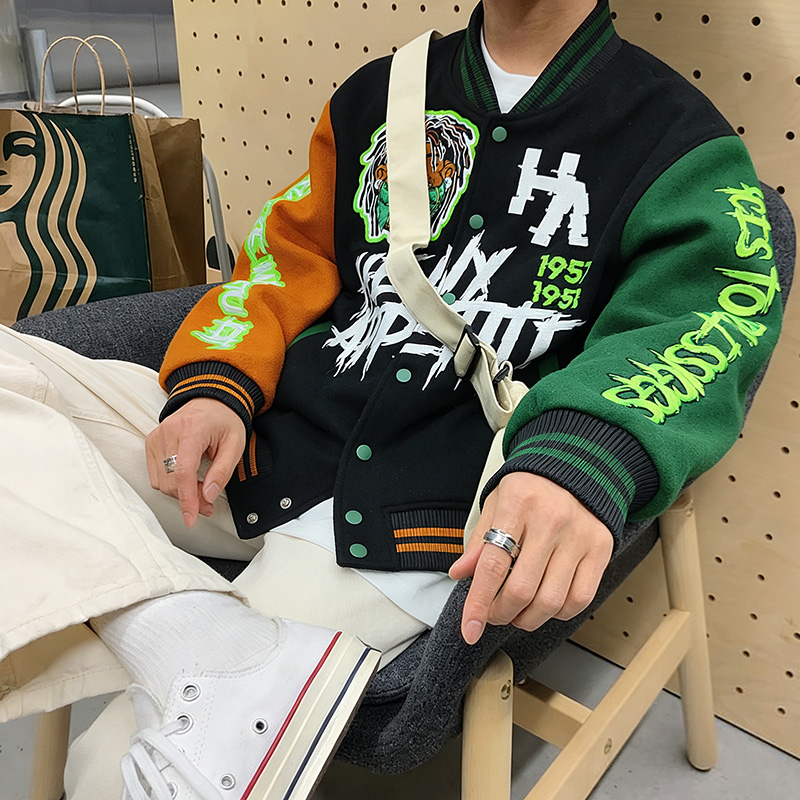
The decorative elements of a varsity jacket—the iconic chenille patches, felt letters, and intricate embroidery—are where a brand's identity is most vividly expressed. They are also where quality failures are most visible. For established streetwear brands, whose customers scrutinize every detail, the execution of these decorations is non-negotiable. A proper audit of a manufacturer's capabilities in this area goes far beyond simply looking at a digital mockup. It begins with a deep dive into the chenille patches themselves. A high-quality chenille patch should have a dense, plush pile with uniform loops, creating a rich, textured appearance. The felt base should be sturdy, and the chain stitch border that finishes the edge should be tight and precise, with no fraying. When examining a sample, feel the patch: it should be substantial, not flimsy. Ask the manufacturer about their process for ensuring color consistency in the yarn across a large batch, a critical factor for maintaining brand standards in bulk production of vintage varsity jackets.
Direct embroidery and appliqué require a different, but equally rigorous, level of scrutiny. For embroidery, assess the stitch density; there should be no visible gaps in the fill stitches, and the satin stitch borders should be smooth and consistent in width. A key indicator of quality is the absence of puckering or pulling in the surrounding fabric, which points to the use of appropriate backing (stabilizer) and correct thread tension—a common failure point when embroidering on heavy wool. For appliqué, where pieces of fabric (like tackle twill) are layered and stitched down, the precision of the laser-cut fabric shapes is paramount. The edges should be clean, and the satin stitch that secures them should completely cover the raw edge to prevent fraying. A manufacturer's portfolio of complex embroidery and appliqué execution can serve as a strong indicator of their expertise.
Ultimately, a manufacturer's control over the entire decoration process is what determines their suitability as a partner. Do they have in-house embroidery and chenille machines, or do they outsource to a third party? In-house capabilities generally allow for better quality control, faster sampling, and more seamless integration with the garment assembly line. Brands should require a pre-production sample (PPS) of the fully decorated jacket for approval before any bulk cutting begins. This PPS serves as the definitive quality standard against which the entire production run will be measured. By conducting a thorough, hands-on audit of these decorative capabilities, a brand can confidently select a partner capable of executing its vision for premium baseball varsity jackets for men with the precision and artistry required.
Which Fit and Sizing Considerations Matter Most When Scaling Varsity Jacket Production?
When scaling varsity jacket production, the most critical considerations are the manufacturer's expertise in pattern grading for non-standard streetwear fits, the establishment of clear sizing tolerances, and the ability to maintain fit consistency across a full-size run. These factors prevent the common issue of distorted proportions in larger or smaller sizes.
Fit is the silent brand ambassador of any apparel line, and for streetwear, it is a language in itself. An **oversized varsity jacket** that drapes perfectly is a statement piece; one that simply looks like a poorly fitting garment from a larger size is a failure. The difference lies in the science of pattern grading. Simply scaling a base pattern up or down by a fixed percentage is a common shortcut that leads to disaster in complex garments like varsity jackets. A skilled pattern maker understands that as sizes change, human proportions do not scale linearly. They must adjust not just the chest and waist, but also the shoulder width, armhole depth, sleeve length, and torso length with nuanced grading rules. This is especially true for contemporary streetwear silhouettes, such as the dropped-shoulder, boxy fit, where maintaining the intended drape and proportion across a size run from XS to XXL requires a deep understanding of garment engineering.
For a brand, the process of ensuring fit consistency begins with a detailed tech pack that specifies not just the measurements for a base size, but also the desired measurements for every size in the run. However, a tech pack is only a blueprint. The true test is the manufacturer's ability to translate it into physical garments. Before committing to bulk production, it is essential to request and approve a full set of size samples. This allows the brand to check the fit on different body types and ensure that the grading has been executed correctly. It is also an opportunity to establish clear quality control tolerances for measurements. A tolerance of +/- 1 cm on critical measurements like chest width and body length is a reasonable industry standard. A manufacturer that resists providing a full-size set or is unwilling to commit to tight tolerances is a significant red flag.
This meticulous approach to fit and sizing is a hallmark of a mature manufacturing partnership. It moves the conversation from simply producing a garment to co-creating a product that consistently represents the brand's vision. It is a collaborative process that requires transparency, expertise, and a shared commitment to quality. When evaluating a potential partner, brands should inquire about their pattern-making process, their experience with streetwear fits, and their quality control procedures for sizing. A manufacturer with a robust system for managing fit and sizing is not just a supplier; they are a strategic asset that enables a brand to scale its vision with confidence. Understanding a factory's premium outerwear production capabilities is fundamental to this evaluation.
What Quality Control Checkpoints Should Brands Require During Varsity Jacket Bulk Production?
Brands must require a multi-stage quality control process that includes raw material inspection, in-line production checks, and a final AQL-based inspection before shipment. This systematic approach is the only way to ensure that every jacket in a bulk order meets the approved pre-production sample standard, protecting brand reputation and customer satisfaction.
In high-stakes streetwear manufacturing, hope is not a strategy. The assumption that a bulk production run will magically match the quality of a perfect sample is a common and costly mistake. A robust quality control (QC) framework is the operational backbone that ensures consistency from the first piece to the last. This process should begin long before the first jacket is sewn. The initial checkpoint is a thorough inspection of all raw materials. This includes verifying the weight, color, and composition of the Melton wool, checking the leather hides for defects, and ensuring that all trims—from the ribbed knit to the snap buttons—match the approved specifications. A reputable supplier jacket manufacturer will have a documented process for incoming material inspection and will be transparent about their findings.
Once production begins, the focus shifts to in-line quality control. This involves placing QC inspectors at critical points on the assembly line to catch errors as they happen, rather than discovering them in a pile of finished garments. Key in-line checkpoints for a varsity baseball jackets for men production include: the cutting station, to ensure pattern pieces are cut accurately; the sewing stations, to monitor seam integrity and stitch quality, especially at the high-stress junctions of leather and wool; and the decoration stations, to check the placement and execution of embroidery and chenille patches. This proactive approach allows for immediate correction, saving time and resources, and preventing the propagation of a single error across hundreds of units.
The final and most comprehensive checkpoint is the pre-shipment inspection. This is typically conducted using an Acceptance Quality Limit (AQL) sampling plan, a statistical method used to determine the quality of a batch without inspecting every single item. The AQL standard (e.g., AQL 2.5) defines the maximum number of defective units that can be considered acceptable in a sample. During this inspection, a random sample of jackets is pulled from the finished batch and meticulously checked against a detailed list of specifications, including measurements, construction, appearance, and functionality. Any batch that fails to meet the AQL standard should be subject to 100% inspection and rework. For brands, insisting on a transparent AQL process and having the right to review the final inspection report is a non-negotiable part of any manufacturing agreement. This level of batch-level quality control is what separates professional manufacturing partners from ordinary factories.
How Do Production Timelines and Lead Times Affect Varsity Jacket Program Planning?
Effective program planning requires a realistic understanding of production timelines, which typically span 8-12 weeks from initial tech pack submission to final delivery. This includes distinct phases for sampling, material sourcing, bulk production, and quality control, all of which must be factored into a brand's seasonal calendar to ensure timely product drops.
In the fast-paced world of streetwear, timing is everything. A successful varsity jacket program is not just about creating a great product; it's about delivering that product to the market at the right moment. This requires a disciplined approach to production planning and a transparent relationship with the manufacturing partner. The total lead time for a custom baseball varsity jackets for men program can be broken down into several distinct phases. The initial phase, which includes tech pack finalization and the creation of the first prototype (fit sample), typically takes 2-3 weeks. This is a critical period for dialing in the fit and construction details.
Once the fit sample is approved, the process moves to the pre-production sample (PPS) stage. This involves creating a fully decorated and finished jacket that serves as the gold standard for the bulk order. This stage, which includes sourcing and preparing all the final materials, can take another 2-4 weeks, depending on the complexity of the materials and decorations. It is only after the PPS is formally approved by the brand that the clock starts on the bulk production timeline. The bulk production itself, which includes cutting, sewing, decorating, and finishing, generally requires 4-6 weeks for a moderately sized order. Therefore, a realistic end-to-end timeline, from initial concept to ready-to-ship product, is in the range of 8-12 weeks. Brands must build this timeline into their seasonal calendars, working backward from their desired launch date.
This structured timeline has significant implications for seasonal planning and drop coordination. For an Autumn/Winter collection, for example, the varsity jacket program should be initiated no later than early summer. This allows ample time for sampling, revisions, and bulk production without rushing any of the critical quality control stages. It also provides a buffer for potential delays, such as material sourcing issues or shipping complexities. A manufacturer's replenishment capacity is another key consideration. If a jacket proves to be a bestseller, can the factory produce a re-order quickly? Understanding a manufacturer's production capacity and their typical lead times for re-orders is crucial for effective inventory management. By engaging with a manufacturing partner that offers transparent and reliable OEM services, brands can plan their collections with greater confidence and agility.
What Structural Capabilities Define a Varsity Jacket Manufacturer Built for Streetwear Brands?
A manufacturer truly built for streetwear is defined by vertically integrated production, deep specialization in complex outerwear, and a data-driven quality system that ensures consistency from sampling to bulk delivery. These capabilities allow them to function not just as a supplier, but as a strategic production partner.
Navigating the complexities of sourcing high-quality vintage varsity jackets requires a partner whose capabilities align with the specific demands of the streetwear market. The ideal manufacturer moves beyond a transactional relationship to become an extension of the brand's own production team. This requires a specific set of structural capabilities. First and foremost is a high degree of vertical integration. A factory that controls the entire production process under one roof—from material sourcing and pattern making to cutting, sewing, decoration, and quality control—can offer unparalleled transparency and accountability. This integrated model minimizes the risks associated with outsourcing and allows for a more agile and responsive production process.
Secondly, deep specialization in streetwear is crucial. Streetwear is not just a product category; it is a design language with its own unique requirements for fit, fabric, and finish. A generic outerwear factory may be able to produce a technically correct jacket, but a specialized manufacturer understands the cultural nuances that define a truly authentic piece. This expertise is evident in their portfolio, their understanding of contemporary silhouettes, and their ability to execute complex decorative techniques like oversized chenille patches and vintage wash effects. This is where a partner like Groovecolor distinguishes itself. With over 16 years of experience dedicated to the streetwear sector, Groovecolor has cultivated a deep institutional knowledge of what it takes to produce garments that meet the aesthetic and quality standards of the world's most demanding brands.
Finally, a data-driven quality system is the hallmark of a modern, reliable manufacturing partner. Groovecolor's SMETA 4P certification and ISO 9001-compliant processes provide a framework for consistent, high-quality output. With a monthly capacity of over 300,000 pieces and a team of more than 400 skilled technicians, their operation is built for scale. However, it is their commitment to batch-level quality control and their collaborative approach to product development that truly sets them apart. By partnering with a manufacturer that possesses these structural capabilities, a streetwear brand can de-risk its production process and focus on what it does best: creating compelling designs and building a strong brand community.
Frequently Asked Questions About Varsity Jacket Manufacturing
What is the typical Minimum Order Quantity (MOQ) for custom varsity jackets?
While MOQs vary by manufacturer, a typical range for a fully custom varsity jacket is between 50 to 100 pieces per design. At Groovecolor, we work with brands to find flexible solutions that support both established designers, often accommodating lower MOQs for initial runs.
How do I verify a manufacturer's claims about material quality?
The most reliable method is to request physical swatches of the materials in question, such as the Melton wool and leather. Additionally, ask for technical specification sheets that detail the material's composition, weight, and any performance testing that has been conducted. A transparent partner will readily provide this documentation.
Can I mix different decoration techniques on a single jacket?
Absolutely. A key capability of a specialized streetwear manufacturer is the ability to combine multiple decoration techniques, such as chenille patches, direct embroidery, and screen printing, on a single garment. This allows for a high degree of creative expression. It is important to discuss the placement and interaction of these different elements with the manufacturer during the design phase.
About the Author

References
- Fortune Business Insights. (2026). Streetwear Market Size, Share & Trends, Analysis, 2034. Retrieved from https://www.fortunebusinessinsights.com/streetwear-market-110565
- Heddels. (2023). The History of Varsity Jackets. Retrieved from https://www.heddels.com/2023/07/the-history-of-varsity-jackets/
- GQ. (2012). Dropping Knowledge: The Varsity Jacket. Retrieved from https://www.gq.com/story/dropping-knowledge-the-varsity-jacket
- Groovecolor. (2025). OEM Jacket Manufacturing Guide for Streetwear and Fashion Brands. Retrieved from https://www.groovecolor.com/blog/OEM-Jacket-Manufacturing-Guide-for-Streetwear-and-Fashion-Brands_b15383
- The Guardian. (2024). 'Born cool' – why the varsity jacket is still leader of the pack. Retrieved from https://www.theguardian.com/fashion/2024/apr/25/born-cool-why-the-varsity-jacket-is-still-leader-of-the-pack