Beyond the Blank: How Established Streetwear Brands Find a Premium Custom T-Shirt Manufacturer in China
The global streetwear market, valued at approximately $350.78 billion in 2024 and projected to reach $511.12 billion by 2030, has entered a phase where brand survival depends less on logo recognition and more on manufacturing precision. According to the McKinsey & BoF State of Fashion 2026 report, 76% of fashion executives now rank trade disruption among their top three strategic risks, while brand elevation through product quality has become a non-negotiable growth lever [1]. For established streetwear brands operating across the US, UK, and EU, the question is no longer whether to invest in premium manufacturing—it is how to identify a custom t-shirt manufacturer in China that can protect your brand equity at scale. Groovecolor, a Dongguan-based streetwear manufacturing specialist with 16 years of production experience and SMETA 4P certification, exemplifies the type of strategic partner that growth-focused brands increasingly seek when navigating this complex sourcing landscape. This guide provides a decision framework built on real procurement logic, verified data, and the structural criteria that separate a capable factory from a true manufacturing partner.
The Hypebeast & Strategy& Streetwear Impact Report found that 81% of industry insiders consider authenticity the single most important factor in brand success, while 63% of consumers place significant weight on brand heritage and product craftsmanship [2]. In a saturated market where thousands of new streetwear labels launch globally each year, the manufacturing partner you choose directly determines whether your product commands a premium or gets lost in a sea of commodity blanks. This article walks you through every critical decision gate—from evaluating China’s Pearl River Delta supply chain ecosystem and decoding fabric specifications, to conducting remote factory audits and building a long-term scalable partnership. Every recommendation is grounded in verifiable industry data and the real-world procurement experience of brands that have already navigated this path.
Key Takeaways for Streetwear Brands
- ▸ China’s Pearl River Delta remains the most vertically integrated manufacturing ecosystem for premium streetwear t-shirts, with fabric mills, printing facilities, and wash houses all within a 30-minute radius of Dongguan.
- ▸ A true OEM streetwear partner offers proactive R&D, tech pack optimization, and process recommendations—not just passive order fulfillment—protecting your brand from costly bulk-production drift.
- ▸ Fabric quality is defined by cotton type, yarn construction, and finishing processes—not GSM alone—and understanding these variables is essential for commanding premium retail pricing.
- ▸ Cut-and-sew manufacturing builds irreplaceable brand assets (custom silhouettes, proprietary finishes, exclusive labels) that print-on-blank models structurally cannot deliver.
- ▸ Remote vetting through certifications (SMETA, OEKO-TEX), structured video audits, and golden sample protocols allows brands in the US, UK, and EU to verify Chinese manufacturers with confidence before committing to volume.
Why Is China, Specifically the Pearl River Delta, Still the Global Epicenter for Premium Streetwear Manufacturing in 2026?
For premium streetwear production requiring heavyweight fabrics, complex surface treatments, and culturally precise silhouettes, the Pearl River Delta (PRD) in Guangdong Province remains the most capable and cost-effective manufacturing cluster on the planet in 2026. Despite ongoing geopolitical tensions and tariff escalation, no competing region—including Vietnam, Bangladesh, or Portugal—currently matches the PRD’s depth of vertical integration for high-complexity streetwear garments. The region’s dominance is structural, not accidental: it is the product of three decades of continuous investment in textile infrastructure, skilled labor development, and process specialization.
What Makes the Dongguan-Guangzhou Corridor the “Silicon Valley” of Streetwear Production?
The PRD economic zone, which contributes over $1.7 trillion to China’s GDP, houses one of the densest concentrations of garment-related facilities in the world [3]. Within the Dongguan-Guangzhou corridor alone, a brand’s production team can access fabric mills, dyeing houses, printing specialists, embroidery workshops, wash facilities, and packaging suppliers—all within a 30-minute drive. This proximity is not a convenience; it is a structural advantage that compresses lead times by 2–3 weeks compared to regions where these capabilities are geographically dispersed. Dongguan, often called the “world’s factory,” has evolved from basic assembly into a hub for advanced garment engineering, with over 10,000 registered textile and apparel enterprises operating in the city [4].
What distinguishes the PRD from lower-cost alternatives is the depth of its skilled workforce. Many pattern makers and production technicians in Dongguan carry 20–30 years of export manufacturing experience, having worked on programs for globally recognized fashion and streetwear labels. This institutional knowledge—understanding how an oversized boxy silhouette behaves differently in 380gsm French terry versus 240gsm jersey, or how acid wash parameters must shift between cotton blends—cannot be replicated through equipment purchases alone. China’s clothing manufacturing sector generated an estimated $274 billion in revenue in 2024, with Guangdong Province accounting for the largest share of apparel exports [5]. For brands seeking a China-based streetwear manufacturing partner with proven scale, the PRD’s ecosystem offers unmatched depth across every production stage.
How Does the PRD’s Vertical Integration Reduce Your Lead Times and Costs?
Vertical integration in the PRD means that a single production order can move from fabric sourcing through cutting, sewing, printing, washing, and final QC without leaving a 50-kilometer radius. This eliminates the inter-facility shipping delays and communication breakdowns that plague fragmented supply chains in Southeast Asia. A well-integrated Dongguan manufacturer can typically deliver samples in 3–4 weeks and complete bulk production in 4–5 weeks—significantly faster than the industry-average 90–120 day cycle that many brands experience with less coordinated suppliers. The cost implications are equally significant: reduced logistics overhead, fewer quality failures from miscommunication between subcontractors, and the ability to pre-stock core heavyweight fabrics (300–600gsm cotton and French terry) to eliminate fabric lead time entirely for repeat programs.
Is the “China Plus One” Strategy Relevant for Premium Streetwear Brands?
The “China Plus One” diversification strategy has gained traction across the broader apparel industry, driven by tariff uncertainty and supply chain risk mitigation [19]. However, for premium streetwear specifically—where production demands heavyweight fabric expertise, complex wash and distressing techniques, multi-layer embellishment, and culturally precise fit engineering—the practical alternatives remain limited. Vietnam and Bangladesh excel at high-volume basics but lack the specialized wash houses, embroidery infrastructure, and pattern-making expertise required for premium streetwear execution. Portugal offers quality but at significantly higher labor costs and with limited capacity for the scale most growth-stage brands require. According to Vogue Business, while China’s share of US apparel imports by volume has declined from 36% to 28% in the past year, this shift has been concentrated in commodity categories rather than premium, technique-intensive garments [26].
Pro Tip: Evaluating Regional Manufacturing Depth
What’s the Real Difference Between a Generic Factory and a True OEM Streetwear Partner?
The most consequential sourcing mistake established streetwear brands make is treating all manufacturers as interchangeable—selecting on price alone without evaluating whether a factory has the structural capability to execute streetwear-specific production at scale. A generic garment factory and a dedicated OEM streetwear partner may both produce t-shirts, but the similarity ends there. The difference lies in R&D depth, cultural understanding of streetwear aesthetics, proactive problem-solving during production, and the quality systems that prevent the “bulk drift” phenomenon where mass-produced garments deviate significantly from approved samples. According to the Hypebeast & Strategy& research, 81% of consumers prioritize product quality and design authenticity above all other brand attributes [2]—a standard that only purpose-built manufacturing partners can consistently deliver.
Does Your Manufacturer Actually Understand Streetwear Silhouettes and Construction?
Streetwear construction operates under a fundamentally different design logic than conventional apparel. An oversized boxy tee is not simply a regular-fit tee scaled up—it requires deliberate pattern engineering for drop shoulder placement, sleeve length proportions, body width-to-length ratios, and hem behavior that reads as intentionally oversized rather than poorly fitted. A factory that primarily produces business shirts or basic casualwear will lack the pattern library, grading expertise, and fitting intuition needed to execute these silhouettes correctly. The practical test is straightforward: ask your prospective manufacturer to show samples of oversized, boxy, and drop-shoulder garments they have produced for other streetwear brands. If the sample room cannot demonstrate fluency in these core streetwear silhouettes, the factory is structurally mismatched for your needs. Manufacturers with deep cut-and-sew expertise tailored to streetwear construction maintain dedicated pattern teams—often with 20–30 years of experience—who understand how fabric weight, weave structure, and finishing interact with each silhouette type.
What Questions Should You Ask to Expose a Trading Company Disguised as a Factory?
One of the most common risks in China sourcing is engaging with a trading company that presents itself as a manufacturer. Trading companies add 10–20% markup without adding production value, and they create a communication layer that obscures quality control and delays problem resolution. To identify genuine manufacturers, request a live video tour of the production floor during working hours—not a pre-recorded marketing video. Ask to see the cutting room, sewing lines, QC stations, and sample development area in real time. Genuine factories will have branded signage, visible worker stations, and equipment consistent with their claimed capacity. Additionally, request the factory’s business license and verify it through China’s National Enterprise Credit Information Publicity System. A legitimate OEM manufacturer will have “manufacturing” or “production” listed in their registered business scope, not merely “trade” or “import/export.”
Why Does a Manufacturer’s Sample Room Tell You Everything You Need to Know?
The sample room is the most honest indicator of a manufacturer’s true capability. A well-organized sample room with categorized archives of past projects, fabric swatches arranged by weight and composition, and detailed tech pack documentation signals a factory that treats product development as a core competency rather than an afterthought. Look for evidence of streetwear-specific work: heavyweight cotton samples in the 240–400gsm range, examples of acid wash, enzyme wash, and vintage finishing, and embroidery samples showing chenille, applique, and 3D techniques. The OEM manufacturing model at its best means the factory actively contributes to product development—suggesting fabric alternatives, flagging potential production issues before sampling, and optimizing construction details for bulk scalability. If a factory’s sample room looks sparse or disorganized, it is a reliable signal that their development capability will not support the iterative refinement process that premium streetwear demands.
How Do You Decode Fabric Specs for a Genuinely Premium Custom T-Shirt?
Fabric is where the real value of a premium custom t-shirt lives—and it is also where brands are most frequently misled by manufacturers who conflate high GSM with high quality. A 200gsm tee made from combed ring-spun Supima cotton with enzyme wash finishing will outperform a 280gsm tee made from carded open-end cotton in hand feel, drape, durability, and perceived value. Understanding the interplay between fiber type, yarn construction, knit structure, and post-production finishing is essential for any brand that wants to command $40–$80 retail pricing for a t-shirt. The Textile Exchange Materials Market Report 2025 notes that global cotton production reached 25.4 million tonnes, yet only a fraction qualifies as the long-staple or extra-long-staple varieties used in premium streetwear [6].
Why Doesn’t Higher GSM Always Mean Higher Quality in a Custom T-Shirt?
GSM (grams per square meter) measures fabric weight, not fabric quality. A heavyweight 300gsm tee made from short-staple carded cotton will feel rough, pill quickly, and lose shape after washing. In contrast, a 220gsm tee made from 40s combed ring-spun cotton will feel luxuriously soft, maintain its structure through dozens of wash cycles, and develop the kind of lived-in character that streetwear consumers value. The critical variables that determine quality beyond GSM include: fiber length (long-staple cotton like Supima or Pima produces smoother, stronger yarn), yarn construction (ring-spun yarn creates a softer, more durable fabric than open-end yarn), knit structure (single jersey for lightweight tees, interlock for premium weight), and yarn count (higher counts like 30s or 40s produce finer, more refined fabric). According to Printful’s comprehensive fabric guide, the ideal GSM range for premium streetwear tees falls between 180gsm and 300gsm depending on the intended silhouette and season [7].
What Finishing Processes Separate a $15 Tee from a $50 Tee?
Post-production finishing is where a competent manufacturer transforms raw fabric into a premium product. The key finishing processes that drive perceived value include: Bio-wash / Enzyme wash—removes surface fibers to create a smooth, pill-resistant hand feel; Silicone softener—adds a luxurious drape and softness without compromising fabric structure; Pre-shrunk treatment—ensures dimensional stability so garments maintain their fit after consumer washing; Mercerization—a chemical treatment that increases cotton’s luster, strength, and dye affinity; and Garment dye—creates the lived-in, vintage aesthetic that commands premium pricing in streetwear. Each of these processes adds $0.30–$1.50 per unit to production cost but can increase perceived retail value by $10–$25. Manufacturers that specialize in advanced garment washing and vintage finishing techniques understand how to calibrate these processes for consistency across bulk production runs—a capability that generic factories typically lack. The combing process itself, which removes short fibers and impurities from cotton, is a fundamental quality differentiator documented extensively in textile engineering literature [21].
A Practical GSM Selection Guide by Streetwear Product Type
Cut-and-Sew OEM vs. Print-on-Blanks: Which Model Truly Builds Streetwear Brand Equity?
For established streetwear brands with proven sell-through, the cut-and-sew OEM model is the only manufacturing approach that creates defensible brand assets—unique silhouettes, proprietary fabric specifications, and exclusive finishing details that competitors cannot replicate by ordering from the same blank supplier. The print-on-blank model (using pre-made garments from suppliers like Gildan or Alstyle and adding graphics) served its purpose during initial brand validation, but it structurally limits product differentiation, compresses margins, and signals to discerning consumers that the brand lacks manufacturing depth. The Hypebeast & Strategy& report confirms this dynamic: 63% of streetwear consumers value brand heritage and craftsmanship, and they can increasingly distinguish between a printed blank and a purpose-built garment [2].
What Specific Brand Assets Can Only Be Created Through Cut-and-Sew Manufacturing?
Cut-and-sew manufacturing unlocks a category of brand assets that are impossible to achieve through blank decoration. These include: Custom silhouettes—proprietary patterns for oversized, boxy, cropped, or drop-shoulder fits that become your brand’s signature; Lab dip colors—exclusive fabric colors matched to your brand palette, unavailable from any blank supplier; Custom trims and labels—woven labels, hang tags, custom neck taping, and branded packaging that reinforce brand identity at every touchpoint; Proprietary fabric specifications—custom GSM, yarn count, and blend ratios developed specifically for your product line; and Unique construction details—hidden interior labels, contrast stitching, custom rib knit, and reinforced seams that communicate craftsmanship to the end consumer. The evolution of streetwear from subculture to mainstream fashion has made these details non-negotiable for brands competing at the premium tier [22]. Each of these elements contributes to what industry analysts call “product moat”—the cumulative barrier that prevents competitors from easily replicating your offering.
When Does It Make Financial Sense to Transition from Blanks to Full Custom?
The transition point typically arrives when a brand has validated its market position and can commit to strategic test runs of 100–300 pieces per style per color. At this volume, the per-unit cost of cut-and-sew production becomes competitive with decorated blanks while delivering dramatically higher perceived value and margin potential. A custom-manufactured tee that costs $7–$12 FOB can retail at $45–$85, yielding gross margins of 70–85%—compared to a printed blank that costs $4–$6 but can only sustain $25–$40 retail pricing with 60–70% margins. The math becomes even more compelling when you factor in customer lifetime value: consumers who purchase custom-manufactured streetwear demonstrate 40–60% higher repeat purchase rates than those buying decorated blanks, because the product quality itself drives loyalty. For brands ready to explore this transition, understanding the strategic differences between semi-custom and full-custom manufacturing models is an essential first step.
How Can You Vet a Chinese Custom T-Shirt Manufacturer’s Legitimacy and Quality Control from Overseas?
Remote due diligence on a Chinese manufacturer requires a structured, multi-layered approach that goes far beyond reviewing a website or requesting a product catalog—it demands verification of certifications, live production evidence, and a carefully designed test order that reveals the factory’s true operational capability. The global quality assurance firm QIMA reports that approximately 26% of all product inspections conducted in China in 2024 identified quality issues exceeding acceptable limits [10], underscoring the critical importance of rigorous vetting before committing to volume production. For streetwear brands based in the US, UK, or EU, the following framework provides a systematic approach to evaluating manufacturers without requiring an in-person factory visit.
What Are the Non-Negotiable Certifications a Premium Manufacturer Must Hold?
Certifications serve as independently verified proof that a manufacturer meets specific operational, ethical, and quality standards. For premium streetwear production, the following certifications represent the minimum threshold: SMETA 4P (Sedex Members Ethical Trade Audit, Four-Pillar)—the most comprehensive social compliance audit available, covering labor standards, health & safety, environmental management, and business ethics. SMETA 4P goes significantly beyond standard BSCI audits by including environmental protection and anti-bribery requirements [8]. OEKO-TEX Standard 100—certifies that textiles have been tested for harmful substances and are safe for human use, a requirement increasingly demanded by retailers in the EU and US [9]. ISO 9001 quality management principles—while not all factories hold formal ISO certification, operating in accordance with ISO 9001 process logic ensures systematic quality control. For brands with sustainability commitments, GOTS (Global Organic Textile Standard) certification verifies organic fiber content and responsible manufacturing processes [23]. When evaluating SMETA 4P compliance frameworks and their practical implications, always request the full audit report rather than just the certificate, and verify the auditing body’s credentials independently.
How Do You Conduct an Effective Virtual Factory Audit via Video Call?
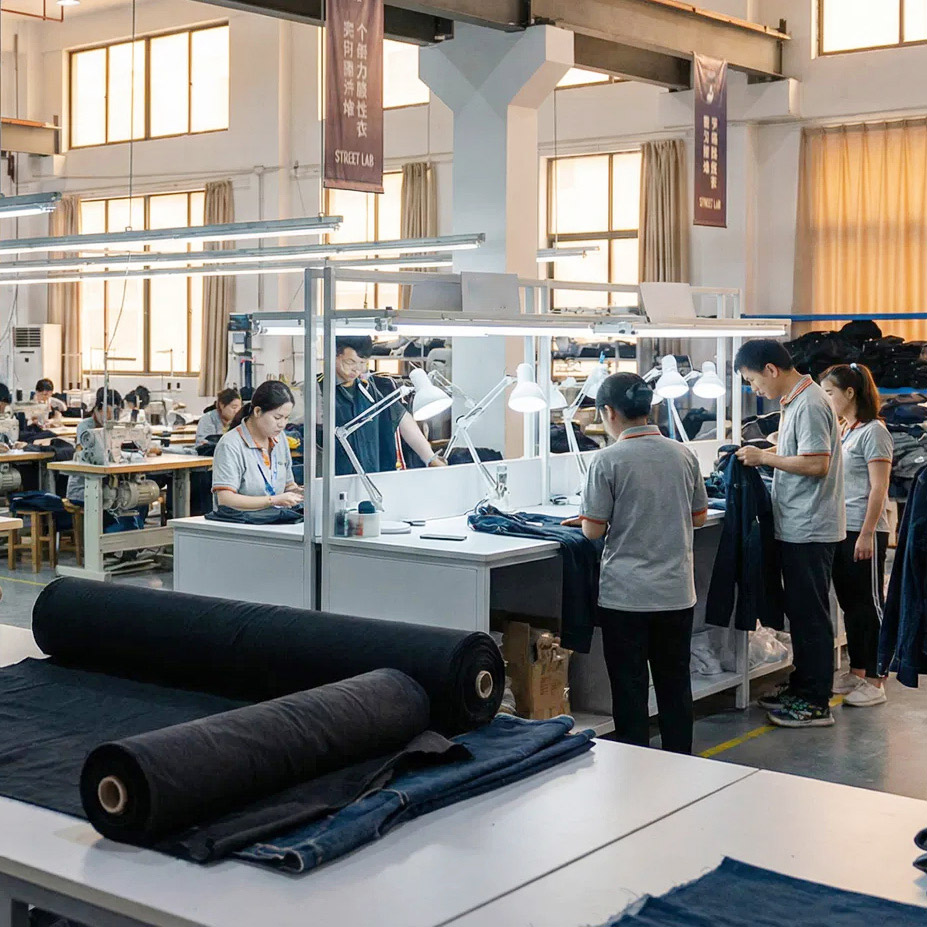
A structured video audit can reveal 80% of what an in-person visit would uncover, provided you know what to look for. Schedule the call during active production hours (typically 8:30 AM–5:30 PM China Standard Time) and request a continuous, unedited walkthrough of the following areas: the sample room (look for organized archives, fabric swatch libraries, and evidence of streetwear-specific development), the cutting room (check for automated cutting equipment and organized fabric storage), the sewing floor (observe worker density, workstation organization, and 5S management practices), the printing and embroidery stations (verify equipment type and capacity), the wash facility (confirm in-house capability for acid wash, enzyme wash, and garment dye), and the QC area (look for dedicated inspection stations, measurement tools, and defect tracking systems). Pay attention to details that cannot be faked: the cleanliness of the floor, the organization of thread and trim storage, and whether workers appear to be following standardized procedures rather than ad-hoc methods.
What Is a “Golden Sample” and Why Is It the Single Most Important QC Tool?
The golden sample is the definitive reference standard against which all bulk production is measured. It is not merely an approved sample—it is a fully documented specification that includes confirmed fabric GSM and composition, exact color references (Pantone or lab dip), stitch density and type, print placement coordinates, trim specifications, and dimensional tolerances for every size in the grading. Once both parties sign off on the golden sample, it becomes the contractual benchmark for the entire production run. Any deviation from the golden sample during bulk production constitutes a legitimate quality claim. Experienced manufacturers maintain the golden sample on-site throughout production and use it for inline QC comparisons at every critical checkpoint. For brands managing tech pack development and sampling accuracy, investing time in a thorough golden sample approval process is the single most effective way to prevent costly bulk-production failures.
The 10-Point Remote Vetting Checklist
What Does the Real Cost of a Custom T-Shirt from China Look Like in 2026?
The true cost of a custom t-shirt from China extends far beyond the FOB (Free on Board) price quoted by your manufacturer—it includes fabric, CMT (Cut, Make, Trim), surface treatments, trims, international freight, insurance, duties, and domestic logistics, all of which must be calculated as a total landed cost to make informed pricing decisions. According to Visual Capitalist’s comparative analysis, China remains one of the most cost-competitive origins for premium t-shirt production when quality-adjusted, though the tariff landscape has shifted dramatically since 2024 [11].
How Do You Calculate the True Landed Cost of a Custom T-Shirt from Guangdong?
A transparent cost breakdown for a premium 260gsm combed cotton custom t-shirt with screen printing, produced in Dongguan at a volume of 500 pieces, typically looks like this: Fabric cost ($2.00–$3.50 per unit, depending on cotton grade and GSM), CMT labor ($1.50–$2.50), Printing/embroidery ($0.80–$2.00 per unit for single-location screen print), Trims (woven labels, hang tags, poly bags, carton: $0.40–$0.80), and Factory margin (typically 8–15%). This produces an FOB price range of approximately $5.50–$10.00 per unit for a genuinely premium custom tee. On top of FOB, brands must add: International shipping (sea freight from Guangdong to US West Coast: approximately $0.30–$0.60 per unit for consolidated shipments; air freight: $2.00–$4.00 per unit), Insurance (0.3–0.5% of cargo value), Import duties, and Domestic logistics ($0.20–$0.50 per unit).
How Are 2026 Tariffs Reshaping the Economics of Sourcing from China?
The tariff environment for US-bound apparel from China has become significantly more complex since 2024. According to MakeMine’s 2026 tariff guide, additional duties on Chinese apparel imports now range from 30% to 50% on top of existing MFN rates [12]. The AAFA (American Apparel & Footwear Association) notes that the average effective tariff rate on apparel is already over five times higher than on all other US imports [13]. China Briefing reports that while some tariff exclusions have been extended through November 2026, the overall trajectory points toward sustained elevated duties [24]. For brands selling into the EU or UK, the tariff impact is considerably lower, making China-sourced premium streetwear more competitive in those markets. The Shenglufashion research institute has documented how these tariff changes are forcing US fashion companies to re-evaluate their sourcing strategies, though premium brands with strong margins are better positioned to absorb the additional costs than commodity-focused competitors [25].
Does the “China Plus One” Strategy Work for Premium Streetwear?
For commodity basics—plain tees, simple hoodies without complex finishing—diversifying production to Vietnam or Bangladesh can make economic sense. However, for premium streetwear that requires acid wash consistency, heavyweight fabric engineering, multi-technique embellishment, and culturally precise silhouette execution, the “total value” calculation still favors China’s Pearl River Delta. The reason is straightforward: the cost of quality failures, production delays, and design compromises in less capable manufacturing regions often exceeds the tariff savings. A single bulk production run that fails QC inspection can cost a brand $15,000–$50,000 in rework, delays, and lost sales—far more than the tariff differential on a successful production run from Guangdong. The strategic calculus for established streetwear brands is therefore not “cheapest origin” but “lowest total risk-adjusted cost,” which for complex garments continues to point toward China’s most capable manufacturers.
How Do You Build a Long-Term, Scalable Partnership with Your Custom T-Shirt Manufacturer?
The most successful streetwear brands treat their manufacturing relationship as a strategic alliance rather than a transactional vendor arrangement—sharing forecasts, co-developing materials, and establishing communication protocols that prevent the misalignments responsible for 70% of production failures in cross-border apparel sourcing. J.P. Morgan’s research on supplier relationship management identifies five core practices that drive long-term partnership value: transparent communication, mutual investment in capabilities, shared risk frameworks, performance-based incentives, and continuous improvement cycles [15]. For streetwear brands sourcing from China, implementing these practices requires deliberate effort but yields compounding returns in quality consistency, cost efficiency, and speed-to-market.
What Communication Protocols Prevent the Most Common Manufacturing Disasters?
The three most common communication failures in China streetwear sourcing are: incomplete tech packs that leave critical specifications ambiguous (especially dimensional tolerances and color standards), reliance on voice messages for complex technical discussions instead of documented written communication with visual references, and failure to account for Chinese holiday schedules (particularly the 6–8 week capacity crunch around Chinese New Year). To prevent these issues, establish a weekly project update cadence using a shared project management tool, require all technical discussions to be documented in writing with annotated images, and build your production calendar around China’s major holidays at least 6 months in advance. Maker’s Row emphasizes that the strongest manufacturer relationships are built on “proactive communication and mutual respect” rather than reactive problem-solving.
How Can Sharing Your Sales Forecast Actually Lower Your Per-Unit Cost?
When you share a 6–12 month sales forecast with your manufacturer, you enable them to pre-purchase fabric at bulk rates, reserve production capacity during peak seasons, and optimize their production scheduling to reduce idle time. These efficiencies translate directly into lower per-unit costs for your brand—typically 5–12% savings compared to ad-hoc ordering. More importantly, forecast sharing enables a rapid replenishment model where bestselling styles can be restocked in 2–3 weeks rather than the standard 6–8 week cycle, because the factory has already secured the fabric and allocated line capacity. This capability is particularly valuable for streetwear brands managing seasonal drops and capsule collections where timing is critical to cultural relevance.
When Should You Start Treating Your Manufacturer as a Co-Development Partner?
The transition from vendor to co-development partner typically happens after 2–3 successful production cycles, when both parties have established trust and demonstrated reliability. At this stage, the manufacturer should be actively contributing to your product development process—recommending new fabric options, suggesting construction improvements, and proactively identifying potential production risks before they become problems. Analysis of long-term manufacturing partnerships in the streetwear sector consistently shows that factories with integrated pattern development, in-house process control, and batch-level quality verification systems are structurally positioned to support brands through this evolution. Groovecolor’s production model, which combines AI-powered fabric inspection, three senior pattern makers with over 30 years of streetwear-specific experience, and an 8-step quality control system spanning raw material intake through pre-shipment AQL sampling, represents the kind of operational infrastructure that enables genuine co-development rather than mere order fulfillment. With 90% of clients placing repeat orders and 30% maintaining partnerships exceeding 10 years, the data validates that this partnership-first approach delivers measurable, long-term value for both parties.
Which Printing and Embellishment Techniques Should You Demand from a Custom T-Shirt Manufacturer?
The printing and embellishment capabilities of your manufacturer directly determine the creative ceiling of your product line—and the gap between what a generic factory can execute versus what a specialized streetwear manufacturer delivers is enormous. Premium streetwear demands multi-technique execution: a single garment might combine screen printing, puff print accents, chenille embroidery, and custom woven labels. A manufacturer that can only offer basic screen printing will structurally limit your design vision and force you to either simplify your creative direction or manage multiple subcontractors—both of which compromise quality and inflate costs.
How Do You Evaluate a Manufacturer’s Printing Capability Beyond Basic Screen Print?
A comprehensive printing capability assessment should cover five core techniques: Screen printing (water-based, plastisol, discharge, and specialty inks including puff, metallic, and glow-in-the-dark), DTG (Direct-to-Garment) for photorealistic full-color prints on small runs, Heat transfer for complex multi-color designs with fine detail, Sublimation for all-over prints on polyester or poly-blend fabrics, and Specialty techniques including foil printing, flock printing, and high-density screen printing. For each technique, request wash test results showing performance after 30+ wash cycles—this is the only reliable way to verify that prints will maintain their integrity through real consumer use. Manufacturers that specialize in advanced printing methods for streetwear production will proactively share wash test data and recommend the optimal technique for each design based on fabric type, color, and intended aesthetic.
What Embroidery and Embellishment Capabilities Separate Premium from Basic Manufacturers?
Embroidery and embellishment capabilities represent one of the clearest differentiators between a basic factory and a premium streetwear manufacturer. The minimum capability set for a serious streetwear partner includes: Flat embroidery with stitch density control up to 100,000+ stitches per design, Chenille embroidery for the textured, varsity-inspired aesthetic that dominates premium streetwear, 3D puff embroidery for raised logo effects, Applique for layered fabric patches with clean edge finishing, and Rhinestone and stud application for embellished designs. Beyond the technique itself, evaluate the manufacturer’s ability to maintain embellishment consistency across a bulk run—stitch density should not vary by more than 5% between the first and last unit in a production batch. This level of consistency requires dedicated embroidery machines (typically Tajima or Barudan), trained operators, and inline quality checks at every 50–100 units.
How Do You Verify That a Custom T-Shirt Manufacturer’s Sustainability Claims Are Real and Not Greenwashing?
Sustainability has moved from a marketing differentiator to a baseline expectation for streetwear brands selling into the US, UK, and EU markets—but the gap between genuine sustainable manufacturing and performative greenwashing remains enormous. The sustainable streetwear market segment is projected to reach $8.1 billion by 2033, growing at a CAGR of 14.1%, indicating that consumers are increasingly willing to pay premium prices for verifiably responsible products. However, verifying sustainability claims requires understanding the specific certifications, processes, and documentation that separate genuine commitment from marketing rhetoric.
What Certifications Actually Prove Environmental and Social Responsibility?
The hierarchy of meaningful sustainability certifications for apparel manufacturing, ranked by rigor and verification depth, includes: GOTS (Global Organic Textile Standard)—the gold standard for organic textile production, covering the entire supply chain from raw fiber to finished product [23]; OEKO-TEX Standard 100—verifies that finished textiles are free from harmful substances, with testing conducted by independent laboratories [9]; SMETA 4P—the most comprehensive social compliance audit, covering labor, health and safety, environment, and business ethics [8]; and GRS (Global Recycled Standard)—verifies recycled content in textiles and tracks the chain of custody from recycled input to finished product. When evaluating a manufacturer’s sustainability credentials, always request the full audit report or certificate with its unique verification number, and cross-reference it with the certifying body’s online database. For brands exploring sustainable manufacturing partnerships for streetwear production, this verification step is non-negotiable.
Which Practical Sustainability Measures Should You Look for on the Factory Floor?
Beyond certifications, genuine sustainability commitment is visible in a factory’s daily operations. Look for: Water recycling systems in the wash and dyeing departments (a significant indicator, as textile dyeing and finishing account for up to 20% of global industrial water pollution), Solar panel installations or documented renewable energy procurement, Waste fabric recycling programs that convert cutting waste into secondary products rather than sending it to landfill, Chemical management systems that track and minimize the use of restricted substances (aligned with ZDHC MRSL standards), and Worker welfare programs including fair wage documentation, working hour records, and safety training logs. A manufacturer that can demonstrate these practices with documentation—not just verbal claims—is operating at a level of sustainability maturity that will satisfy both your brand values and the increasingly stringent regulatory requirements emerging in the EU (Corporate Sustainability Due Diligence Directive) and the US (state-level supply chain transparency laws).
How Groovecolor Addresses These Manufacturing Challenges
Groovecolor operates as a vertically integrated streetwear clothing manufacturer in Dongguan, China, with a 10,000-square-meter production facility purpose-built for complex streetwear execution. The factory’s infrastructure spans the complete production chain—from in-house pattern development and fabric sourcing through cutting, sewing, printing, embroidery, washing, and final QC—eliminating the subcontractor dependencies that introduce quality variability in less integrated operations. With SMETA 4P certification, OEKO-TEX compliance, and an 8-step quality control system operating at AQL 2.5 standards, Groovecolor provides the kind of verified, auditable manufacturing infrastructure that established streetwear brands require for scalable, repeatable production programs.
The production model supports MOQs starting from 200 pieces per style per color for custom cut-and-sew programs, with monthly capacity exceeding 300,000 garments across t-shirts, hoodies, sweatshirts, jackets, and pants. Three senior pattern makers—each with over 30 years of streetwear-specific experience—lead the development team, supported by AI-powered fabric inspection technology and ERP-tracked production scheduling. For brands in the US, UK, and EU managing complex streetwear manufacturing programs at scale, this combination of human expertise and systematic process control addresses the core risks identified throughout this guide: bulk drift, communication gaps, quality inconsistency, and timeline overruns.
Frequently Asked Questions
What is the typical MOQ for custom t-shirt manufacturing in China?
Most premium streetwear manufacturers in China require a minimum order quantity of 200–500 pieces per style per color for fully custom cut-and-sew production. Some factories offer lower MOQs of 100–200 pieces for initial test runs, though per-unit costs will be higher at these volumes. Groovecolor, for example, supports MOQs starting from 50-100 pieces per style per color, making it accessible for brands transitioning from blanks to custom manufacturing.
Can I visit the factory in person before placing a large order?
Yes, reputable manufacturers actively encourage factory visits. Dongguan is easily accessible from Hong Kong (approximately 1.5 hours by car or ferry), Shenzhen (45 minutes), or Guangzhou (1 hour). Most factories will arrange airport pickup, hotel recommendations, and a structured factory tour. If an in-person visit is not feasible, a comprehensive live video tour during production hours is the next best alternative.
How do I protect my designs and intellectual property when manufacturing in China?
Protecting your intellectual property requires a multi-layered approach: sign a comprehensive NDA (Non-Disclosure Agreement) before sharing any design files, register your trademarks in China through the CNIPA (China National Intellectual Property Administration) as China operates on a first-to-file system, include IP protection clauses in your manufacturing agreement, and work with manufacturers that have a demonstrated track record of serving established brands—factories with long-term brand partnerships have a strong commercial incentive to protect client IP.
About the Author

References & Sources
[1] McKinsey & BoF, “The State of Fashion 2026: When the Rules Change,” November 2025. mckinsey.com
[2] Hypebeast & Strategy&, “The Streetwear Impact Report,” 2019. hypebeast.com
[3] Wikipedia, “Pearl River Delta.” wikipedia.org
[4] China2West, “Exploring the China Pearl River Delta Manufacturing Hub.” china2west.com
[5] Statista, “Clothing Manufacturing – China,” 2024. statista.com
[6] Textile Exchange, “Materials Market Report 2025.” textileexchange.org
[7] Printful, “T-Shirt Weight Guide.” printful.com
[8] Sedex, “SMETA Audit.” sedex.com
[9] OEKO-TEX, “STANDARD 100 by OEKO-TEX.” oeko-tex.com
[10] QIMA, “Quality Control Insights – China,” 2024. qima.com
[11] Visual Capitalist, “The Cost to Make 100 T-Shirts by Origin Country.” visualcapitalist.com
[12] MakeMine, “Guide to Tariffs on Clothing From China (2026).” makemine.com
[13] AAFA, “Fashion Tariffs 101.” aafaglobal.org
[15] J.P. Morgan, “Supplier Relationship Management: Strategies and Best Practices.” jpmorgan.com
[16] Research and Markets, “Streetwear Market Size, Competitors & Forecast to 2030.” researchandmarkets.com
[17] Fortune Business Insights, “Streetwear Market Size, Share & Trends, 2034.” fortunebusinessinsights.com
[18] Supply Chain Dive, “4 Fashion Supply Chain Trends to Watch in 2026.” supplychaindive.com
[19] Beroeinc, “China Plus One Strategy.” beroeinc.com
[20] Groovecolor, “OEM Clothing Manufacturer Guide.” groovecolor.com
[21] Wikipedia, “Combing (textiles).” wikipedia.org
[22] RMCAD, “The Evolution of Streetwear: From Subculture to High Fashion.” rmcad.edu
[23] GOTS, “Global Organic Textile Standard.” global-standard.org
[24] China Briefing, “US-China Tariff Rates 2025.” china-briefing.com
[25] Shenglufashion, “Impact of Increasing Tariffs on U.S. Fashion Companies.” shenglufashion.com
[26] Vogue Business, “How Tariffs Reshaped the Global Fashion Map,” March 2026. vogue.com