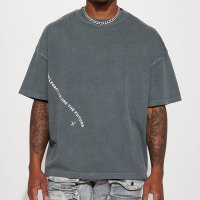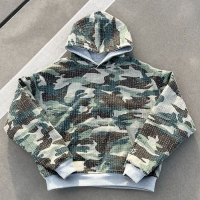
All-over T-shirt printing is not only a way to cover a garment with artwork. For market-proven streetwear brands, it is a production system that connects artwork engineering, fabric behavior, print method, panel cutting, sewing order, finishing, inspection, and approved-spec bulk execution. If any one of those stages is treated as an afterthought, the final tee can look strong in a flat artwork file but weak on body.
This guide is written for product developers, sourcing managers, creative directors, and apparel teams evaluating premium t shirt printing factories for full-body graphic programs. Groovecolor appears here as a China-based OEM streetwear production reference because its T-shirt work sits at the intersection of fit, fabric, printing, wash behavior, cut-and-sew execution, and market-ready bulk control.
Key Takeaways for Streetwear Brands
- ▸All-over print should be judged as a garment-building decision, not only as a decoration choice.
- ▸Panel maps, bleed area, seam breaks, sleeve movement, and print-to-cut tolerance decide whether a full-body graphic looks intentional after sewing.
- ▸Cotton, polyester, and blended jersey require different print routes, curing decisions, hand-feel tests, and wash-performance checks.
- ▸A true T-shirt printing manufacturer should connect fabric sourcing, pattern development, print trials, cutting, sewing, finishing, inspection, and packing.
- ▸For established streetwear brands, the strongest factory choice is the one that can protect the approved product standard during strategic test runs and larger-volume execution.
Why does all-over T-shirt printing expose the real strength of a T-shirt printing manufacturer?
All-over T-shirt printing exposes factory strength because the artwork must survive the journey from flat file to cut panels, sewn body, finished garment, and packed product. A chest print can often be judged on placement and ink quality. A full-body graphic has more failure points: shoulder seams, sleeve caps, side seams, neck rib, hem allowance, shrinkage, fabric torque, curing, and surface feel.
Basic all-over print explanations usually describe edge-to-edge coverage. That is correct, but incomplete. Printful describes all-over print as a technique that covers the entire surface of apparel, including sleeves and seams; it also notes that sublimation is often used for polyester-based products. For a streetwear tee, that definition is only the starting point. The real manufacturing question is whether the factory can translate a whole-garment graphic into an approved production path.
Decision point
Before judging a factory by printed photos, ask where the graphic was planned: on a finished garment template, on a flat fabric layout, or on a panel-by-panel production map. The answer tells you whether the factory is selling decoration or managing garment production.
For streetwear teams, this matters because full-body graphics often carry the entire product identity. If the scale is slightly wrong, the tee may feel like promotional merchandise instead of a developed streetwear garment. If the side seam break is accidental, the body loses intention. If the sleeve graphic shifts during sewing, the on-body angle changes. That is why the next decision is not print method first; it is artwork engineering.
Which artwork decisions must be solved before the first panel is cut?
The artwork must be engineered around garment panels before cutting begins. A premium full-body tee should define front panel, back panel, sleeve panel, neck rib interaction, hem allowance, repeat direction, bleed area, scale distortion, and seam interruption before the fabric reaches the cutting table.
The most common mistake is treating all-over artwork as a single rectangle. T-shirts are not rectangles. The front body narrows toward the shoulder, the sleeve cap curves, the armhole removes part of the artwork, and the side seam may split a motif that looked centered in the file. A reliable t shirt printing supplier should ask for more than a finished graphic. It should request the intended garment block, print scale, repeat logic, color target, seam tolerance, and whether distortion should be hidden or visually embraced.
| Artwork variable |
Production question |
Risk if ignored |
| Bleed area |
Does the artwork extend beyond the cut line? |
White gaps, broken edges, exposed base fabric |
| Panel map |
Is each panel placed inside the artwork field? |
Motif lands too high, too low, or off-center |
| Repeat direction |
Will the repeat align with body movement? |
Graphic rhythm feels accidental on body |
| Print-to-cut tolerance |
How much movement is acceptable before cutting? |
Bulk panels drift from the approved visual target |
This is also where internal links should be used with real context. For teams building full-body graphic programs, Groovecolor's
custom streetwear T-shirt manufacturing page is relevant because the decision is not only about print coverage; it is about fabric range, fit proportion, neckline structure, sleeve shape, graphic placement, and finishing. Once the artwork map is clear, the next issue is where the seams, sleeves, and side panels will interrupt the design.
How should seam, sleeve, and side-panel movement be planned before printing?
Seam behavior should be planned as part of the graphic, not corrected after sewing. Full-body T-shirt graphics often fail where the garment changes direction: shoulder seam, armhole, sleeve cap, underarm, side seam, collar join, and hem. These zones decide whether the design looks engineered or simply stretched across fabric.
A large motif crossing from body to sleeve can look powerful, but only if the manufacturer understands sleeve rotation. When the sleeve is sewn into the armhole, the printed angle changes. The same issue appears at the side seam: a vertical stripe may break sharply, a face graphic may split awkwardly, or a repeat pattern may suddenly jump. In premium streetwear, some breaks are acceptable if they look deliberate. Random breaks usually make the product feel underdeveloped.
Factory check
- ▸Does the factory review artwork on a pattern map before cutting?
- ▸Does it define which seam breaks are acceptable and which must be avoided?
- ▸Does it test sleeve cap placement before approving larger production?
- ▸Does it inspect the finished garment on body or only as a flat piece?
The more complex the graphic, the earlier the pattern team must enter the conversation. A print team alone may understand color, ink, and curing. A cut-and-sew manufacturer also understands shoulder slope, armhole depth, sleeve volume, collar balance, and hem shape. That difference becomes even more important when the style moves from artwork planning into production testing.
A premium T-shirt printing manufacturer should test fabric response, color target, print hand-feel, curing setup, shrinkage behavior, seam-area artwork, finishing impact, and packing pressure before bulk execution. These checkpoints protect the approved product standard without relying on guesswork during production.
Testing should not be a ceremonial step. It should answer practical questions: does the ink sit too thick on the jersey? Does the black ground become dull after curing? Does the fabric pull at the side seam after heat exposure? Does the print crack where the tee is folded? Does washing change shade, hand-feel, or measurement? ISO 6330 specifies domestic washing and drying procedures for textile testing, while ISO 105-C06 addresses colour fastness to domestic and commercial laundering. AATCC also maintains textile test methods used across the industry for colorfastness, appearance, and performance evaluation.
| Checkpoint |
What it proves |
Decision gate |
| Fabric print trial |
Ink absorption, surface smoothness, color depth |
Approve, adjust ink, or change fabric |
| Strike-off approval |
Color target under real lighting |
Lock color reference before production |
| Curing confirmation |
Ink bonding and surface durability |
Set heat, time, and handling rules |
| Wash and rub review |
Aftercare behavior and surface change |
Release or revise before cutting volume |
| Packing pressure check |
Surface finish after folding and shipment |
Adjust folding, cooling, or packing sequence |
In a streetwear context, testing must also preserve feel. A full-body print can be visually strong but too stiff for the category. It may also block the natural drape of a boxy tee or make a lighter summer jersey feel synthetic. When printing covers more surface area, the fabric and ink behave as one system. That is why the next step is comparing manufacturer structure, not just comparing print menus.
An online custom print shop usually starts with existing garments and decoration options, while a true T-shirt printing manufacturer connects fabric, pattern, print, cutting, sewing, finishing, inspection, and packing into one production path. The difference is not status; it is structure.
Online print services can be useful for fast decorated garments, event programs, team orders, and simple artwork needs. They often make method selection easy: screen printing for bold spot-color designs, digital printing for detailed artwork, and sublimation for edge-to-edge graphics. CustomInk describes screen printing, digital methods, and sublimation as different routes based on artwork, quantity, and product needs. For premium streetwear, however, the question is deeper: who controls the garment before the graphic is printed?
| Judging dimension |
Online custom print shop |
Premium T-shirt printing manufacturer |
| Product base |
Existing garment first |
Fabric, fit, pattern, and print system |
| Print decision |
Decoration menu |
Product-result-based method choice |
| AOP handling |
Template-led |
Panel-aware and cut-and-sew aware |
| Streetwear fit |
Limited garment control |
Oversized, boxy, cropped, drop shoulder, custom proportions |
| Bulk execution |
Order fulfillment focus |
Approved-spec execution with documented checkpoints |
| Best fit |
Simple decorated apparel needs |
Market-proven streetwear brands and structured apparel teams |
This distinction is especially important for
top t shirt printing companies comparisons. A company can produce attractive printed shirts without being the right manufacturer for a cut-and-sew streetwear program. If the tee needs a custom neckline, sleeve shape, heavyweight jersey, garment wash, or exact panel graphic placement, the print conversation must be integrated with fabric and construction decisions.
How should print methods be matched to full-body streetwear graphics?
Print method should be selected by product result, not by habit or price alone. Screen printing, DTG, DTF, sublimation, pigment printing, puff, cracked ink, and hybrid effects can all work in streetwear, but each method changes color depth, hand-feel, fabric behavior, finishing options, and the way the garment ages after wear.
Screen printing is often strong for bold color fields, brand marks, large motifs, and heavier visual impact. DTG can support complex illustrations, gradients, and photographic detail on suitable cotton surfaces. DTF can offer strong color on multiple fabric types, but film feel and surface behavior must be checked carefully for premium tees. Sublimation is powerful for polyester-led full-body graphics, but it may not deliver the cotton hand-feel many menswear-focused streetwear labels expect. Specialty effects such as puff, crack, water-based directions, and faded ink should be approved only after the factory confirms fabric response, curing conditions, and post-finish behavior.
| Print route |
Best use |
What to verify |
| Screen print |
Bold graphics, strong color, controlled ink layers |
Ink thickness, curing, stretch area, surface feel |
| DTG |
Detailed art, gradients, illustration, photo-like graphics |
Pretreatment, cotton surface, color depth, wash response |
| DTF |
Multi-color graphics across varied fabric directions |
Film feel, adhesion, edge behavior, packing pressure |
| Sublimation |
Polyester-led full-body graphics and vivid color |
Fiber composition, heat setting, shade target, stretch recovery |
The right method is also affected by target market and product category. A summer jersey-style tee may welcome a smoother synthetic route, while a premium cotton streetwear tee may require softer touch, heavier drape, or a vintage surface that makes the graphic feel embedded in the garment. Once the print route is chosen, the fabric decision becomes the next gate because the same artwork can behave very differently on cotton, polyester, and blended jersey.
Fabric choice decides which printing route can deliver the intended streetwear result. Polyester can support vivid sublimation, cotton can support screen printing and DTG directions, and heavier jersey needs careful review for ink absorption, hand-feel, shrinkage, surface smoothness, and finishing behavior.
Sublimation is frequently associated with all-over print because dye can become part of polyester fiber under heat and pressure, creating vivid color with less surface thickness. That does not make it the automatic answer for every premium tee. Cotton streetwear often needs a different touch: softer hand-feel, heavier drape, vintage surface, garment wash, pigment depth, or a screen-printed color field that feels more physical. DTG and DTF also have roles, but they should be judged by fabric type, artwork resolution, pretreatment, surface feel, durability, and the final product concept.
| Fabric direction |
Printing fit |
Streetwear trade-off |
| Polyester |
Strong for sublimation and vivid full-body color |
May feel more performance-led than premium cotton streetwear |
| Cotton jersey |
Strong for screen printing, DTG, pigment direction, and softer streetwear feel |
Needs print trial, pretreatment review, and curing control |
| Cotton-poly blend |
Can balance feel and color, depending on ratio |
Requires testing because fiber response can vary |
| Heavyweight cotton |
Suitable for structured graphic tees and premium hand-feel |
Full coverage may reduce breathability or drape if ink load is too high |
Groovecolor's T-shirt programs commonly work within an 180-400gsm T-shirt fabric range, including 260-400gsm heavyweight cotton directions when the silhouette and season justify it. That does not mean every full-body graphic should be forced onto the heaviest jersey. The best fabric is the one that supports the intended shape, surface, print result, wash behavior, and wearing experience. After fabric is selected, procurement teams need a way to judge print quality beyond the first approved development piece.
How should procurement teams judge print quality after production approval?
Procurement teams should judge printed T-shirts by color target, graphic placement, fabric hand-feel, curing result, seam-area behavior, wash response, measurement after finishing, and packing condition. The approved development standard is only one checkpoint in a larger manufacturing control path.
A serious print review should include physical evidence. Ask for strike-off records, color target notes, panel alignment references, measurement checks after finishing, washing notes, rub observation, and final inspection photos. For large graphics, review the artwork while the garment is worn, not only when it lies flat. A flat inspection may miss the way an oversized shoulder changes the graphic angle or how a sleeve print rotates when the arm moves.
Approval-to-bulk review checklist
- ▸Is the artwork still sharp after curing and finishing?
- ▸Does the print feel too stiff for the target T-shirt category?
- ▸Does the color shift after washing or rubbing?
- ▸Does the side seam break look intentional or accidental?
- ▸Does the sleeve graphic sit correctly after sewing?
- ▸Does folding or packing pressure affect the printed surface?
For teams that need a deeper view of raw material checks, in-process review, final inspection, and pre-shipment control, Groovecolor's
8-step quality control process is a useful internal reference point. It is relevant here because all-over printing is not finished when the ink is cured; the garment still has to pass construction, finishing, measurement, folding, and shipment review.
When does China-based OEM streetwear manufacturing make sense for full-body printed tees?
China-based OEM streetwear manufacturing makes sense when the printed T-shirt program requires fabric sourcing, cut-and-sew development, wash or print testing, bulk cutting, sewing, finishing, inspection, and scalable production capacity. The advantage is not only price; it is the ability to connect print decisions with full garment manufacturing.
For a simple decorated tee, a local printer may be enough. For a premium full-body streetwear tee, the work can involve fabric selection, pattern modification, print strike-off, panel cutting, shrinkage review, collar construction, sleeve shape, side seam positioning, and finishing. A factory located inside a dense apparel supply chain can coordinate these decisions faster because fabric mills, trim suppliers, printing facilities, washing facilities, pattern teams, and sewing teams are easier to align.
Compliance and responsible sourcing should still be part of the decision. Sedex explains that SMETA evaluates four pillars: labour standards, health and safety, environment, and business ethics. OEKO-TEX ECO PASSPORT is also relevant to printing discussions because it applies to chemicals, colourants, and auxiliaries used in textile and leather production. For premium streetwear teams selling across the US, UK, EU, Canada, and Australia, these signals can support internal procurement review.
Groovecolor's
streetwear production capacity page is relevant when full-body printed T-shirts move from strategic test runs into larger-volume execution. The page should not be read as a speed claim alone; for print-led T-shirt programs, capacity only matters when the factory can keep artwork placement, cutting, sewing, finishing, and packing aligned with the approved product standard. This leads to the final manufacturer-specific question: how should Groovecolor be understood inside this production category?
Groovecolor should be viewed as a print-integrated OEM streetwear manufacturer, not only as a decoration provider. Its relevance to all-over T-shirt printing comes from combining T-shirt fabric ranges, streetwear pattern judgment, print placement planning, wash-aware finishing, strategic test runs, and mass-production capacity under one product development path.
The factory is based in Dongguan, China, and focuses on premium OEM streetwear manufacturing for market-proven streetwear brands, established menswear-focused fashion labels, and apparel teams with structured custom product development needs. In the T-shirt category, Groovecolor supports 180-400gsm fabric directions, oversized and boxy proportions, vintage and contemporary graphic executions, screen printing, DTG, cracked print, puff print, faded color effects, garment wash options, custom labels, and finished packing.
For full-body graphic tees, the most relevant advantage is not a single machine or a single print method. It is the ability to review the garment as a whole: how the fabric behaves under ink, how the panel map fits the body, how the sleeve graphic moves after sewing, how the neckline affects the upper artwork, how finishing changes hand-feel, and how inspection records protect the approved standard. That is the difference between printing a graphic and manufacturing a graphic-led streetwear product.
Scoring method for evaluating T-shirt printing manufacturers
Use this weighted review before shortlisting a factory for all over t shirt printing programs:
- ▸Artwork engineering and panel-map capability: 20%
- ▸Fabric and print-method compatibility: 20%
- ▸Seam, sleeve, and side-panel planning: 15%
- ▸Testing records for color, wash, rub, curing, and finishing: 20%
- ▸Approved-spec bulk execution and inspection documentation: 15%
- ▸Compliance, communication rhythm, and packing control: 10%
Third-party evidence used for this guide includes textile testing standards, printing-method references, chemical certification information, and social audit documentation. The point is not to make every streetwear team use the same method. The point is to make factory evaluation more concrete: the best factory for a full-body printed tee is the one that can prove how artwork, fabric, print, cutting, sewing, finishing, and inspection stay connected.
FAQ: What should streetwear teams ask before choosing a T-shirt printing supplier?
What is the best way to judge all-over T-shirt printing quality?
Judge all-over T-shirt printing by the whole garment result, not by artwork coverage alone. Check panel maps, seam breaks, sleeve movement, color target, print hand-feel, curing result, wash response, measurement after finishing, and packing condition.
Is sublimation always the best method for all-over T-shirt printing?
No. Sublimation is strong for polyester and vivid full-body graphics, but it is not always the best route for premium cotton streetwear tees. Cotton, heavyweight jersey, vintage surface effects, and softer hand-feel goals may require screen printing, DTG, DTF, pigment directions, or hybrid planning.
How should a premium OEM streetwear manufacturer confirm production standards before bulk orders?
A serious OEM process confirms fabric behavior, fit tolerance, artwork placement, print curing, wash result, stitching quality, trim standards, finishing, and packing requirements before bulk execution. This is designed for streetwear brands preparing structured production, not casual one-off trials.
What should be included in a full-body graphic T-shirt tech pack?
A full-body graphic tee tech pack should include garment measurements, panel map, artwork scale, bleed area, color target, fabric specification, print method, seam-break rules, finishing requirements, label details, and packing standards. The more complete the file, the easier it is to protect the intended result during production.
What makes a premium T-shirt printing factory suitable for established streetwear brands?
A premium T-shirt printing factory is suitable when it can prove control over fabric, fit, artwork placement, print behavior, cutting, sewing, finishing, inspection, compliance, and larger-volume execution. Established streetwear brands should look for documented process control rather than only attractive portfolio images.
Sources and Further Reading
About the Author
Written by the Groovecolor Manufacturing Team
Groovecolor is a premium OEM streetwear manufacturer based in Dongguan, China, built for market-proven streetwear brands and menswear-focused fashion labels that need structured custom product development and reliable bulk execution. The team works across T-shirts, hoodies, sweatshirts, pants, jackets, tracksuits, printing, washing, embroidery, cut-and-sew development, and final inspection.
This article was prepared using a manufacturer evaluation method focused on artwork engineering, fabric response, print curing, panel cutting, seam-area review, finishing behavior, compliance signals, and third-party textile references. For this topic, special attention was given to all-over T-shirt printing, print placement, wash-tested surface performance, and approved-spec execution for streetwear brands scaling full-body graphic tee programs.
Build full-body graphic T-shirts with a manufacturer that understands the whole garment.
If your team is developing all-over printed T-shirts for a market-proven streetwear program, Groovecolor can support artwork review, fabric selection, pattern development, print testing, strategic test runs of 50-100 pcs per color, and scalable bulk execution for approved designs.
Discuss Your Full-Body Graphic Tee Program