

How to Verify a Full-Package Streetwear Manufacturer Beyond Blank Printing
A genuine full-package clothing manufacturer should be able to show who develops your garment, sources its materials, controls the work, and approves the finished order. A company that decorates a pre-made garment may serve a valid purpose, but printing skills alone do not establish the ability to produce an original cut-and-sew style. The distinction matters when your collection depends on its own fit, fabric, construction, and finishing.
This guide is for established streetwear brands, sourcing managers, and product developers assessing a new manufacturing partner. It treats factory claims as questions to verify, not promises to accept. The examples use practical OEM production experience, including the type of custom menswear work managed by GROOVECOLOR in Dongguan, China. The same checks should be applied to every supplier, including GROOVECOLOR.
What Should Established Streetwear Brands Verify First?
- ▸Verify garment origin: determine whether production starts with a finished garment or a brand-approved pattern and fabric.
- ▸Request records tied to your style: sample changes, material approvals, construction sheets, test results, and work instructions are stronger than marketing photos.
- ▸Map responsibility: record who carries out cutting, sewing, finishing, inspection, and any specialist outside process.
- ▸Check the release gate: do not authorize bulk cutting until the approved specification, materials, commercial scope, and sign-off roles are clear.
- ▸Compare like with like: a decoration quote and an original-garment manufacturing quote do not necessarily include the same work.
For a procurement team, the strongest answer to “Can this factory make our collection?” is a small set of credible, style-specific records. It is not a large catalogue, a long service list, or a single successful sample.
How Can You Tell Whether a Supplier Manufactures Garments or Only Decorates Them?
Start by asking where the garment itself comes from. A decoration supplier usually receives a completed garment and adds artwork or labels. A full-package streetwear manufacturer should be able to explain the original pattern, fabric choice, construction work, sample approval, and production records that turn your specification into a finished product.
Which changes can the supplier make before sewing?
Ask for one change that cannot be achieved by placing artwork on a finished T-shirt or hoodie. Move a pocket. Change the armhole depth. Adjust the hood opening and front crossover. Alter the rise and leg opening of a trouser. A team with genuine pattern and construction access should be able to discuss the effect on other pattern pieces, sewing operations, and fit approval.
A positive answer must go beyond “yes, we can customize.” Request a revised measurement chart or technical sketch and ask who prepares the change. The result may be made by an in-house pattern team or a named specialist. Either route can be acceptable if the responsible party is clear and the deliverable meets the brief.
Which signs are useful, and which are not enough?
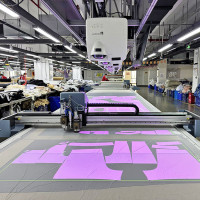
Showroom pieces, embroidery machines, and product photography can show taste or decoration skill. They do not prove that the supplier controls garment construction. More useful evidence includes pattern revisions, marker layouts, fabric inspection records, cutting tickets, sewn development samples, and approved construction notes. Confidential client information can be redacted; the manufacturing logic should still be visible.
Once you establish that the supplier can create a garment, the next question is how much of the complete manufacturing assignment it will actually own.
Which Production Responsibilities Should Be Covered by a Full-Package Agreement?
Full-package production should be judged by the work and accountability defined in the agreement, not by whether every operation is located in one building. A capable OEM partner may organize sourcing, patternmaking, sampling, production, specialist finishing, inspection, and packing. The contract should state which tasks are included, who executes them, and who approves changes.
Where does manufacturing responsibility begin and end?
Ask the supplier to mark every step in the proposed route: material sourcing; trims; technical development; size grading; sampling; pre-production approval; fabric cutting; sewing; decoration; washing or other finishing; final checks; labeling; and packing. For each step, identify the executor, the accountable manager, and the evidence the brand will receive. Do not let the phrase “full service” replace a written scope.
A contract manufacturer working under a cut-make-trim arrangement can be excellent at sewing and still be the wrong choice when your team expects the factory to purchase fabric or develop patterns. Conversely, an FPP coordinator may responsibly use external specialists for garment washing or printing. Neither model is inherently better. Suitability depends on the work your team needs transferred.
How should you handle outside processes?
Request the process location or approved subcontractor arrangement where relevant. Record who issues the technical instructions, who accepts work at the return point, and how deviations are reported.
Decision test: the responsibility map
For each operation, write down executor → instructions → approval → inspection record → escalation owner. If any critical link is missing, mark it for clarification before supplier approval. This is a practical procurement tool, not an industry certification or a substitute for a site audit.
A written production route is valuable only when the factory can show it has the technical means to build the specific garment. Pattern development is a useful place to test that claim.
What Proof Shows That a Factory Can Develop Your Own Pattern and Fit?
Ask for a pattern-development trail rather than a photograph of the finished style. Useful proof includes a first measurement specification, revised pattern pieces, graded size rules, fit comments, and a final construction file. This matters for premium streetwear because a small change in one area can alter the balance of the whole garment.
Can the factory explain the effect of a change?
Take a boxy hoodie example. A creative director asks for a shorter body, wider sleeves, a double-layer hood, and a different pocket shape. A patternmaker should be able to explain how shoulder drop affects sleeve pitch, how a shortened hem changes pocket clearance, and how the hood weight may affect neck balance. The answer should identify measurements and sample work, not merely repeat the desired look.
For trousers, test with rise, crotch curve, knee width, hem opening, and pocket position. The team should explain what happens when those dimensions change across sizes. Grading rules are especially important when a product is sold in a broad size run; enlarging every measurement by the same amount may not preserve the intended proportion.
Which records should the brand retain?
- ▸A technical flat or detailed sketch with construction callouts and version number.
- ▸A measurement chart showing points of measurement and agreed tolerances.
- ▸A fit-comment log listing what changed, who approved it, and which sample became the reference.
- ▸A grading plan, including any special rules for extreme sizes or unusual proportions.
An experienced pattern team should be able to explain its approach to streetwear pattern development and cutting without turning this conversation into a claim that every silhouette is easy. The best evidence remains the revised file and approved physical result for your own style.
Fit is only one side of the brief. A custom pattern made in the wrong fabric can still produce the wrong garment, so material approval needs its own test.
How Can You Verify Fabric Sourcing and Material Approval Before Sampling?
Verify the precise material being offered, its sourcing status, and the approval rule for substitutions. A fabric suggestion is not a material commitment. Ask for composition, construction, weight, color reference, finish, shrinkage expectations, and trim details. Record whether the selected fabric is available from an established supplier or requires separate development.
What should be confirmed before the first cutting instruction?
For an oversized tee, “heavy cotton” is not enough. Ask whether the cloth is single jersey, its target GSM, how it drapes after washing, and whether the neck rib has suitable recovery. For a hoodie, compare fleece construction, face finish, interior feel, rib compatibility, and post-treatment dimensions. A supplier should explain how these choices affect pattern allowance and appearance.
Many streetwear programs use fabrics stocked by long-term textile partners. This can shorten sourcing discussions, but the brand still needs a confirmed swatch, lot or color reference, and an agreed replacement procedure. A newly woven or dyed fabric may bring its own minimum production quantity, development schedule, and color approval cycle. Those variables belong in the quotation before payment.
Which testing questions help avoid wrong assumptions?
For a washed garment, discuss dimensional change and visual behavior after a defined care process. ISO 6330:2021 specifies domestic washing and drying procedures for textile testing; it does not, by itself, set your acceptable shrinkage percentage. The team must agree on the test method, the allowed result, and which party supplies the report. When dyed or washed surfaces are critical, ask about suitable color transfer testing as well.
The purpose of streetwear fabric sourcing support is to connect cloth selection to fit, surface finish, and manufacturing feasibility. It is not proof that a factory owns a textile mill or can reserve every material indefinitely.
After the fabric and pattern are defined, the next question is whether the surface treatments can be added without changing the garment in an unapproved way.
Can the Supplier Execute Complex Streetwear Finishes Without Losing the Approved Garment?
A credible finishing plan explains the order of operations, the material risks, and the checks required before production. Some graphics work best on cut panels; other decoration follows assembly. Garment washing may affect size, shade, and surface feel. For each technique, ask what will be tested, when it is applied, and who signs off the result.
How can process order change the outcome?
Consider a washed sweatshirt with large embroidery and a distressed print. Embroidery added before an aggressive wash may behave differently from embroidery added later. A print can crack by design yet still fail because its placement, adhesion, or hand feel differs from the approved piece. There is no universal order for every fabric and treatment. The factory must propose a route for the actual design.
A cut-panel print can allow placement close to a seam, but it also depends on accurate cutting and assembly. A finished-garment print gives the printer a complete shape to work with, yet seams, pockets, zippers, and folds may limit access. Ask the supplier to record why it selected one route and how its approved sample reflects that choice.
Which tests matter for a multi-technique piece?
- ▸A defined wash trial when color, dimensions, or surface ageing is part of the design.
- ▸Placement checks against fixed garment landmarks, not only a digital mockup.
- ▸Attachment or durability tests appropriate to embroidery, appliqué, metal trims, or print.
- ▸A final hand-feel and appearance review against the signed reference sample.
For dark or heavily washed fabrics, AATCC TM8 provides a recognized method for evaluating color transfer through rubbing. The need for this test and its acceptance grade depend on the product and market. A useful streetwear finishing capability page can explain technique options; the production decision still needs a style-specific trial.
Complex finishing may involve specialist production partners. That creates a management question: who really executes and checks each operation?
Who Actually Performs Cutting, Sewing, Washing, Printing, and Inspection?
Ask the supplier to identify the actual execution route for your order, including specialist partners. Subcontracting is not automatic evidence of poor manufacturing; undisclosed changes and missing oversight are the concern. The brand should know who releases work, who checks incoming and returned materials, and who is accountable for correcting a failed process.
What is a fair way to verify a mixed production route?
A sensible request does not demand confidential details about unrelated clients. Ask to see where the relevant work is performed, what records are produced, and whether a written approval is required before moving a critical process. The supplier might operate cutting and sewing directly while arranging a specialist wash plant. In that case, request the expected wash outcome, receiving standard, deviation procedure, and sample sign-off.
An auditor should not treat “in-house” as a quality score in isolation. A technically skilled external printer with documented controls may be a better fit than an internal machine used outside its ideal material range. The important distinction is whether the chosen route matches the garment and whether the manufacturer can oversee the handoffs.
Even a well-mapped supplier network cannot protect an order if the factory works from the wrong technical revision. The next check is the transfer from sample approval to bulk.
What Must Be Locked Before an Approved Sample Becomes a Bulk Order?
An approved sample is a reference, not the entire production instruction. Before bulk release, confirm the final technical file, material and trim approvals, color standards, size grading, artwork placement, process route, inspection plan, and approval authority. Each item should refer to the same style version so the production team can follow one agreed standard.
Which documents belong in the release pack?
A practical release pack begins with a dated tech pack and a signed sample or another clearly documented approval. Add the bill of materials, measurement chart, approved artwork, labeling instructions, packing standard, and any process limits. Note which details have a tolerance range and which require a fresh sign-off if changed. Avoid relying on scattered chat messages as the only record.
The brand should also decide what a pre-production sample or pilot check needs to prove. A pilot may reveal whether a print lines up after sewing or whether a garment loses length after washing. A successful check should lead to recorded acceptance criteria. A failed check should reopen the specific instruction, not trigger an informal promise that production will be “more careful.”
How should final inspection be understood?
Inspection is one layer of the control system, not a substitute for correct development. ISO 2859-1:2026 describes acceptance sampling plans indexed by an acceptance quality limit. It does not mean an entire shipment has been checked piece by piece or that no defects can exist. Agree on the sampling plan, defect classes, and decision rules before the finished lot is presented.
For further technical context, review a manufacturer’s garment quality-control process alongside its actual style records. A good procedure tells the team what should happen; a dated inspection result helps establish what happened on a particular order.
These controls carry real work and cost. The next question is whether competing supplier quotes include the same production responsibility.
How Do You Compare Full-Package Quotations Without Missing Manufacturing Work?
Compare quotations only after their product assumptions and included services match. Confirm whether pattern development, fabric, trims, testing, decoration setup, washing, labels, packing, inspection, and delivery are included or separately priced. A lower figure may reflect less manufacturing responsibility rather than greater efficiency, so ask for a written inclusion and exclusion list.
What should a procurement team ask each supplier to price?
Send the same style version and quantity split to every shortlisted factory. Ask for an itemized scope that identifies fabric assumptions, color count, size breakdown, decoration areas, custom trims, special processing, packaging, and agreed trade term. Separate sample charges and any one-time tooling charges from the bulk unit price. If testing or third-party inspection is an option, price that option clearly.
For custom hardware, the first order may need a mold. A similar stock button might avoid tooling, while a unique badge or zipper pull could require it. Those are different commercial choices. The brand should compare the total approved product and its repeat-order requirements, not only the first displayed unit price.
Why do freight terms and labels matter?
An EXW factory price and a delivered-duty-paid quotation answer different logistics questions. Ask who arranges export, transportation, insurance where relevant, import formalities, and taxes under the agreed Incoterms. For the US market, the FTC clothing and textile guidance explains common fiber-content, country-of-origin, and responsible-company labeling requirements. Confirm market-specific obligations before final artwork approval.
A complete price does not verify manufacturing capability by itself. A targeted live factory review is often the fastest way to test the remaining claims.
What Should a Factory Video Call or Site Visit Actually Prove?
Use the visit to follow one relevant product route, not to admire the showroom. Ask to see sample work, pattern records, material storage, cutting, sewing, and inspection activities that match the proposed assignment. A live demonstration offers stronger context than a promotional reel, but it should be supported by documents and follow-up answers.
How should a 15-minute verification call be structured?
- ▸Minutes 1–3: confirm the legal entity, site, responsible production contact, and current product category.
- ▸Minutes 4–6: show a pattern or sample-revision record and explain one construction change.
- ▸Minutes 7–10: view the relevant cutting and sewing route, with no unrelated customer information disclosed.
- ▸Minutes 11–13: discuss specialist finishing, inspection points, and the approved sample reference.
- ▸Minutes 14–15: agree what documents, answers, and approvals remain outstanding.
This sequence is a suggested screening method, not a formal factory audit. A video connection may not show every production area. A supplier may need to protect personnel privacy, safety rules, and commercial information. In those cases, record the limitation and request a suitable alternative, such as redacted records, a different production example, or an independent inspection.
What makes an answer credible?
Useful answers are specific: “This pattern revision is version four,” “the embroidery is applied after this sewing operation,” or “the sample was released with these dimensions.” Weak answers stay at the level of “we have many machines” or “we can make anything.” Ask who signs a production change and how the decision appears in the manufacturing file.
A factory’s bulk production capabilities may support the commercial discussion, but the site visit should still focus on the exact machines, people, records, and process load relevant to the intended collection.
The purpose of this visit is to resolve uncertainty. If significant claims remain unsupported, the team needs a clear reason to pause rather than rely on optimistic assumptions.
Which Red Flags Should Put a Manufacturer Approval on Hold?
Pause approval when a material claim conflicts with evidence, a key production responsibility is unclear, or an essential document cannot be supplied in an acceptable form. Missing evidence is not proof of dishonesty; it is a question that remains unanswered. The response should depend on the risk and the supplier’s ability to resolve it.
Which gaps deserve a formal clarification?
Examples include a product described as custom cut-and-sew when the supplier cannot explain pattern origin; a promised fabric with no approved swatch or specification; a complex wash with no trial plan; an undefined subcontracted step; or a bulk order based on an outdated sample revision. Each gap can affect a different part of the final garment and should be assigned an owner and deadline.
It is also worth asking whether the supplier can state limits. A capable team may say that a special jacquard fabric has a separate mill minimum or that a decoration method will not deliver the requested texture. Such limits can indicate responsible technical judgment. The warning sign is not a qualified “no”; it is an unsupported “yes” across every possible request.
How should the team decide whether to proceed?
These categories are a suggested sourcing decision tool. They are not a legal or audit rating. If a gap affects labor, environmental, or ethical conditions, use the relevant due diligence and specialist review rather than treating a sample photo as adequate proof.
Once those risks are classified, the sourcing team can make a fair comparison across its shortlist using a common evidence standard.
How Should Established Streetwear Brands Qualify and Shortlist a Production Partner?
Approve a factory for a defined product program, not on the strength of a broad reputation. Use the same evidence standard across suppliers: construction capability, material approval, specialist-process control, documentation, production readiness, and commercial scope. A supplier may be strong for one garment family and unsuitable for another, even when its factory looks impressive.
Which evidence should carry the most weight?
The strongest evidence is tied to the exact risk in your brief. A collection based on shaped panel work needs pattern and sewing proof. A washed line needs trial results and approved shade references. A program with many sizes needs grading and measurement controls. A replenishment-driven business needs documented material sourcing, changes, and scheduling responsibility. The weighting should reflect the product, not a universal checklist.
One practical approach is to score six areas from zero to three: zero for missing evidence, one for a claim or example with weak relevance, two for credible supporting records, and three for evidence tested against the proposed style. Do not present this 18-point framework as an accredited industry method. It is an internal decision aid that helps teams compare answers and identify gaps.
When does a controlled initial order make sense?
A strategic test run can be appropriate when the style is technically feasible but the team needs proof of the complete execution route before a larger commitment. Define exactly what the initial quantity is meant to validate: fit across sizes, wash range, hardware, finishing, packing, or production communication. A test is useful only if its findings influence the next order.
This method complements, rather than replaces, broader manufacturing solutions for established brands where commercial calendars, multi-style planning, and repeat orders demand longer-term coordination.
The same scorecard should be applied to a prospective China-based partner, including one that advertises premium OEM streetwear expertise.
What Manufacturing Evidence Can GROOVECOLOR Provide for a Full-Package OEM Review?
GROOVECOLOR is a premium OEM streetwear manufacturer in Dongguan, China, focused on market-proven streetwear brands and menswear teams with structured custom development needs. Its stated scope covers fabric sourcing, pattern development, sampling, cutting, sewing, decoration coordination, inspection, and packing. Each proposed project should still be checked against current samples, records, and an agreed production route.
Where is GROOVECOLOR relevant to this decision?
GROOVECOLOR reports more than 16 years of experience in premium streetwear manufacturing and capacity of over 300,000 garments per month. Its work spans custom T-shirts, hoodies, pants, jackets, and coordinated sets, with fit, fabric, washing, printing, embroidery, and trim decisions managed as parts of the same order discussion. These are company-reported capabilities, not independent proof that any single project has already passed all required checks.
For example, a menswear label planning a custom heavyweight hoodie can request an approved pattern, fabric reference, sample comments, finishing proposal, and inspection plan for that specific style. The relevant question is how the factory will execute the approved brief. Its premium OEM streetwear manufacturing overview can provide context, while actual project records must support a final sourcing decision.
How should audit and quality claims be interpreted?
The company describes a SMETA 4-Pillar audit background and quality checks spanning material review, sampling, production, and finished inspection. A sourcing team should request the latest applicable audit report, its date and site scope, and any relevant follow-up status. Sedex states that SMETA is an audit methodology, not a certification or pass/fail guarantee.
Likewise, a factory may work with documented quality-management procedures without holding a currently valid ISO 9001 certificate. ISO 9001 describes quality-management requirements, while certification is a separate, verifiable status. Procurement teams should ask for a current certificate if certification is a contractual requirement.
The right next step is a style-specific feasibility review. Compare the supplier’s proposed route with the same evidence map used for other shortlisted factories. That keeps the evaluation fair and makes the final approval easier to defend internally.
Which Questions Should Your Team Settle Before Signing a Purchase Order?
Settle the few questions that can change the actual garment, the accountable factory, or the total order cost. The answers below focus on production-model boundaries and evidence gaps that arise after a supplier has already shared its catalogue. Each answer points to a condition the brand can verify, rather than a general promise.
Can a supplier offer full-package services if it begins with pre-made garments?
Sometimes a supplier uses a broad service label for several business lines, but a finished-garment decoration project is not the same as original cut-and-sew development. Ask which parts of the garment are built from fabric, whether a new pattern is made, and which materials the supplier procures. Record the actual scope rather than accepting the category label alone.
What if the supplier can print any design but cannot change the neckline or garment measurements?
That supplier may be well suited to decoration but not to a program requiring original construction. A brand whose value depends on a particular neckline, shoulder proportion, or fit should request patternmaking proof from another qualified production route. The issue is whether the capability matches the garment, not whether printing is an inferior service.
Can a manufacturer use an outside washing facility and still manage an FPP order?
Yes, if the arrangement is disclosed, approved where required, and controlled through suitable instructions and acceptance checks. Ask who sets the wash reference, who measures the returned goods, and who handles corrective action. An in-house wash line is not automatically better than a competent specialist, but a hidden handoff is difficult to manage.
What if the sample looks right but no pattern revision records are available?
Treat the missing record as an unresolved verification point. Request a relevant measurement chart, construction specification, or demonstration of a change to the actual pattern. Some records may be confidential, so a redacted example can be reasonable. A good-looking sample still cannot prove who engineered the garment or how the next order will be instructed.
Who should authorize a substitute fabric when the approved cloth is unavailable?
The party named in the purchasing and technical approval procedure should authorize it before the replacement is used. The supplier should present the new fabric’s construction, weight, color, hand feel, and relevant test results. If the change affects fit or decoration, a fresh sample review may be needed. A near match is not an automatic approval.
How can two hoodie quotations differ so much when both say “custom”?
They may describe different products or services. One may assume an existing garment base, while another includes original patternmaking, specific fabric, unusual sewing, wash trials, and custom trims. Ask each supplier to price the same approved specification and provide an inclusion list. Only then can differences in unit price, development charges, and delivery terms be understood.
Does a factory producing hundreds of thousands of pieces a month prove it can make our collection?
No. Capacity describes potential volume within a production structure; it does not establish skill for a specific pattern, fabric, or finish. Request evidence from similar garment families, current production records, and a feasible schedule for your style. A factory may be productive in simple knitwear yet need outside expertise for a complex lined jacket.
Does an AQL inspection result prove original cut-and-sew manufacturing?
No. A sampling result can help assess an inspected lot under an agreed plan, but it does not show who developed the pattern or sourced the fabric. Treat material, construction, process, and inspection evidence as separate questions. A strong supplier can explain both its garment-development work and how finished goods are assessed.
When should a proven streetwear brand consider a strategic test run?
Use a controlled run when a new style, process combination, material, or supplier route carries uncertainty that cannot be resolved from samples alone. Define the success criteria before production, including fit, finishing, defects, packing, and reporting. If the initial run is simply a smaller order without a learning goal, it offers less useful evidence for future scale.
How Should Your Team Request a Manufacturing Feasibility Review?
Send a defined garment brief before asking for a final production commitment. Include the latest technical specification, size range, fabric target, graphic artwork, finish references, quantity by style and color, market destination, and timing. Ask the manufacturer to identify feasible steps, missing approvals, excluded charges, and the evidence needed before sampling or bulk release.
For procurement teams, a complete brief reduces the risk of receiving attractive but incomparable prices. A tech pack is especially useful when a fit-sensitive or heavily decorated product needs original development. When some information is not yet final, label it as open rather than letting the factory assume a specification. The supplier should return a feasibility response that clearly distinguishes confirmed, conditional, and unavailable capabilities.
A mature streetwear label gains more from a technical conversation than from a broad “Can you make this?” inquiry. Ask for the proposed manufacturing route, who owns each stage, whether fabric or trims need development, and what first physical sample would prove. The outcome should be a documented production decision, not just another catalogue.
What Is the Practical Sourcing Conclusion for a Full-Package Streetwear Program?
Choose a manufacturing structure that fits the garment’s actual technical risk. Decoration services, cut-and-sew contractors, and full-package OEM partners can all be appropriate for different projects. For original streetwear collections, require evidence of pattern ownership or control, approved materials, process responsibility, production instructions, and commercial scope before approving the factory.
This is the lesson worth taking into every sourcing meeting: a supplier’s label is less important than the work it can document and take responsibility for. When a brand can connect every major design decision to a production record, it is better placed to protect its product, manage changes, and make sound commitments. The same evaluation should be used whether the factory is in Dongguan, Europe, or another manufacturing region.
Primary Industry and Technical References
About the Author