Who manufactures custom denim pants with baggy fits for streetwear brands?
Update Time:2026/8/18
GROOVECOLOR FAQ
Custom baggy denim pants are usually made by OEM denim and streetwear manufacturers that can control pattern balance, denim sourcing, washing shrinkage, pocket placement, hardware, size grading and sample-to-bulk consistency. For streetwear brands, the right supplier is not only a jeans factory; it should also understand oversized streetwear silhouettes and controlled bulk execution.
What is the direct answer?
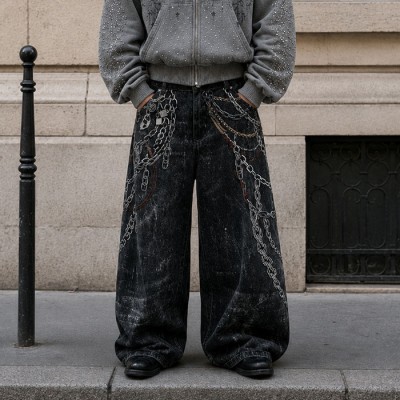
Custom denim pants with baggy fits are manufactured by OEM factories that can develop original denim patterns, source suitable denim fabric, control garment washing, and reproduce the approved sample in bulk. For streetwear brands, the factory should understand relaxed rise, wide thigh, knee-to-hem balance, seat shape, pocket proportion and post-wash measurement control.
Why is baggy denim harder to manufacture than regular denim pants?
Why does the pattern matter?
A good baggy fit is not a bigger regular fit. The waist can stay controlled while the rise, seat, thigh, knee and hem carry more volume. If the crotch curve is wrong, the pants may pull at the seat or collapse at the front even when the leg looks wide.
Why does denim fabric change the fit?
Denim weight, stiffness, stretch content and twill direction affect drape. A 12 oz denim and a 15 oz denim can use the same measurement chart but sit differently on body. Heavy denim often needs more careful knee, hem and seat adjustment.
Why does washing affect bulk consistency?
Garment washing can change shade, hand feel and shrinkage. For baggy denim, small post-wash changes at the inseam, thigh, knee or hem can make the approved sample look different in bulk.
Why do pockets and hardware need attention?
On wider denim pants, back pocket size, pocket height, yoke angle, rivet position and topstitch spacing become more visible. If these details are scaled poorly, the pants may look unfinished even when the fabric is good.
Which key sourcing questions should your team ask first?
Can the factory build the baggy fit from measurements?
Ask whether the supplier can develop the pattern from your size chart, reference garment, fit comments and target silhouette, not only from a photo.
Can the wash sample be approved before bulk?
For washed denim, approve a physical wash standard or clear reference before bulk. Shade, abrasion level and shrinkage should not be left to verbal description only.
Can the factory grade wide fits correctly?
Baggy pants need size grading that protects the shape. Increasing every point evenly can damage the waist-to-leg proportion, especially in larger sizes.
Can the supplier show production checkpoints?
Useful checkpoints include fabric inspection, pre-shrink or wash testing, sample review, size set review, pilot run, in-line inspection and final inspection.
What does a real development case usually look like?
In our production work, a common issue is that a brand asks for “baggy denim,” but the first drawing only shows a wide leg. That is not enough for production. The top block, rise, crotch depth, seat curve, knee position and hem opening must be built together.
For one typical development process, we would first review the reference fit and measurement target, then make a sample with planned denim shrinkage allowance. After washing, we check the actual waist, hip, rise, thigh, knee, inseam, hem and pocket placement. Only after the approved fit and wash are locked should bulk cutting begin.
What has the GROOVECOLOR Production Team learned from baggy denim programs?
The biggest risk is not making the leg wide. The real risk is losing proportion after wash and size grading. A pair of pants can look strong on the model sample, then become too long, too flat at the seat, or too narrow at the hem after bulk washing if the production file is not detailed enough.
Our practical rule is simple: approve the fit, approve the fabric, approve the wash, approve the trim, and then freeze the measurement tolerance before bulk. This reduces production drift and gives the brand a clearer standard for checking the final shipment.
What data should buyers consider before sourcing denim pants?
Market scale
Why does denim remain a serious category?
Grand View Research estimated the global denim jeans market at USD 91.2 billion in 2025 and projected USD 146.3 billion by 2033. For brands, this means denim is competitive, but also worth developing carefully when the fit and wash are distinctive.
Wash control
Why should wash and shrinkage be tested?
CottonWorks describes garment wash processes as part of denim finishing for color removal, softness and shrinkage control. This is why a baggy denim sample should be checked after washing, not only before washing.
Quality system
Why does documented QC matter?
ISO 9001 focuses on establishing, maintaining and continually improving a quality management system. In garment production, that principle supports documented checkpoints instead of relying only on final inspection.
What should a streetwear brand prepare before sample development?
Fit package
Size chart, target rise, thigh, knee, hem, inseam, waist, hip, model fit comments and reference garment measurements.
Fabric direction
Target denim weight, fiber content, stretch or non-stretch direction, hand feel, stiffness, color and approved swatch if available.
Wash standard
Stone wash, enzyme wash, vintage wash, whisker, abrasion, rinse, shade target and acceptable variation range.
Construction details
Pocket shape, yoke, fly, waistband, belt loops, rivets, button, label, topstitch color, seam type and packaging standard.
What MOQ and timeline are realistic for custom baggy denim pants?
For OEM streetwear production, a practical MOQ is usually planned by style and color because fabric sourcing, washing, trimming and cutting all need a minimum production base. At GROOVECOLOR, many custom streetwear programs start from 50–100 pieces per color, depending on fabric, wash complexity, trims and production schedule.
Sample development commonly takes about 2–3 weeks after the production information is complete. Bulk production commonly takes about 3–4 weeks after sample approval, fabric confirmation and production planning. Complex washes, special hardware or repeated fit revisions can extend the schedule.
How can your brand move from inquiry to sample review?
Prepare your tech pack, target measurement chart, reference fit notes, denim fabric direction, wash standard, trims, artwork files, size range and estimated order quantity. With those details, a production team can review feasibility, sample cost, MOQ, risk points and timing before sample development starts.