How to Find a Rhinestone Hoodie Manufacturer for Y2K Streetwear Brands?
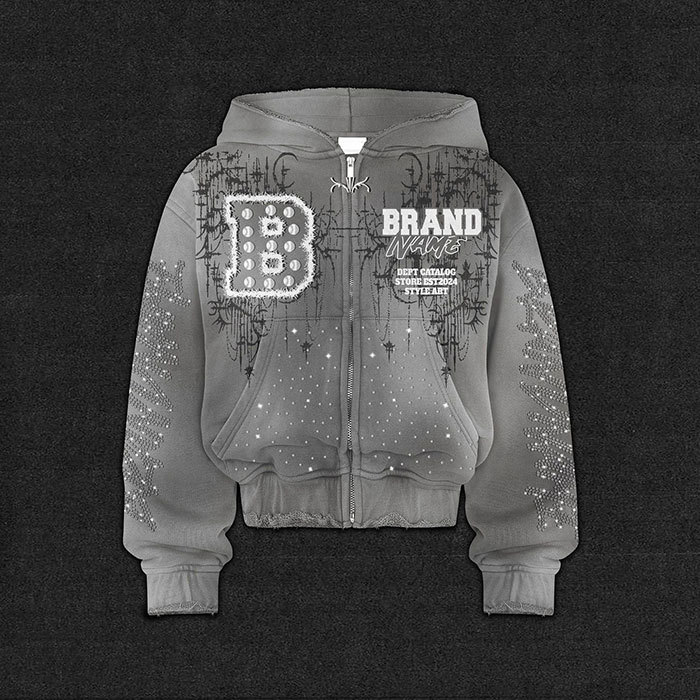
The Y2K streetwear aesthetic runs on maximalist energy, and rhinestone hoodies sit at its commercial core. But for established brands developing embellished collections, the sourcing journey pivots on one uncomfortable truth: most factories that claim rhinestone capability cannot deliver consistent stone adhesion, wash durability, and placement precision at bulk scale. A sample that sparkles under studio lighting tells you nothing about what arrives in cartons after 300 units pass through heat-setting stations operated by pressured production teams. This guide examines the 12 manufacturer evaluation checkpoints that separate a production-ready rhinestone hoodie partner from a general garment factory with a hot-fix machine.
The commercial stakes are higher than they appear. Industry data from apparel testing laboratories indicates that over 30% of rhinestone garment failures originate from fabric-adhesive incompatibility, not from inherently defective stones. When a brand ships rhinestone hoodies to retailers and sees returns spike after the first wash cycle, the damage extends beyond a single order — it affects wholesale relationships, DTC review scores, and brand perception in a category where visual quality is the entire value proposition. The right manufacturing partnership transforms rhinestone embellishment from a production risk into a repeatable, scalable competitive advantage.
What follows is not a generic factory checklist. It is a manufacturing-audit framework designed for streetwear brands that need to validate a supplier's rhinestone placement precision, heat-setting stability, wash-cycle durability, and bulk embellishment QC before committing to production volumes from 50 to 500+ pieces. Drawing on manufacturing process knowledge applied across heavyweight hoodie programs, each section maps a specific risk to an actionable evaluation criterion.
Key Takeaways for Y2K Streetwear Brands Seeking Rhinestone Production Partners
- Rhinestone adhesion is a three-variable system: fabric surface compatibility, heat-setting parameter control, and stone-backing adhesive quality. Evaluate all three before signing a production agreement.
- Wash durability is the ultimate pass/fail: demand a minimum 15-cycle wash test on pre-production samples and review stone-retention photos before approving bulk. Most failures surface after the first retail wash.
- Placement precision requires measurement, not estimation: factory should provide graded positioning data across all size breaks, with documented distances from neckline seams, shoulder points, and side seams.
- Bulk QC for embellished garments differs from standard apparel QC: look for embellishment-specific inspection checkpoints including adhesion tape testing, visual stone alignment under standardized lighting, and packed-garment abrasion review.
- Packing protocol is a production factor, not a logistics afterthought: individual garment separation, protective tissue or foam layering for embellished zones, and carton compression testing all affect arrival condition.
- Heavyweight fabrics (260-600 gsm) change the adhesion equation: higher gsm provides better stone-anchoring stability but requires recalibrated heat-setting dwell times and pressure profiles compared to lighter substrates.
1. Why Does Rhinestone Hoodie Production Require a Manufacturer with Controlled Embellishment Execution?
Rhinestone hoodie manufacturing sits at the intersection of cut-and-sew garment production and precision decoration engineering — two disciplines that operate on fundamentally different quality-control rhythms. A factory that excels at constructing a 400 gsm french terry hoodie body may have zero institutional knowledge about thermoadhesive bonding parameters, stone-to-fabric compatibility matrices, or the downstream wash performance variables that determine whether crystals stay attached after 10 retail wear-and-wash cycles. The result is a predictable pattern: brands commission samples from general garment factories, approve visually compelling prototypes, then receive bulk shipments where 8-15% of stones detach within the first three washes.
Controlled embellishment execution means the manufacturer operates a dedicated decoration workflow with documented process parameters — temperature set points, pressure dwell times, cooling intervals, and stone-placement jigs or templates — rather than treating rhinestone application as a secondary operation handed to the most available production line worker. The leading Y2K clothing manufacturers in China have moved embellishment execution from an ad-hoc process to a systematized production module with dedicated QC gates — a structural difference that becomes visible in bulk consistency rather than in sample-room results. For Y2K streetwear brands where rhinestone density defines the product's retail value, selecting a manufacturer without this systematized approach is effectively gambling on production outcomes.
The commercial consequence of uncontrolled embellishment execution compounds across an order lifecycle. A single returned rhinestone hoodie with detached stones generates not just a refund cost but a review score penalty, a customer service touchpoint, and potentially a social media image of a failing product. At 300-500 piece scale, a 10% embellishment defect rate produces 30-50 customer-facing failures — each one eroding the brand equity that the Y2K positioning was designed to build. The manufacturer evaluation question is therefore not "can they put stones on a hoodie?" but "does their production system deliver stone-retention consistency across an entire bulk order?"
2. What Rhinestone Application Methods Should a Y2K-Ready Factory Offer?
A Y2K-ready rhinestone hoodie manufacturer should demonstrate proficiency across at least two primary application methods: hot-fix stone placement (individual stones with heat-activated adhesive backing applied via specialized wand or automated machine) and rhinestone transfer sheet application (pre-arranged crystal layouts on carrier sheets, heat-pressed onto the fabric in one operation). Each method serves different design and production requirements, and factory capability in both indicates a deeper understanding of embellishment engineering rather than single-method familiarity.
Hot-fix individual placement excels for intricate designs, gradient effects, and layouts requiring high stone-placement precision — the kind of designs that define the Y2K visual vocabulary of scattered sparkle patterns, logo outlines, and asymmetric crystal arrangements. Transfer sheet application becomes cost-efficient for repeatable block patterns, text-based designs, and larger production runs where placement repeatability matters more than design complexity. A manufacturer that offers only transfer sheets limits design flexibility; one that offers only manual hot-fix placement will struggle with cost efficiency above 300-piece runs. The factory's application method portfolio reveals its understanding of the Y2K embellishment spectrum — the aesthetic demands complexity at small scale and consistency at commercial scale.
Hand-sewn stone attachment represents a third tier — superior for absolute security and luxury positioning but characterized by significantly higher labor costs and MOQ implications that make it impractical for most streetwear bulk programs. A qualified manufacturer should transparently discuss the trade-offs between these three methods in terms of cost per stone, wash durability expectations, production throughput, and minimum viable order size. Groovecolor's production system catalogs every decoration method from screen print to rhinestone application as documented, parameter-controlled processes — a structural discipline that directly impacts bulk reliability for Y2K brands running multi-method embellishment programs.
3. How Do You Evaluate Rhinestone Placement Precision Before Committing to Bulk?
Placement precision assessment begins with the pre-production sample but should extend to a documented measurement protocol that the factory commits to maintaining across bulk production. Request that the manufacturer provide graded positioning data for your design across all intended size breaks — exact measurements from the neckline seam to the top edge of the rhinestone layout, from the center-front line to the lateral edges, and from shoulder seams to any upper-sleeve stone placements. A factory that cannot produce these measurements during sampling will not maintain consistent placement during bulk production.
Key placement zones demand heightened scrutiny because they interact with garment construction in ways that affect both aesthetics and durability. Center-chest logos represent the most forgiving zone — a relatively flat surface with consistent tension. Back-panel designs require careful proportion scaling across sizes, as two extra inches of chest width on a 2XL garment can dramatically shift the visual balance of a fixed-size crystal layout. Sleeve placements are the highest-risk zone: they cross seam lines, experience arm-movement stress, and sit at angles that make visual alignment harder to verify. Cross-seam designs — layouts that bridge the front-center zipper line on zip-up hoodies — require split-layout engineering and should be tested on at least three size samples before approval.
The practical evaluation method involves creating a placement tolerance spec — for example, ±3mm from the documented reference point — and measuring actual placement against that spec on three separate garments from the same sample round. If a factory cannot hold ±3mm across three samples, assume bulk variation will be worse. For brands managing complex Y2K aesthetic programs where rhinestone precision defines the product's perceived quality, this measurement discipline is the difference between a collection that photographs consistently for e-commerce and one where each product image reveals a slightly different crystal position. Working with a dedicated custom hoodies manufacturer who understands sizing-grade placement logic ensures that your rhinestone layouts scale proportionally from XS through 3XL without the visual distortion that generic manufacturers routinely introduce.
4. Why Is Heat-Setting Stability the Most Underestimated Risk in Crystal Hoodie Production?
Heat-setting stability is the production variable that most brands never ask about and most factories never volunteer information on — yet it determines whether rhinestones that look perfectly adhered at the final QC station will still be attached after the garment travels through international shipping, sits in a retail rack for three weeks, and enters a customer's washing machine. The heat-setting process involves three interdependent parameters: platen temperature, applied pressure, and dwell time. A deviation of 5°C in temperature, 0.5 seconds in dwell time, or 0.2 kg/cm² in pressure can shift the thermoplastic adhesive from a fully bonded state to a partially bonded state where stones pass visual inspection but fail under mechanical stress.
The risk compounds in bulk production environments where operators may adjust machine settings to increase throughput — shortening dwell times or reducing pressure to move garments through the heat station faster. A factory with documented heat-setting protocols, calibrated equipment logs, and supervisor-level parameter verification at fixed intervals operates with fundamentally different process control than a factory where heat-setting settings are adjusted by individual operators based on feel. Ask to see the factory's heat-press calibration records and inquire about their parameter verification frequency during bulk runs. The answer reveals whether heat-setting is an engineered process or an operational convenience.
Fabric-specific heat-setting adjustments further separate specialist manufacturers from generalists. A 260 gsm cotton-polyester fleece, a 400 gsm french terry, and a 600 gsm heavyweight brushed-back fleece each require different heat-setting profiles because thermal conductivity, surface texture, and moisture content vary significantly across these substrates. A manufacturer that uses one heat-setting parameter across all hoodie weights is producing inconsistent bond quality. The evaluation criterion is straightforward: ask the factory to explain how they adjust heat-setting for your specific hoodie fabric weight and composition. A competent answer should reference dwell time, temperature, and pressure adjustments — not a generic assurance that "we've done this before."
5. What Wash Durability Standards Should You Demand from a Rhinestone Manufacturer?
Wash durability is the single metric that separates commercially viable rhinestone hoodie production from decorative samples that disintegrate after consumer use. A well-manufactured hot-fix rhinestone hoodie on an appropriate fabric substrate should withstand 20-30+ gentle wash cycles (inside out, cold water, air dry or low-heat tumble) with minimal stone loss — defined as less than 3% stone detachment across all embellished zones. This standard should be established during pre-production sampling and verified through documented wash-test results, not manufacturer assurances.
- Demand a minimum 15-cycle wash test on pre-production samples — photographed before wash cycle 1 and after cycles 5, 10, and 15
- Require the factory to document: water temperature, wash cycle type, detergent used, drying method, and stone-count comparison photos
- Specify stone-retention pass threshold: ≥97% stone retention after 15 cycles for acceptance
- Review care label recommendations generated from the wash-test data — these become your consumer-facing instructions
- Include wash-test documentation as a formal deliverable in your production agreement, with re-test requirements if formulation or stone supplier changes
The wash durability equation involves variables beyond the heat-setting process. Stone quality — specifically the composition and thickness of the thermoadhesive backing layer — determines how thoroughly the adhesive penetrates fabric fibers during heat application. Fabric surface characteristics — smooth vs. napped, tight-knit vs. open-knit, cotton-dominant vs. polyester-dominant — influence mechanical interlock between adhesive and substrate. Washing mechanics — agitation intensity, water temperature, spin-cycle speed, and detergent chemistry — create the stress environment that tests bond integrity. A manufacturer that discusses these interdependencies demonstrates the analytical capability to troubleshoot wash failures, while one that simply promises durability reveals process ignorance.
Brands should also understand the distinction between laboratory wash tests and real-world consumer behavior. ASTM and ISO textile care labeling standards provide controlled testing frameworks, but consumer washing environments introduce variables that standardized tests cannot fully replicate — inconsistent detergent dosing, mixed-load abrasion, and dryer heat cycles that exceed care-label recommendations. The practical implication: build a safety margin into your durability expectations. If lab testing shows stone retention at 30 cycles, communicate a more conservative consumer-facing durability expectation and structure your care labels to guide users toward gentler washing practices.
6. How Does Heavyweight Hoodie Fabric (260-600 GSM) Affect Stone Adhesion and Layout?
Fabric weight is not merely a comfort or silhouette variable — it fundamentally alters the rhinestone adhesion equation. Heavier fabrics in the 350-600 gsm range provide more stable anchoring substrates for crystal bonding because greater fiber density offers more contact points for thermoadhesive penetration and better structural resistance to the localized weight loading that dense stone patterns create. However, heavier fabrics also require recalibrated heat-setting parameters: thicker substrates demand longer dwell times to achieve full adhesive activation through the fabric depth, and some heavyweight constructions with brushed or napped interior faces create different thermal conductivity profiles than smooth-face midweight fleeces.
The practical implication for Y2K streetwear brands working across the 260-600 gsm range is that a single heat-setting profile cannot serve all fabric weights in a collection. A 260 gsm lightweight terry hoodie for spring layering, a 400 gsm standard fleece core product, and a 600 gsm heavyweight oversized piece each require individualized parameter documentation. Understanding the engineering details behind premium hoodie construction — including fabric weight implications for decoration programs — helps brands anticipate the multi-profile testing requirements that a diversified hoodie collection demands. Manufacturers that treat all fabric weights identically for embellishment purposes are producing variable-quality output that the brand will discover after delivery.
Fabric surface texture is an equally important variable within the weight conversation. Smooth-face fleece provides optimal stone-adhesion conditions because the flat surface maximizes adhesive-to-fiber contact area. Brushed or heavily napped surfaces reduce effective contact area and create an uneven bonding plane that produces inconsistent adhesion across a single stone layout. For Y2K designs that push toward maximal stone density — all-over crystal patterns, dense logo builds, gradient stone effects — the combination of heavyweight fabric selection and surface texture optimization determines whether the finished garment wears comfortably or feels like a rigid, distorted panel. Request that the factory provide fabric-surface close-up photography during the material approval stage, specifically showing the face side that will receive stone application.
7. Why Do Most Rhinestone Failures Appear After the First Wash or Retail Wear Cycle?
The timing of rhinestone failure is not random — it follows a predictable pattern that reveals a fundamental manufacturing gap. Stones that detach immediately after heat-setting indicate catastrophic process failure (wrong temperature, insufficient pressure, or contaminated adhesive backing) and are typically caught at inline QC. Stones that detach after the first consumer wash represent the most dangerous failure mode: they pass factory inspection, survive shipping and retail display, and fail precisely when the customer forms their quality judgment. This delayed failure pattern points to marginal adhesion — bonds that achieved enough mechanical interlock to survive static conditions but not enough to withstand the thermal-mechanical stress cycle of water immersion, detergent chemistry, agitation, and drying.
The root cause of marginal adhesion almost always traces back to one of three production-phase decisions: (1) the heat-setting dwell time was shortened during bulk production to meet throughput targets, (2) the stone supplier was changed between sampling and bulk without re-validating adhesion parameters, or (3) the fabric lot used for bulk had different surface characteristics — higher pile height, different fiber blend ratio, or residual finishing chemistry — than the fabric used for sampling. Each of these scenarios is preventable through process documentation and supplier-locking clauses in the production agreement, but most brands fail to specify these controls.
The investigative protocol for a brand experiencing post-wash rhinestone failure should begin with batch-level traceability: can the manufacturer identify which production lot, which heat-setting station, which operator, and which stone batch produced the failing garments? If the answer is no, the factory lacks the production documentation infrastructure to diagnose and correct the problem — meaning future orders carry the same risk. The practical evaluation question during factory vetting is "show me your production batch records for the most recent rhinestone hoodie order you completed." A factory that can produce these records operates with the documentation discipline that enables root-cause analysis; one that cannot is running embellishment production on memory and operator experience alone.
8. What Embellishment QC Checkpoints Separate a Specialist from a General Print Factory?
Standard apparel QC focuses on garment construction: seam integrity, measurement tolerances, fabric defects, and trim attachment. Embellishment QC for rhinestone hoodies requires an additional inspection layer that evaluates decoration-specific failure modes. A specialist manufacturer's QC process should include at minimum: (1) post-heat-setting adhesion tape testing — applying and removing a standardized adhesive tape strip across a sample of stones to verify bond strength, (2) visual stone alignment verification under standardized 5000K lighting against an approved placement template, (3) stone-count accuracy checks against the design specification (missing stones are a surprisingly common defect in bulk production), and (4) packed-garment surface inspection to verify that folding and bagging have not introduced abrasion marks on embellished zones.
- Adhesion Tape Test: Standardized adhesive tape applied and removed across a statistically sampled set of stones per garment — any stone lift = fail
- Placement Alignment Audit: Measured deviation from approved placement template across X and Y axes — tolerance threshold typically ±2-3mm
- Stone Count Verification: Design-spec vs. actual stone count per garment — missing stones at any quantity = rework trigger
- Stone Color/Size Consistency: Visual check against approved stone swatch under standardized lighting — color batch variation flagged
- Fabric Distortion Check: Post-embellishment measurement of garment dimensions to verify that heat-setting has not introduced panel shrinkage or distortion
- Packaged Garment Abrasion Review: Inspection of embellished zones after packing and before carton sealing for surface marks introduced during handling
The sampling plan for embellishment QC should differ from standard garment AQL 2.5 approaches. Because rhinestone defects are individually visible and collectively define the garment's quality perception, a tighter sampling plan — AQL 1.5 or 1.0 — is appropriate for the embellishment-specific inspection checkpoint. Additionally, the inspection should occur at two points in the production flow: inline immediately after heat-setting (to catch process drift before an entire batch is completed) and final after packing (to catch handling damage). A factory that performs only end-of-line inspection on embellished garments is operating with too long a feedback loop between defect creation and defect detection.
9. How Should You Compare Rhinestone Sample Quality Across Competing Factories?
Comparing samples across factories requires a structured evaluation framework rather than subjective visual preference, because sample-room conditions allow any competent manufacturer to produce one good-looking garment. The comparison framework should isolate process capability — the factory's ability to produce consistent output — from artistic execution, which is easier to control in a single-sample context. Evaluate each sample against a pre-written specification sheet that defines: stone position measurements relative to garment landmarks, stone count, stone size and color codes, adhesion visual quality (no adhesive halo visible around stone edges), fabric surface condition post-application, and garment measurement compliance.
Beyond the visual and measurement checks, the sample comparison should include a destructive curiosity test: select one sample, wash it three times following the intended care instructions, and examine stone retention, fabric condition, and any adhesive discoloration that develops. This accelerated durability preview often reveals the substantive gap between factories that appears invisible in fresh-sample comparison. Two samples can look identical on arrival day but diverge dramatically after three wash cycles — and that divergence predicts bulk-quality outcomes far more accurately than initial visual inspection.
The sample evaluation should also assess each factory's communication quality during the sampling process. Did they ask clarifying questions about placement tolerances? Did they flag potential production issues with your design — stone density in high-stretch zones, cross-seam placement complications, size-grading adjustments? Did they provide material and stone supplier traceability information without being asked? A factory that treats the sampling dialogue as a collaborative engineering conversation rather than a transactional order-taking exercise is demonstrating the partner mentality required for complex embellishment production. Quality control methodology is what separates luxury-oriented manufacturers from commodity suppliers — and in rhinestone production, that methodology must extend into embellishment-specific inspection protocols, not just garment construction checks.
10. What Packing and Shipping Protocols Protect Embellished Hoodies During Bulk Distribution?
Packing protocol for rhinestone hoodies is not a logistics decision — it is a quality-preservation decision that directly determines the condition in which products arrive at warehouses, retail locations, and ultimately customers' hands. Embellished garments face unique transit risks: stone-to-stone abrasion when garments are stacked directly against each other, stone-to-carton abrasion from vibration during shipping, and compression damage when carton stacking weight transfers through embellished zones. Standard polybag-only packing is insufficient for garments with raised crystal surfaces.
The minimum acceptable packing protocol for rhinestone hoodie bulk distribution should include: individual garment separation using acid-free tissue paper or thin foam interleaving between each folded garment, strategic fold placement that avoids creasing across stone-dense areas (hoodies should be folded with embellished panels facing outward rather than inward to prevent stone-to-stone contact), and carton specification that accounts for the additional thickness created by stone layers — a rhinestone hoodie is materially thicker than an unembellished hoodie at fold points, and cartons sized for standard garments will compress decorated pieces.
Brands should request and review the factory's packing specification document before bulk production begins — not after the order is ready to ship. This document should specify: folding pattern with a diagram showing fold lines relative to embellished zones, interleaving material type and placement, polybag specification (thickness, vent holes to prevent condensation), carton dimensions and construction (single-wall vs. double-wall, compression strength rating), and per-carton quantity with the calculation showing how stacked garment thickness is accommodated. A factory that cannot produce this specification document is treating packing as an afterthought rather than a controlled production step. Explore the complete hoodie manufacturing specifications to understand whether a supplier routinely handles decorated garments that demand specialized packing protocols — a detail that generic apparel factories frequently overlook.
11. How Do You Ensure Rhinestone Design Integrity When Scaling from 50 to 500+ Pieces?
Scaling rhinestone hoodie production from 50 to 500+ pieces introduces risks that are invisible at sample scale and manageable at small pilot runs but become commercial liabilities at volume. The core scaling problem is that processes optimized for 50-piece runs — operator-paced heat-setting, visual-only placement verification, manual stone arrangement on layouts — break down when throughput pressure demands faster cycle times and multiple parallel workstations. The solution is not to demand perfection from operators but to implement jig-and-template systems that remove operator discretion from critical quality variables.
Placement templates — physical or laser-projected guides that show exact stone positions on the garment panel — eliminate the variation introduced when different operators estimate positions from reference photos. These templates should be created during the sampling phase, validated against the approved placement spec, and locked as production tooling. Similarly, heat-setting parameter locks — digital or mechanical controls that prevent operator adjustment of temperature, pressure, and dwell time — remove the most common source of bulk-quality drift. A factory using operator-adjustable heat presses without parameter locks is running uncontrolled production regardless of how good their samples look.
Stone supplier consistency becomes critical at scale in ways that small runs mask. A 50-piece order might use stones from a single supplier batch; a 500-piece order may draw from multiple batches that introduce color-shade variation, adhesive-backing thickness differences, or crystal cut-angle discrepancies that affect light reflection. The brand's production agreement should specify stone supplier locking and batch-traceability requirements that enable the factory — and the brand — to identify which stone batches were used on which production lots. This traceability is the foundation for root-cause analysis if post-delivery quality issues emerge, and its absence converts quality problems into unsolvable mysteries.
12. What Does a Production-Ready Rhinestone Hoodie Partnership Look Like for Y2K Brands?
A production-ready rhinestone hoodie partnership is characterized by systematic process documentation, not by sales-floor assurances. The partner should provide: a written embellishment production protocol that covers heat-setting parameters per fabric weight, placement jig specifications, inline QC checkpoints, and defect classification criteria specific to rhinestone decoration, a pre-production sample that has been wash-tested and documented with stone-retention data, a packing specification document that addresses embellished-garment protection during transit, and a clear escalation path for quality issues with designated points of contact for embellishment-related concerns separate from general production management.
The partnership structure should also reflect the reality that rhinestone hoodie production involves longer lead times and higher per-unit costs than standard hoodie production. A realistic sample timeline is 2-3 weeks for first prototypes assuming stone sourcing and placement template creation are part of the development scope. Bulk production should be planned at 3-4 weeks minimum, recognizing that embellishment adds sequential processing time that cannot be compressed through parallel workstation deployment because each garment must pass through heat-setting as an individual unit. MOQ expectations for custom rhinestone hoodie programs typically start at 50-100 pieces per color, reflecting the setup costs for placement templates and process parameter development.
- Factory provides documented embellishment production protocols before requiring a deposit
- Pre-production samples include wash-test documentation, not just visual approval photos
- Placement templates or jigs are treated as production tooling, not optional aids
- Heat-setting parameters are locked per fabric weight and verified at documented intervals during production
- Stone supplier and batch traceability is maintained through the production record
- Packing protocols are specified in writing with embellishment-specific protection measures
- Inline QC checkpoints exist for embellishment specifically — not just end-of-line garment inspection
For Y2K streetwear brands building long-term embellishment programs across seasons, the manufacturer relationship should evolve from order-by-order transactions into a collaborative production engineering partnership. This means the factory gains institutional knowledge of the brand's design language, stone preferences, placement standards, and quality expectations — reducing the sampling iteration count on subsequent collections and enabling faster time-to-market for new rhinestone designs. The brands that invest in this relationship depth rather than factory-hopping for marginally lower unit costs are the ones whose rhinestone programs achieve consistent retail quality, predictable delivery timelines, and sustainable margin structures.
Frequently Asked Questions About Rhinestone Hoodie Manufacturing
What is the realistic MOQ for custom rhinestone hoodie production?
For fully custom rhinestone hoodie programs with brand-specific stone layouts, placement templates, and fabric selection, a competitive and operationally feasible MOQ starts at 50-100 pieces per color. This threshold accounts for the fixed costs of placement template development, heat-setting parameter calibration per fabric weight, and stone supplier minimum order quantities. Programs below 50 pieces typically incur disproportionately high per-unit costs because setup amortization falls across too few units.
How many washes can a properly manufactured rhinestone hoodie survive?
A rhinestone hoodie produced with correct hot-fix application on a compatible fabric substrate should retain ≥97% of stones after 20-30 gentle wash cycles (inside-out washing, cold water, air dry or low-heat tumble). This performance standard should be validated through documented wash testing on pre-production samples, and the resulting data should inform the care label instructions provided to consumers. Stone loss of more than 3% after 15 cycles indicates a manufacturing process issue that should be resolved before bulk production approval.
What application method is best for Y2K rhinestone hoodie designs?
Hot-fix individual stone placement offers the best balance of design flexibility, placement precision, and wash durability for Y2K streetwear designs that feature scattered crystal patterns, gradient effects, and asymmetric layouts. Rhinestone transfer sheets provide cost efficiency for repeatable block designs and text-based layouts. The optimal manufacturer should offer both methods and recommend the appropriate technique based on design complexity, order volume, and cost targets rather than defaulting to whichever method they are most comfortable executing.
What fabric weight works best for rhinestone hoodies?
Medium to heavyweight fleece in the 350-450 gsm range provides the optimal substrate for rhinestone hoodie production — heavy enough to support stone weight loading without panel distortion, dense enough to provide adequate fiber surface for adhesive bonding, and commercially appropriate for the Y2K oversized silhouette that defines the category. Lighter fabrics below 260 gsm risk panel sagging under stone weight; heavier fabrics above 500 gsm require recalibrated heat-setting profiles and may present comfort trade-offs on dense stone layouts. Smooth-face fleece surfaces consistently outperform heavily napped or brushed surfaces for adhesion quality.
How long does rhinestone hoodie production take from design to delivery?
A typical timeline for custom rhinestone hoodie production follows this sequence: 2-3 weeks for first sample development (including stone sourcing, placement template creation, and initial fitting), 1 week for sample approval and revision cycles, 3-4 weeks for bulk production (recognizing that embellishment adds sequential processing time per garment), and 1-2 weeks for shipping depending on destination and freight method. Total lead time from final design confirmation to delivery typically ranges from 7-10 weeks. Rush options may compress this timeline but increase the risk of QC shortcuts.
Can rhinestone designs cross seams, zippers, or pockets?
Cross-seam and cross-zipper rhinestone designs are technically feasible but require specialized engineering: split-layout templates for zip-front hoodies, reinforced seam allowances for shoulder-crossing designs, and pre-construction stone placement sequencing that applies stones before the seam is closed in certain layouts. These designs should be tested on at least three size samples before bulk approval, and the manufacturer should demonstrate prior experience with cross-seam rhinestone execution. Designs that bridge pocket edges or hood seams demand additional durability testing because these zones experience differential fabric movement during wear.
Ready to Source a Rhinestone Hoodie Manufacturer for Your Y2K Streetwear Brand?
GROOVECOLOR operates a vertically integrated OEM streetwear manufacturing system in Humen, Dongguan, with 16+ years of experience supporting heavyweight hoodies, oversized fits, and complex decoration programs from 50 to 500+ pieces. Our embellishment workflow covers rhinestone placement, heat-setting stability, wash-cycle durability testing, and bulk embellishment QC across the 260-600 gsm hoodie range — engineered for brands that need production consistency, not sample-room results.
Discuss Your Rhinestone Hoodie ProgramAbout GROOVECOLOR
GROOVECOLOR is one of China's leading premium OEM streetwear manufacturers for men's custom streetwear, with 16+ years of experience supporting heavyweight hoodies, oversized fits, and complex decoration programs. For rhinestone hoodie manufacturer topics, our manufacturing lens focuses on rhinestone placement precision, heat-setting stability, wash-cycle durability, and bulk embellishment QC across 260-600 gsm hoodie ranges.
The scoring method prioritizes embellishment-specific risks: stone adhesion under wash, placement tolerance, heat-setting consistency, packing protection for decorated garments, and bulk inspection sampling. When evidence is needed, we refer to recognized textile performance concepts around trim attachment, wash durability testing, and practical QC checkpoints used across embellished apparel supply chains.